

International and China Methanol Freight Increase Analysis
In June, the freight from Europe to Asia and from the Persian Gulf to Asia continued to rise, and that from Europe to Asia even doubled. Meanwhile, China’s methanol market also saw higher freight from the major producing areas to consumption markets.
International market: The freight from Europe to Asia kept advancing with intensive inventory release.
Sea transportation has always been the most important mode of methanol transportation. Affected by weather, logistics and geopolitics, the shipping market is volatile. From March, the overstocked methanol resources in some European areas were released intensively. In addition, the arbitrage window between China and Southeast Asia was open, bringing frequent trade flows. However, limited transport capacity resulted in constant rises in the sea freight.
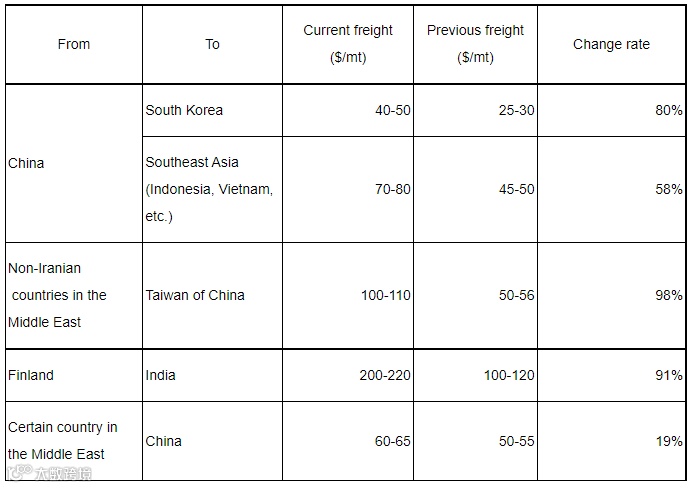
Influenced by the emergency in March and subsequent events, the important methanol plant in certain European country had to sell its resources stored in Finland to Asia (India and China). Up to June 20, there were 68-70kt of methanol cargoes arrived in India from certain European country, and 22kt arrived in China. Accordingly, this led to short supply in Central and Eastern Europe. Taking this opportunity, the suppliers from the Middle East and the U.S. sold more methanol to Europe for arbitrage, followed by continuous rises in freight. As shown in the above table, in the middle of June, the freight from Europe to India climbed to $200-220/mt, up 91%-100%, and that from a few non-Iranian countries in the Middle East to China was elevated to $100/mt, up 98%-100%. Besides, port congestion, tight tank capacity and potential demurrage also weighed on importers. Some importers chose hedging to reduce the risks of profit looses from large cost fluctuations.
China market: The freight from the major producing areas to consumption markets rose on intensive demand release.
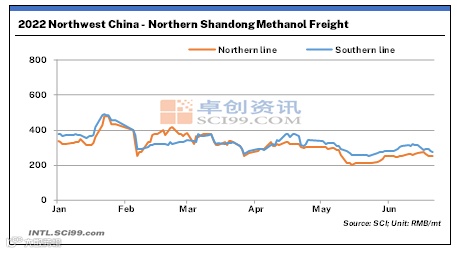
After the Dragon Boat Festival, with the feedstock methanol inventory dropping to a medium-to-low level, the traders and downstream plants in the important inland consumption areas enlarged their pick-up volume. In addition, the methanol futures prices kept fluctuating upwards in H1 June, bringing some speculation demand. In such a climate, the freight in the inland market rose notably. Up to June 17, the average freight from Inner Mongolia southern line market to northern Shandong increased to RMB 310/mt, up 14.81% W-O-W.
In the near term, it is predicted that the freight will remain at a high level, given the recovery of domestic transportation, limited newly added transport capacity, port congestion, etc. However, continuously high freight, shrinking import profits and expected demand declines brought by the interest rate hikes in Europe and the U.S. will curb the transport capacity to a large extent, and then the freight may go down. Therefore, it is projected that the freight may first rise and then fall back in the second half of the year.
However, on the whole, the freight growth has limited influences on China’s methanol market currently. First, China’s methanol export dependence degree is only about 0.5%, and the export growth rate is low in the first half of the year, so the marginal effect on the methanol export is small. Second, although facing rising freight and high feedstock prices, both importers and inland producers intend to maintain firm offers, downstream users are not willing to accept higher methanol prices, and the cost transmission is not smooth.
All information provided by SCI is for reference only, which shall not be reproduced without permission.
Please click "Read more" for the full article.