

Dec Semi-Steel Tire Operating Rate to Be Weak
The operating rate, which reflects the production status of tire producers, is a crucial metric of the tire industry. Holidays, inventory, maintenance, air pollution control, logistics and transportation in recent years are the key factors affecting tire operating rates. However, producers typically alter production in response to the pressure from their inventory owing to various force majeure factors.
Review
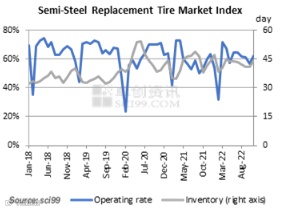
Reviewing the operating rate data in the past five years, it was significantly affected by New Year’s Day, the Spring Festival, May Day and National Day holidays in January, February, May and October respectively. Enterprises stopped production to have holidays, so the operating rate declined significantly. At the same time, due to the high inventory at producers before the May Day holiday and the National Day holiday, producers intended to take holidays during these holidays to ease the inventory pressure. In addition, in November, without the influence of force majeure factors, tire enterprises adjusted production according to their sales and inventory. After the Spring Festival, around March of each year, the market ushered in a small peak of sales with intensive replenishment, and producers’ inventory was consumed at that time. At the same time, producers conducted production actively. Producers intended to make preparations in the last month of the year for intensive shipment after the Spring Festival. Therefore, producers produced actively in December to reserve inventory, resulting in high operating rates. On the whole, the factors affecting tire producers’ operating rates mainly include holidays, sales, inventory and some force majeure factors.
Dec Operating Rate Forecast
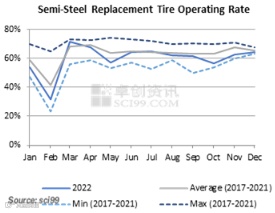
SCI analyzed the operating rate at semi-steel tire enterprises from 2017 to 2022 and drew conclusions as follows. The operating rate at semi-steel tire enterprises was relatively stable in December, ranging from 62.99% to 67.54%, and the average operating rate was 65.63%. In 2022, the lowest operating rate was 31.82% in February, down 9.82% Y-O-Y, and the highest operating rate was 71.50% in March, down 1.51% Y-O-Y. In 2022, the operating rate of semi-steel tires was lower than the average level from 2017 to 2021. Only in March 2022, the operating rate of semi-steel tires was 73.38%, which was higher than the average level of the same period in previous years. It is estimated that the operating rate of semi-steel tires in December 2022 will still be lower than the average level of previous years.
Key Operating Rate Drivers Assessment
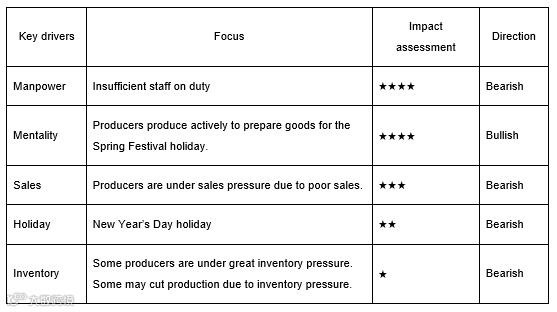
In December 2022, the factors affecting the operating rate at semi-steel tire producers mainly include manpower, enterprise mentality, sales, New Year’s Day holiday, inventory, etc. In December, the logistics and transportation are smooth. Producers are active in preparing goods for the Spring Festival holiday, so they are more motivated to produce in December compared with November. However, due to poor sales and high inventory, some producers cut production, so the operating rate in December is expected to be lower than the average level in previous years. At the same time, semi-steel tire producers’ production is greatly affected by the lack of employees on duty, so it is difficult to reach a high operating rate. Therefore, SCI predicts that semi-steel tire producers’ operating rate will be about 63% in December 2022, which is lower than the average level of 67.54% in previous years.
Please click "Read more" for the full article.