

Navigate China NBR Market
The price fluctuation of the commodity market is mostly driven by expected changes. The 2-month downturn of the NBR market price ended in the middle of November, and the market price had stabilized recently. On the whole, the core price driver is not the improvement of current demand, but the expected improvement later.
In the past month, China’s NBR market price stopped falling and stabilized. Taking 3305E in East China as an example, the closing price was RMB 14,200-14,400/mt by December 13, which increased by 2.51% from the lowest point in the middle of November.
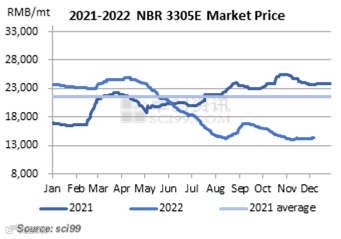
Current fundamentals are not the most important price driver.
The fluctuation of commodity prices is frequently influenced by a number of variables, but it is simple to determine by separating various indicators that the price increase and decrease in each link of the industrial chain or the change in drivers will eventually be attributed to the supply and demand of commodities. As a result, the basis for examining changes in commodity market prices is direct supply and demand.
On the basis of the historical price and output of NBR and the output of automobiles in the terminal consumer market in the past seven years since 2015, price fluctuation usually precedes the fluctuation of supply and demand. On the one hand, when the supply is expected to decrease, market players usually replenish goods in advance, leading to a decrease in the number of available spot goods in the current market, thus driving up the price. On the other hand, when downstream demand is expected to increase, downstream producers usually purchase feedstock first, thus boosting prices.
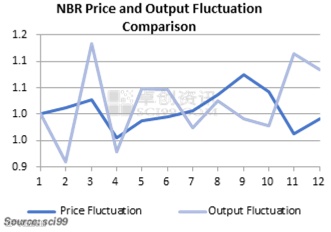
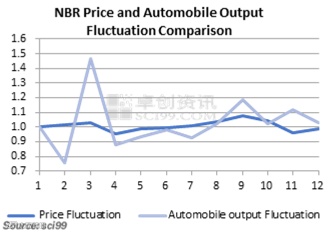
Looking back at the recent market price, from the middle of September, affected by the expected sufficient supply and weak downstream demand, the NBR market price began to fall, and the downturn did not end until the middle of November. In December, the low-end market price stabilized, and the mentality of some market players also gradually improved. Specifically, the current performance of fundamentals is not optimistic. Despite the tight supply of some grades, the downstream demand underperformed. The main reason why prices have stabilized is that, on the one hand, some external constraints have been gradually relaxed, and some traders have more faith in the recovery of medium and long-term demand; On the other hand, some NBR producers have planned unit maintenance for Q2 of 2023 and their sales plans may be gradually scaled back in Q1 of 2023. The expected decrease in supply boosts some market players’ mentality. Therefore, the main reason for the price stabilization is not the current performance of fundamentals, but the expected result of the improved supply and demand environment in the medium and long term.
The bright future might be a long way off.
The projected macroeconomic upswing is now supporting the NBR market, but it is yet too early to label the market as optimistic. It is heard that some downstream producers may not be eager to purchase feedstock at the end of the year, despite the possibility that some external restraints may gradually be lifted. Additionally, manual production might be somewhat constrained in some areas. Overall, a considerable amount of time is still required for the optimistic recovery of downstream demand. The reality of declining demand could constitute a long-term obstacle to the rising price of NBR. However, as these bearish causes gradually go away, the price may likewise bottom out over time.
All information provided by SCI is for reference only, which shall not be reproduced without permission.
Please click "Read more" for the full article.