

H1, 2022 ABS Price Declined on Increased Capacity but Limited Demand
In H1, the ABS price trended down, and it lacked momentum to recover affected by the weak fundamentals and external environment. In H2, the downstream demand is expected to improve, while the capacity expansion will accelerate, so the supply-demand structure will not change much. ABS producers are facing thin profits and attention can be paid to whether the cost will give support to the price in the future.
The weakened fundamentals weighed down the price.
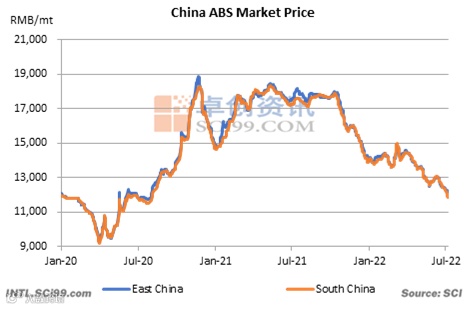
In H1, the ABS price trended down, falling to a medium-to-low level. The release of newly added capacity and limited demand growth intensified the imbalanced supply and demand, weighing down the price accordingly. In H1, the price showed an uptrend from end-February to H1 May and from end-May to H1 June. The rises were mainly caused by rising prices of styrene and replenishment demand.
In the other time of H1, the ABS price mainly fluctuated downwards affected by the imbalanced supply and demand and limited downstream operating rates dragged down by limited transportation in some areas and short supply of matched products. Meanwhile, ABS producers saw rapid profit declines amid a bearish sentiment. As of the end of June, the mainstream price of Chinese-made ABS was RMB 12,150-13,200/mt. The low-end price declined by RMB 1,750/mt from the end of 2021 and the high-end price declined by RMB 1,800/mt from the end of 2021.
The cost increased while the profit shrank.
In H1, the theoretical profit of China’s ABS industry averaged RMB 1,703/mt, down 69.08% Y-O-Y and 64.39% from H2 of 2021. The cost increased in H1, while the ABS priced declined, narrowing the spread between the cost and price. Therefore, the ABS profits declined notably. The prices of styrene butadiene increased while that of acrylonitrile dropped. From end-May, the ABS industry started to saw thin profits or even profit losses.
Chinese-made ABS output increased and import volume declined notably.
In H1, the output of Chinese-made ABS was around 2,358.4kt, up 6.68% Y-O-Y and 5.65% from H2 of 2021. In H1, LG Chem (Huizhou) Petrochemical put its 150kt/a ABS unit into production. In addition, with the capacity of two units put into production in H2, 2021 released, China’s ABS supply continued to increase. However, the improved output didn’t push up the operating rate. Due to the weak demand, declined profits and planned unit maintenance, the weekly ABS operating rate declined to a 2-year lowest of 74.02%.
In H1, China’s import volume of ABS reached 731.8kt, down 17.44% Y-O-Y and 15.78% from H2, 2021. The increased supply of Chinese-made ABS, higher ABS import prices and other factors led to the large decline in the ABS import volume. From May to June, some foreign producers cut their planned export volume to China, so China’s monthly ABS import volume fell to a 12-year low in those months.
In H1, China’s ABS export volume reached 39.6kt, down 13.80% Y-O-Y while up 13.79% from H2, 2021. However, the export volume was small. The increased supply in China didn’t improve the export volume notably.
H2: Newly added capacity will continue to increase, while the imbalanced supply and demand will linger.
As for the cost, 590kt/a newly added acrylonitrile capacity will be put into production in H2, so the industry will remain in oversupply and the price may not increase much. The styrene price may increase first and then decline in H2. The butadiene price will see more uncertainties with uncertain commissioning of newly added units.
In H2, if all the newly added units are put into production as planned, it’s estimated the capacity will grow by around 2,400kt/a. As most of the newly added capacity will be put into production in Q4, and it takes time for the new units to run normally, so the actual output increment will be much smaller than expected.
It’s the demand peak season in Christmas and Double 11 & Double 12 online shopping carnival. In addition, China’s consumption of new energy vehicles is expected to perform well. However, the overseas demand and the demand from some durable consumer goods will be uncertain. It’s estimated that the ABS price may fluctuate downwards in H2, while the cost may give certain support to the market.
All information provided by SCI is for reference only, which shall not be reproduced without permission.
Please click "Read more" for the full article.