

China PBR Market Supply and Demand Analysis
Snapshot: From 2018 to 2022, the growth rate of PBR supply in the market was higher than that of demand, with the adjustment of PBR capacity in the market. However, the major downstream tire industry was relatively saturated, with expected supply glut in the market. Thus, PBR enterprises actively explored PBR exports. China was converted from a major PBR importer to an exporter.
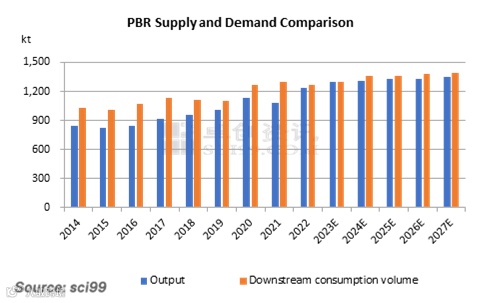
From 2018 to 2022, the average growth rate of China’s PBR supply was around 4.79%, while that of PBR demand was around 4.51%. The overall growth rate of supply was higher than that of demand. During the 13th Five-year Plan, although remarkable results were achieved in reducing overcapacity, there was a supply glut in the PBR market. From Q4, 2021 to 2022, the feedstock butadiene capacity was constantly expanded. The PBR industrial profit improved year by year, driving up the overall supply. In 2022, the PBR market saw a supply glut again, underlining the importance of overseas demand.
According to SCI, China’s total PBR supply volume was 1,484.3kt, up 3.1% Y-O-Y. The output increased notably, while the increment in import volume was minor. The output recovered due to the fairish profit and rising capacity utilization rate. Meanwhile, the import volume hovered at lows mainly due to the stable domestic PBR supply, tepid downstream demand and high prices of imported resources. In 2022, China’s total PBR demand volume was 1415.3kt, up 2.11% Y-O-Y. The downstream consumption fell back, while the export volume ramped up. The downstream consumption slid, mainly because the all-steel tire capacity release was low in 2021. The all-steel tire output declined by 7.55% Y-O-Y, dragging down the demand for PBR. The export volume moved up, for the reason that the demand in Southeast Asia was fairish and the regional price was higher than that in China’s market. Traders showed high interest in export for arbitrage.
From 2018 to 2022, China’s PBR import volume showed a reverse V-shaped trend. China was a major consumer of PBR. In 2020, some overseas PBR consumption transferred to China, with low import prices. Thus, the import volume in 2020 hit a five-year high. From 2021, China’s PBR import volume saw obvious cutback, with the world economy recovering and China’s PBR self-sufficiency rising. In 2022, China’s total PBR import volume reached 195.8kt, narrowly up 4.2% Y-O-Y, which accounted for 13.19% of China’s total PBR supply.
From 2018 to 2022, China’s PBR export volume trended up year by year. In 2022, China’s PBR export volume reached around 143.8kt, up 58.02% Y-O-Y. First, China’s PBR self-sufficiency increased due to the steady development of China’s PBR industry. Second, China’s leading tire enterprises constantly set up plants in Southeast Asia, with higher regional price than that in China. Thus, traders showed rising interest in export for arbitrage. Meanwhile, major exporters in Europe met changes in sources of PBR in 2022, so some traders found substitutions in China and exported them to other countries and regions.
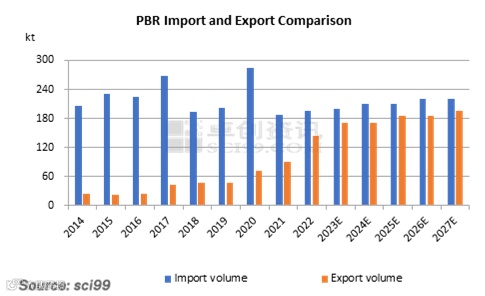
In next five years, newly added PBR capacity may be released. Thus, the overall PBR supply is likely to rise. As for demand, China’s tire industry has been relatively saturated. In next five years, the supply glut may hardly change. The PBR consumption volume is likely increase slowly. SCI reckons that China’s PBR total supply volume may reach around 1,639.8kt in 2027, while the total demand volume may be around 1,586.3kt. As the import volume may gradually shrink, and the export volume is likely to climb, China’s is expected to be converted from a major importer to a major exporter.
All information provided by SCI is for reference only, which shall not be reproduced without permission.
Please click "Read more" for the full article.