

Benzene Prices Struggled to Rise Despite Strong Fundamentals
Recently, China’s benzene market price has been moved within a small range, hovering around RMB 7,400-7,500/mt. So far, the spread between the highest price and then lowest price in April is only RMB 40/mt. Although the absolute price change of benzene is limited, there are still many bright spots in the benzene market.
1. Benzene spot-futures price spread narrowed.
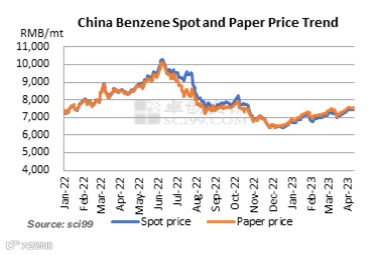
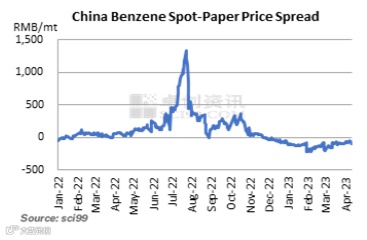
From the chart below we can see that the price trends of benzene spot market and paper market were quite similar after March, showing an N-shaped trend. The posted benzene prices at state-owned refineries were firm, thus driving up spot benzene prices and leading to a narrowing of the spot-futures price spread. According to SCI, the average price spread in March read RMB -121/mt, RMB 44/mt narrower than the average of RMB -165/mt in February. Since April, the spot-futures price spread has been RMB -74/mt from April to now, showing a significant narrowing trend.
2. East China port inventory decline was slower than expected.
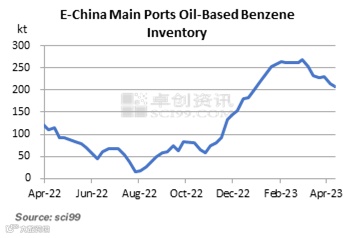
By the end of March 2023, the commercial inventory of benzene at East China’s main ports was 229.4kt, down 32.3kt from 261.7kt on February 22. In March, the arrival volume at East China’s ports remained relatively small, so the port inventory sustained a downward trend. However, downstream users were not active in picking up goods in view of widespread losses. Most of them purchased on a need-to basis, so the consumption of port inventory was slower than expected.
Entering April, the arrival at ports continued to decline, but the destocking didn’t accelerate. For one thing, some downstream users chose to purchase benzene from the Shandong market through automobile considering the low-priced resources there. For another thing, against the backdrop of widespread losses in the downstream market, downstream users had a lower enthusiasm for picking up goods, resulting in a slower decline in port inventory.
3. Demand growth led to an expansion of supply-demand balance.
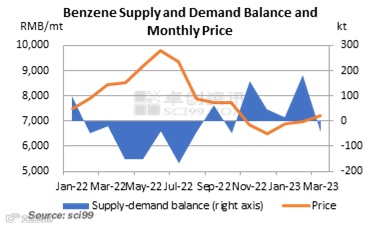
In March, the theoretical supply-demand balance of benzene was -55.3kt, down 243.5kt from that in February. Falling supply and increasing demand led to a widening of the supply-demand balance. In March, China’s domestic output of oil-based benzene and coal-based benzene both inched up, but the import volume of oil-based benzene dropped significantly. At the same time, the consumption of benzene from the four major downstream industries moved up to different degrees.
4. Constant downstream losses may hinder the rise in benzene prices.
Faced with a positive supply and demand structure, as well as the return of downstream styrene maintenance units and the commissioning of newly added styrene units, the fundamentals of benzene have indeed improved, but downstream losses are also a certainty. Therefore, in the periodic market, downstream users have a fear of high benzene prices.
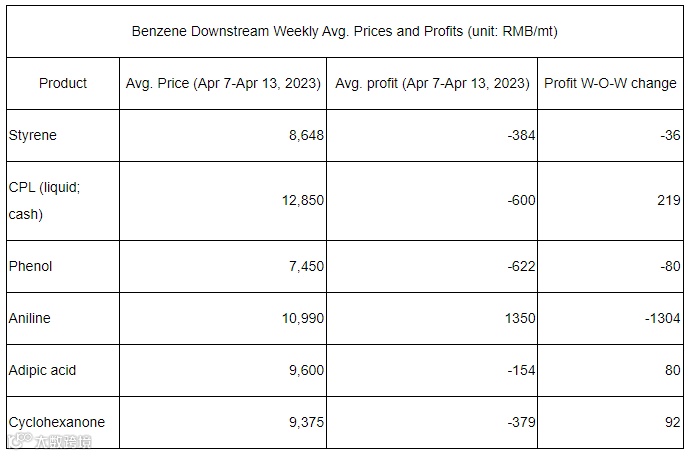
In the short term, the benzene market is predicted to move sideways. Shenghong Petrochemical’s reformer is expected to be restarted, so domestic benzene output may pile up. But the arrival volume at East China’s main ports is still limited, so the port inventory may continue to decrease. In terms of demand, downstream users are resistant to high-priced benzene due to profit loss, which may hinder the recovery of the benzene price. Producers and traders will sell on the rise. It is expected that the benzene price is unlikely to see a significant increase or decrease in the short term.
All information provided by SCI is for reference only, which shall not be reproduced without permission.
Please click "Read more" for the full article.