

Uncoated Woodfree Paper Market in Stalemate as Pulp-Paper Price Gap Expands
Intro: Due to the significant price drop in the pulp market, the price gap between uncoated woodfree paper and raw material pulp has expanded. Downstream paper buyers perceive that the uncoated woodfree paper price will soften following the pulp price downtrend and hold down on purchases. Therefore, the uncoated woodfree paper market enters a stalemate, and the market price may continue to soften slightly in the short term.
Pulp prices fell below average, and the pulp-paper price gap expands
Uncoated woodfree paper is produced from pulp (SWP, HWP and CMP). In terms of unit consumption, HWP accounts for the highest proportion. Thus, the price fluctuation of HWP is most relevant to changes in the production cost of uncoated woodfree paper.
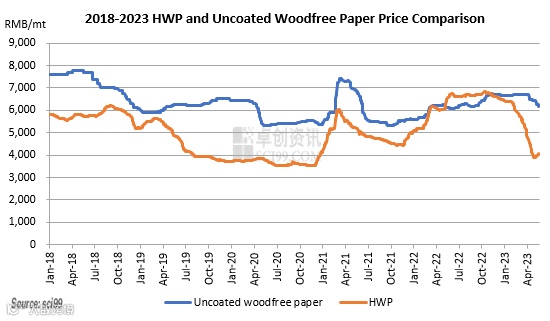
As seen from the below chart, in 2022, the price gap between uncoated woodfree paper and HWP once turned negative back in 2022 because the pulp price surged backed by supply-side issues while the paper price failed to keep up due to limited demand support. In 2023, the pulp price fell quickly, but the price of uncoated woodfree paper was resilient, and hence the price gap expanded.
As of May 11, 2023, the 70g uncoated woodfree paper average price was RMB 6,175/mt, down RMB 388/mt or 5.83%. The HWP market average price was RMB 4,070/mt, down 38% from late 2022. The price gap between the two was around RMB 2,105/mt, which was apparently higher than the average price gap of RMB 1,218/mt in the past five years.
The stand-off between buyers and sellers continues affected by sentiment factors
The rapid decrease in HWP prices had a certain impact on the short-term supply and demand status of the uncoated woodfree paper market. The expanding price gap boosted the profitability recovery at paper mills. In addition to the support from some rigid demand during the H1 peak season, paper mills tend to hold prices firmly. However, with pulp prices on the decrease, downstream buyers perceive that the paper price trend will follow and start to hold down on purchases. Therefore, the market has entered a stalemate lately.
In general, the expanding pulp and paper price gap has affected participants' expectations. Paper mills actively arrange production for better profitability, but downstream purchases start to decelerate. As a result, the demand support weakens, and paper mills face rising inventory pressure.
Uncoated woodfree paper market still faces downward risks in the short term
The pulp price may hardly rebound apparently with building supply pressure. Major new market pulp projects in Latin America (1.56 million tons/a MAPA and 2.1 million tons/a have achieved stable production, and resources will flow into China in the following months, and the supply pressure is to rise constantly. Meanwhile, Q2 is the traditional slack season of the pulp and paper market in China, restricting pulp prices from the demand side.
Paper supply may be abundant due to new capacity expansion. In the short term, the industry operating rate may be maintained at around 67% despite minor maintenance and swings of production at a few paper mills. But a 500kt/a uncoated woodfree paper capacity may be launched at Fujian Liansheng Paper in the near term, which will affect the market trend to some extent.
Publishers’ orders provide bottom support, but demand from other segments remains sloppy. The fulfillment of orders from publishers has eased the inventory of large-sized paper mills. But due to constant pulp price drops, other downstream players still hold bearish expectations on the paper market and stay on the sidelines. Some plans to divide their orders into smaller batches, and as orders may be delayed, the market stalemate will continue.
On the whole, with the release of publishers’ orders in late May, the market demand may improve slightly. But the falling cost factor will continue to bring a bearish influence on market sentiment. In addition to the influence of newly added capacity, SCI estimates that the uncoated woodfree paper market may possibly soften continuously in the short term.
All information provided by SCI is for reference only, which shall not be reproduced without permission.
Please click "Read more" for the full article.