

Food-Grade Ivory Board Supply Hike Hardly Affects Market Balance
Intro: As the ivory board capacity keeps growing promoted by the solid waste import ban and the substitution of plastic packaging with paper alternatives, the demand for food-grade ivory board also expands. In recent years, a rising number of food-grade ivory board capacity projects are reported. Against the background of the general economic deceleration, the sales pressure in the ivory board market has increased.
In recent years, the ivory board capacity keeps expanding, with a high proportion of commodity-grade ivory board. The capacity of food-grade ivory board also increased. SCI’s data indicates that the newly added food-grade ivory board capacity between 2021 and 2023 totaled 1,700kt/a. Therein, two lines with a combined capacity of 650kt/a are converted from duplex board to ivory board production.
2021-2023 Newly Added Food-Grade Ivory Board Capacity
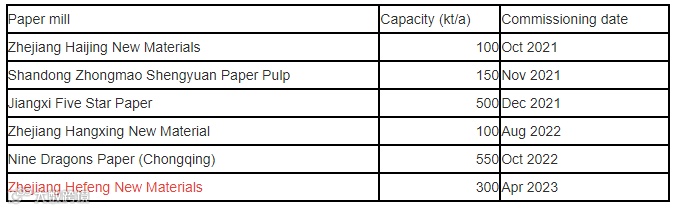
In the future, a total of 26,350kt/a ivory board capacity has been planned, of which food-grade ivory board capacity accounts for 39%. From 2023 to 2024, aside from the 300kt/a capacity at Zhejiang Hefeng New Materials, the 1,200kt/a capacity at Nine Dragons Paper (Beihai) and the 300kt/a capacity at Henan Tianbang Paper are also expected to be launched.
In January 2020, the NDRC and the Ministry of Ecology and Environment jointly announced Opinions on Further Strengthening the Control of Plastic Pollution, and the production, sales and consumption of certain plastic products are prohibited or restricted. In 2021, provincial and city-level authorities promulgated specific plans for plastic pollution control, and the plastic ban policy has been gradually implemented since then. Considering the incomplete industrial structure of degradable plastics and the cost factor, the substitution of plastics with paper alternatives has become the main trend. It has brought a major boost to the demand for food-grade ivory board, especially after the prohibition of disposable plastic cutleries in the catering industry.
The demand for commodity-grade ivory board shrinks under general economic deceleration, but the capacity expanded rapidly in the past few years. As a result, the market is apparently oversupplied, and the profitability of conventional producers decreased. Some commodity-grade ivory board producers switched their units to food-grade production for higher profitability as well as to balance sales pressure. Compared to commodity ivory board, the food-grade ivory board seems to have more favorable fundamentals factors, and its price is more stable. Thus, it has become a primary option for conventional ivory board mills to seek product differentiation and avoid risks.
Major differences between food-grade and commodity-grade ivory board are as follows.
First, production mode. There are numerous grades for food-grade ivory board, and the production is mostly customized. In contrast, commodity-grade ivory board differ limitedly by grade, and it is produced routinely.
Second, application. Food-grade ivory board is used for making packaging with direct contact to food, while commodity-grade ivory board is used for general-purpose packaging.
Third, sales channels. Food-grade ivory board is sold directly to end users, while commodity-grade ivory board is sold mainly via distributors.
Last, clients’ price sensitivity and viscosity. Buyers of food-grade ivory board tend to place high priority on the safety and quality of the product for the image of their own brands. Thus, there will be a much longer inspection and evaluation period for a new ivory board supplier, but the viscosity will also be high once the cooperation is established. In contrast, buyers of commodity-grade ivory board will mainly consider the procurement price and cost, and the viscosity to specific suppliers is relatively low.
Given the current ivory board market fundamentals, the supply of food-grade ivory board is increasing, and the competition is intensifying. But as new entrants will face certain barriers in terms of technology and customer viscosity, and it will also take time for clients and suppliers to establish and deepen cooperation. Considering the high degree of product differentiation, new food-grade ivory board producers will face more difficulties in expanding sales without long-term client accumulation. Thus, despite the apparent trend of supply increase in the food-grade ivory board market, the supply-demand balance may hardly be affected in the short term.
All information provided by SCI is for reference only, which shall not be reproduced without permission.
Please click "Read more" for the full article.