

China PP Capacity Layout Changes on Consecutive Expansions
Preface: China’s PP capacity layout is changing constantly in 2023 with consecutive capacity growth, and PP capacity expansions gradually transferred to consumption regions. Besides, the capacity occupation by different production technologies and feedstock sources also changed.
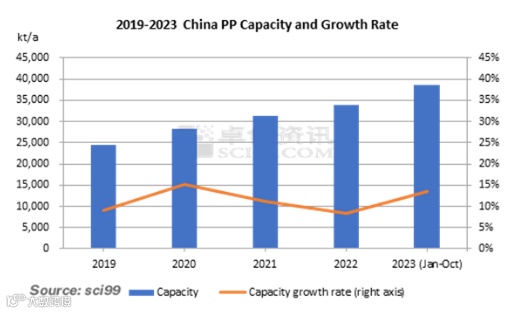
China’s PP capacity release was extensive in 2023. As of October 2023, China’s PP capacity reached 38,490kt/a, up 4,550kt/a from 2022. The capacity growth rate was 13.41% in 2023, which rose by 5.01 percentage points from last year.
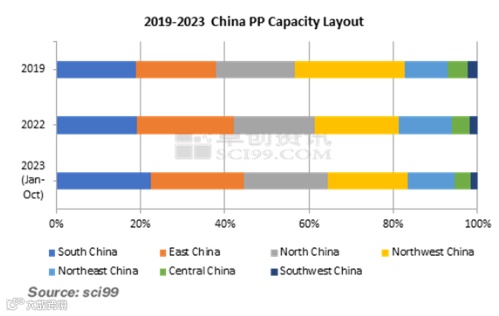
In recent years, China’s PP capacity expansion gradually transferred to consumption regions, and capacity proportion in various regions changed notably. Over the past five years, newly added capacity in Northwest China was limited, so that region occupied a smaller proportion in PP capacity. PP capacity was mainly released in East China, North China and South China this year. Therein, the newly added capacity in South China was large at 2,150kt/a and occupied around 47.25% of the total fresh capacity. As of end-October 2023, PP capacity in South China was the largest and took up 22.40% of the total, up 3.34 percentage points Y-O-Y. In North China, the PP capacity proportion rose a little by 0.86 percentage points Y-O-Y to 19.95% with fresh capacity of 1,200kt/a. Looking at the later PP unit commissioning plan, there are still a large number of units planned to be put into operation in South China, where the capacity proportion may still be in the first place. Although Sinopec Anqing Petrochemical and Ningbo Kingfa Advanced Materials have x successfully put new units into operation in East China, that capacity increase was lower that in South China and North China, and East China’s capacity proportion decreased by 1.06 percentage points compared to last year. This year, new project in Northwest China was limited, and only the third phase unit at Ningxia Baofeng Energy Group was newly added. Accordingly, the PP capacity proportion in Northwest China declined by 1.06 percentage points. There was no capacity expansion in Central China, Southwest China and Northeast China in 2023, and capacity proportions there were 3.79%, 1.56% and 11.22% respectively. Overall, the PP capacity in main domestic PP sales regions was gradually expanding, and regional capacity distribution was uneven. The competitive pressure on non-main sales regions such as Northwest China, Southwest China and Northeast China was more noticeable.
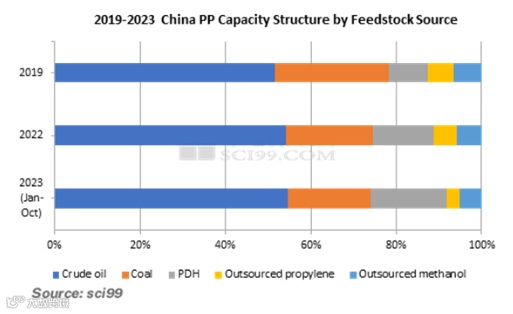
The process of diversified and balanced development of PP feedstock sources was continuously promoted over the past five years. The expansion of new capacity mainly came from new refining and chemical integration units and light ends units. From the perspective of the change in capacity proportion, crude oil-based and PDH-based PP capacity proportion increased rapidly, while other feedstock-based capacity proportion declined slightly.
As of October 2023, crude oil-based PP capacity rose by 2,650kt/a or 0.49% Y-O-Y and accounted for a higher proportion at 54.61%, and PDH-based PP capacity climbed by 1,400kt/a or 3.51% Y-O-Yand also took up a larger proportion. Compared to 2022, the fastest growing capacity in 2023 was still the propane-based PP capacity, with a year-on-year increase of 3.51 percentage points, followed by the crude oil-based PP capacity, with a year-on-year increase of 0.49 percentage points. The proportion of other feedstock-based capacity slightly decreased year-on-year, with coal-based, outsourced methanol-based and outsourced propylene-based PP capacity dropping by 1.12 percentage points, 5.14 percentage points and 3.12 percentage points separately year-on-year. For coal-based PP capacity expansion, only Ningxia Baofeng Energy Group newly constructed 500kt/a third phase PP unit. As of October 2023, the proportions of oil, coal, and propane-based capacity were 54.61%, 19.33%, and 17.80%, accounting for 91.74% of the total capacity. As the occupation of these three major feedstock sources tends to be balanced, the competition among all feedstock sources may further intensify.
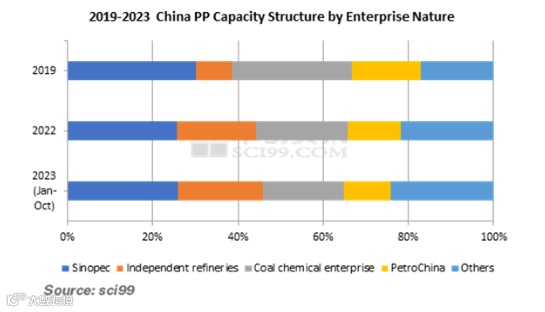
Under the background of PP capacity expansion, the types of enterprises have changed significantly. In particular, independent refineries have taken up higher market shares in recent years after rapid development. As of October 2023, the capacity share of independent enterprises in the domestic PP producers was 19.88%, an increase of 1.32 percentage points from last year, and an increase of 11.29 percentage points from 2019. That continued to impact the leading role of PetroChina and Sinopec. At the same time, due to the rapid development of the light ends industry, other types of enterprises represented by PDH enterprises were developing rapidly, with a capacity share of 24.24% within the year, up 2.35 percentage points from last year. As of October 2023, Sinopec enterprises, with the commissioning of the second phase of Sinopec Hainan Refining & Chemical in South China and Sinopec Anqing Petrochemical in East China, slightly increased their capacity proportion by 0.35 percentage points compared to last year. However, PetroChina had no capacity release this year, and its capacity proportion was reduced by 1.45 percentage points from 2022. This year, only Ningxia Baofeng Energy Group newly added 500kt/a third phase PP unit in the coal chemical industry, so coal-based PP capacity was compressed by 2.56 percentage points from 2022. At the same time, according to the current capacity expansion plan, other types of enterprises represented by private enterprises and joint ventures are expected to have development potential in the future.
Taken together, China’s PP capacity gradually moved up in consumption regions. PP capacity grew rapidly in consumption areas such as East China, South China, and North China, and the proportion of crude oil-based and PDH-based PP capacity was also increasing year by year. Represented by independent refineries, private enterprises and joint ventures have gained momentum in recent years and still have favorable development potential in the future.
All information provided by SCI is for reference only, which shall not be reproduced without permission.
Please click "Read more" for the full article.