

Demand Shored Up Low-MFR PP Copolymer Prices Slightly
Preamble: China’s PP market prices mainly registered a downtrend in Q2, 2023 because of the tepid downstream demand. For various PP categories, the difference among their supply-demand patterns aroused different performance in price. Low-MFR PP copolymer prices prove resilient at present, as its supply is not ample, and its demand from some downstream fields picks up. The price spread between PP raffia and low-MFR copolymer widens gradually.
Remarks: MFR = melt mass-flow rate
As of H2 May, China’s PP market prices ramped up at first but then declined in 2023. In particular, PP market prices trended downwards in Q2, and raffia-grade PP prices dropped to RMB 7,500/mt or so many times, hitting a three-year low. Comparatively, the downward range of low-MFR copolymer prices was narrow on the back of supply side.
Prices of raffia showed a remarkable decline, while that of low-MFR copolymer performed passably.
PP market price rebounded at first but then lost its ground in Q2. The price spread between raffia and low-MFR copolymer was enlarged notably, as raffia prices fluctuated downwards, but low-MFR copolymer prices were range-bound or even rallied a little.
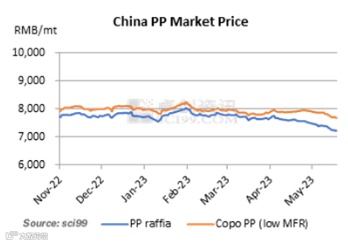
Taking East China as an example, the average price of PP raffia was RMB 7,605.56/mt in April, down 1.20% M-O-M but down 13.05% Y-O-Y, while that of low-MFR copolymer was RMB 7,918.89/mt, up 0.62% M-O-M but down 11.85% Y-O-Y. The latter experienced a smaller downward range. In May, prices of PP raffia and low-MFR copolymer continued to slide, and their price spread was around RMB 450/mt.
Low-MFR copolymer output reduction buoyed its prices.
The drop in low-MFR copolymer supply was a driver to underpin its prices. Specifically, China’s low-MFR copolymer output shrank in February and March, stemming from a reduction in production ratios. This lent support to low-MFR copolymer prices in early April. According to SCI, low-MFR PP copolymer production ratios lingered around 10% between February and March, which declined by 2% from the previous stage.
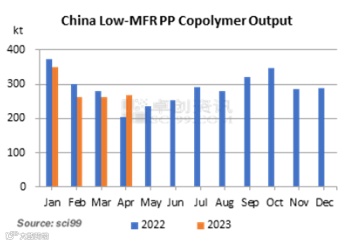
Besides, the operating rate cut and maintenance of units also made low-MFR copolymer supply collapse from February to March. Therein, low-MFR copolymer output dropped by 24.75% M-O-M to 263.6kt in February, and it further declined by 0.24% M-O-M to 262.9kt in March. Output reduction underpinned PP copolymer market prices.
Demand for some PP grades leveled up.
In the first quarter of 2023, PP demand ushered in a wave of improvement, backed by the gradual return to normal life of residents. Therein, the demand for food packaging based on fast-selling products perked up noticeably, but the improvement duration was limited. In the second quarter, the consumption of fast-selling products weakened gradually. Affected by the weakening of overseas orders, China’s PP sales diminished significantly. Continuously sluggish demand pulled down PP market prices.
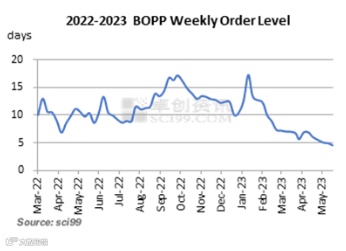
As for low-MFR copolymer downstream demand, some downstream fields showed brightened demand for low-MFR PP copolymer, even though the PP industry encountered the demand dull season in May. Especially, the market demand for new energy picked up, and PP demand from automobile modification field, etc. ramped up. In addition, the demand for low-MFR PP copolymer from pipe, chemical product packaging and daily chemical product packaging fields stayed unabated. Generally, low-MFR copolymer market got favorable support from the demand side.
Intensive unit maintenance led to comfortable supply.
In May, there are newly added PP units to come online, but extensive turnarounds cushioned the supply pressure. However, the overall PP demand remained lackluster amid demand dull season.
For low-MFR copolymer, its output inched up in April, but intensive maintenance was seen at low-MFR copolymer producers in May, such as Shenhua Ningxia Coal Industry Group and Ningxia Baofeng Energy Group. In June, Shaanxi Yanchang Coal Yulin Energy and Chemical Company is expected to experience turnarounds, so the supply of low-MFR copolymer will probably stay tight. But the overall demand for low-MFR PP copolymer is projected to perform poorly. Broadly speaking, low-MFR copolymer prices are likely to move down amid soft demand. For PP raffia, its prices will possibly decline as well, and the price spread between raffia and low-MFR copolymer may be kept large.
All information provided by SCI is for reference only, which shall not be reproduced without permission.
Please click "Read more" for the full article.