

Influence of Tariff Changes from Taiwan of China on PP Imports
Preface: China is set to impose tariffs on some chemical products imported from Taiwan from January 1, 2024. The Customs Tariff Commission of the State Council issued a notice on December 21, announcing a suspension of tariff concessions on some products involved in the Cross-Strait Economic Cooperation Framework Agreement (ECFA). Products include some PP copolymer products. SCI analyzes the effect of tariff change on PP imports after combing its background.
The Customs Tariff Commission of the State Council issued a notice on December 21 and indicated that China would suspend tariff reductions for 12 items such as propylene, PP and toluene stipulated in the ECFA in accordance with the current relevant regulations. This tariff adjustment not only involves PP copolymer with HS code of 39023010 but also includes PP upstream product, namely propylene with HS code of 29012200. After the ECFA is terminated, tariffs on PP copolymer and propylene imported from Taiwan of China will return to the most-favored-nation rate (MFN Rate). Later, how will the propylene and PP import volume from Taiwan of China change in the future, and what influences will tariff increments have on the PP market?
China’s PP self-sufficiency increased constantly and PP import volume declined with continuous capacity release.
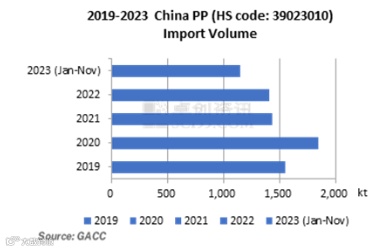
According to SCI, the import volume of PP with HS code of 39023010 in China hovered within 1,100 -1,170kt, taking up nearly one third of the total PP imports. China’s PP self-sufficiency moved up constantly with continuous capacity expansion and advancement of R&D technology and product maturity, which squeezed the import business to a certain degree. Thus, China’s PP import volume declined gradually.
Taiwan of China is one of the major origins of China’s PP imports, but its export volume to China took up a smaller proportion.
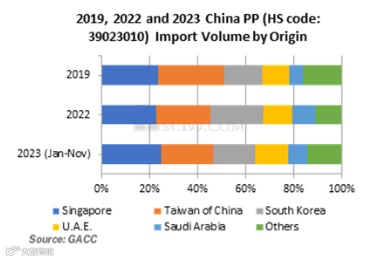
From the perspective of the import origin structure, China’s PP import trading partners have still been dominated by off-shore regions in the recent five years, mainly including Singapore, Taiwan of China, South Korea, the U.A.E. and Saudi Arabia. Among them, the PP import volume from Taiwan of China and South Korea has shrunk year by year, while import volume from the Middle East such as the U.A.E. and Saudi Arabia has increased. Currently, PP capacity in Taiwan of China is around 2,000kt/a, and representative producers include Formosa, LCY Chemical, etc. According to the General Administration of Customs of the People’s Republic of China (GACC), the import volume of PP copolymer (HS code: 39023010) from Taiwan of China was approximately 313.5kt/a in 2022, taking up 22.27% of the total, and that was 246.3kt from January to November 2023, occupying 21.46% and dropping by 12.48% Y-O-Y.
Outsourced propylene-based PP units are limited, lending a small influence on PP production costs.
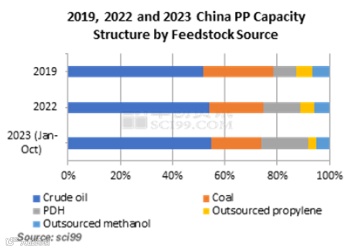
China’s PP capacity expansion was mainly benefitted from refining-chemical integration units and light ends crackers over the past five years. At the same time, crude oil-based and PDH-based PP capacity proportions rose rapidly, while other feedstock-based PP capacity proportions dipped. Therein, outsourced propylene-based PP capacity merely accounted for 3.12% of the total PP capacity as of October 2023, and major enterprises were Formosa Industries (Ningbo), Xuzhou Haitian Petrochemical, Yuntianhua Group and Lihe Zhixin New Material Technology, but only Formosa Industries (Ningbo) imported propylene from Taiwan of China. However, Formosa Industries (Ningbo) mainly produced homo PP injection, copolymer injection and transparent PP (TPP), and their pricing was far higher than mainstream market prices, so that produced limited effects on the PP production cost.
In summary, after the suspension of the ECFA in 2024, the tariff of PP copolymer imported from Taiwan of China will return to an MFN Rate of 6.5% from 0%, and that of propylene will return to an MFN Rate of 2%. The cost of importing PP copolymer will increase, which will intensify the competition pressure of related PP enterprises at home and abroad. In addition, China’s PP imports from Taiwan of China may further decline in the future.
All information provided by SCI is for reference only, which shall not be reproduced without permission.
Please click "Read more" for the full article.