

Benzene prices posted a rising trajectory in H1, 2024
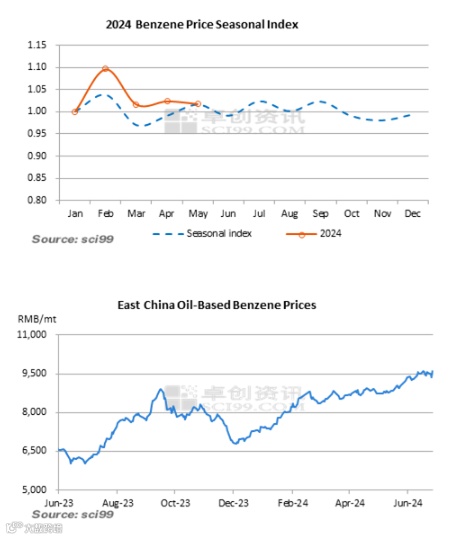
Introduction: In the first half of 2024, the benzene market price in China continued to climb. From January to June 2024, the average price of benzene in East China was RMB 8,659/mt, an increase of 25.20% compared to the same period last year. As of June 30, China’s benzene prices in East China closed at RMB 9,400/mt, an increase of 26.34% compared to the beginning of the year (RMB 7,440/mt).
Benzene prices posted a rising trajectory in the first half of 2024.
From January to February 29, benzene prices climbed to RMB 8,820/mt driven by a strong crude oil market and low benzene inventories. The rapid rise in the benzene price caused resistant sentiment in downstream industries. Some traders start selling to book some profits, pressuring down benzene prices.
From March 1 to March 22, benzene prices first climbed to RMB 8,840/mt amid the expectation for ongoing tight supply and low inventories and then showed downward corrections influenced by increasing production cuts and unit maintenance in downstream styrene, CPL and phenol industries.
From March 23 to now, as the port inventory accumulation was slower than anticipated and the future arrival is still limited, the bearish sentiment in the benzene market diminished. The restart of some benzene units was delayed in June, and the products produced by some plants were found to be unqualified. Furthermore, some overseas benzene plants malfunctioned. Against this background, the benzene price rose to a high of RMB 9,600/mt on June 18.
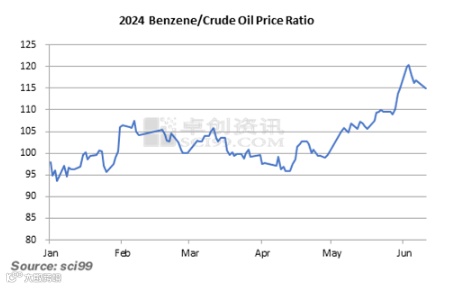
Benzene to crude oil price ratio hit a record high of 120.
The price of benzene continued to be strong in the first half of the year. Since late April, the crude oil price has started to fall, while the benzene price has trended upward due to the improvement of fundamentals and the expectation of tightening supply, so the benzene to oil price ratio once exceeded the historical high of 110. News of delayed ship arrivals, Asian facility maintenance, and unit failures in Brunei contributed to the rise in benzene prices at a time when the commodity was overpriced and there was a risk of a price decline. This allowed the benzene to oil price ratio to break through the record high of 120.
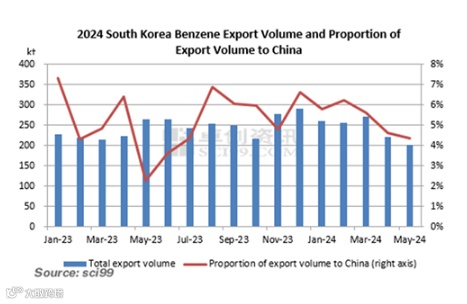
South Korea’s benzene exports increased, but the proportion to China declined.
With the withdrawal of LG Chemical and Hanhua Total from South Korea, the total export volume of benzene from South Korea has begun to increase. The average monthly export volume in the past five years has been 214.3kt, and in the past three years has been 222.5kt. In 2024, the average monthly export volume has increased to 238.5kt.
Throughout the last two years, South Korea’s and the US’ aromatics logistics patterns have seen major changes. High-octane gasoline was scarce since the US banned the import of heavy oil from Russia and the US local gasoline market had high demand. The price of aromatics increased notably in the US as the economy of blending oil using aromatics became prominent. As a result, there was an opportunity for arbitrage between Asia and the US. As a result, South Korea started exporting significant amounts of toluene, xylene, and other aromatic compounds to the US.
In terms of quantity, the export of aromatics from South Korea to the United States in 2022 increased by 135.8% Y-O-Y, with benzene exports increasing by 24.60% Y-O-Y. In 2023, the export volume of aromatics from South Korea continued to grow by 24.97% despite a high base, while benzene exports increased by 53.41% Y-O-Y. The proportion of benzene exported in aromatics has gone through a process of first decreasing and then rebounding.
The aromatics logistics pattern of the United States and South Korea has led to a decline in the proportion of South Korea’s exports to the Chinese Mainland. From January to June 2024, China imported 758.4kt of benzene from South Korea, accounting for 53% of the total imports, down 9 percentage points from 62% in 2022, exacerbating the shortage of benzene supply in China.
Output loss exceeded expectations.
The import volume in the first half of the year was less than anticipated due to the closure of the arbitrage window. Furthermore, the unit maintenance was intensive in April and May, and some units failed to be restarted, resulting in a larger-than-expected output loss caused by maintenance. This exacerbated the tight supply of benzene in China, with the supply-demand balance falling continuously.
Downstream capacity release in H2, 2023 boosted the benzene demand in 2024.
In 2023, the styrene market saw a capacity addition of 3,700kt/a, most of which were put into operation in H1 of 2023, except for Zhejiang Petroleum & Chemical’s 600kt/a and Ningxia Baofeng Energy Group’s 200kt/a. Therefore, styrene output in H1 of 2024 only witnessed a limited increase compared to that in H1 of 2023, and compared to H2 of 2023, styrene output saw a decline of 7 percentage points due to production cuts caused by profit losses. In the phenol industry, most of the newly added capacity in 2023 was released in the fourth quarter, which contributed to an increase of 20% in benzene demand in H1 of 2024. In the aniline industry, the addition of Wanhua Chemical (Fujian) and Chongqing Changfeng Chemical’s capacity in H2 of 2023 also led to the increase in aniline output in H1, 2024, driving up the consumption of benzene.
The continuous narrowing of the supply-demand balance buoyed up benzene prices.
The demand for benzene in the H1 of 2024 was greatly pushed up with the support of the start of multiple downstream units in 2023, which led to a continuous narrowing of the supply-demand balance in H1, 2024, greatly benefiting the price increase.
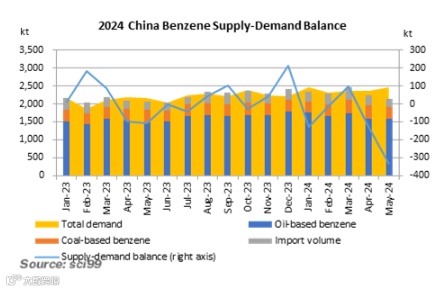
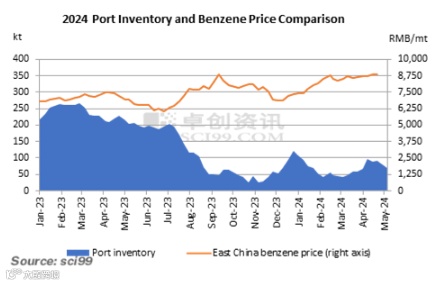
The continuous narrowing of the supply-demand balance, coupled with the limited arrival of imports, led to a continuous decline in the port inventory of benzene, which helped the benzene price reach a high of RMB 9,700/mt at one point.
Downstream new capacity is delayed to be released due to profit losses.
Styrene prices fell below the benzene price in June, with the largest price spread reaching RMB -195/mt. The phenol-benzene price spread saw the largest price spread at RMB -1,595/mt.
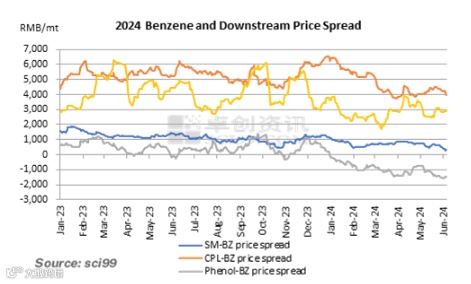
The narrowing of the price difference between downstream products and benzene reflected a compression of downstream profits. In H1 of 2024, the downstream weighted gross profit continued to decline. However, downstream industries’ operating rates remained relatively high. On the one hand, with the rapid capacity expansion in recent years, the degree of downstream integration has increased. On the other hand, downstream factories have locked orders from the far-month paper market in recent years, which has to some extent ensured their profits. Furthermore, due to the social responsibility of factories and the maintenance of market share, the rigid demand for benzene has been guaranteed.
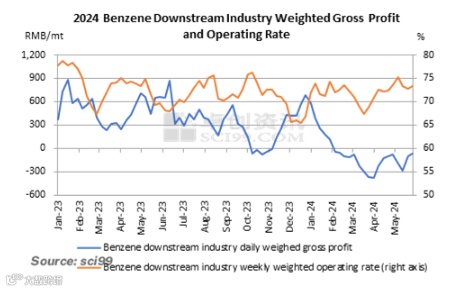
The strong performance of benzene in H1, 2024 has led to a delay in the startup of new downstream units. In H1 of 2024, only a 300kt/a CPL unit at Sinopec Hunan Petrochemical and a 50kt/a CPL unit at Shanxi Lubao Coking Group were put into production, while other capacity was delayed.
The price of benzene has started to decline after the delivery at the end of June. What is the overall price trend in the second half of the year?
Macroscopically, both positive and negative factors exist simultaneously.
On a macro level, this round of PPI has bottomed out in June 2023, and a new inventory cycle has been initiated. Based on the historical experience of proactive inventory replenishment and the judgment of the start time of a new inventory cycle, 2024 is generally in the midst of a new inventory replenishment cycle, with prices prone to rise but difficult to fall.
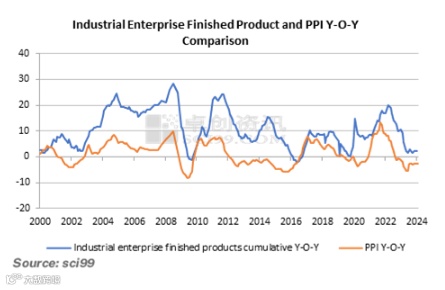
In 2024, commodity prices will generally show an upward trend, and there may be another round of a bull market. However, if the economy encounters “gray rhinoceros” events during the recovery process, commodity prices are also likely to fall.
Looking back at the benzene industry chain, there are still multiple new units in downstream industries planned for 2024, which is expected to provide good support for benzene demand. Regarding benzene, the capacity added in H2 of 2024 is comparatively lower than the new capacity downstream, and the tight supply pattern may persist in H2, 2024.
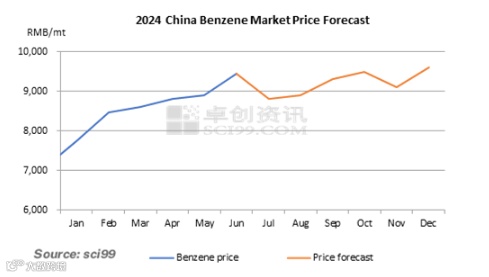
Downstream new units will be kicked off in succession starting in August, and imported cargo will arrive in July. However, downstream industries are suffering from losses at present, and there is significant resistance to price transmission towards the terminal market. As a result, unexpectedly favorable events are still required to propel the benzene price recovery.
All information provided by SCI is for reference only, which shall not be reproduced without permission.
Please click "Read more" for the full article.