

China PVC Powder Prices to Fluctuate Upward in H2, 2024
Preface: China’s PVC powder prices saw a Y-O-Y decline in H1, 2024 mainly due to increased social inventory. The new capacity was released, but China’s domestic demand failed to improve. In H1, PVC powder prices first moved sideways, and then rose, and then fell. In H2, China’s domestic and foreign atmospheres are expected to see an improvement. The Fed may cut interest rates in Q4, which may boost the macro atmosphere. However, fundamentals may weigh on the market. SCI reckons that the average price of PVC powder will likely see an increase in H2 compared with H1.
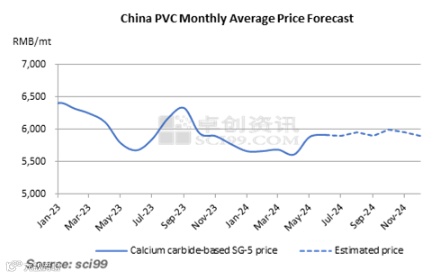
In H1, China’s PVC powder prices first moved sideways, then rose, and then fell. From January to April, PVC powder prices were range-bound. In May, PVC powder prices fluctuated upward. In June, PVC powder prices dropped.
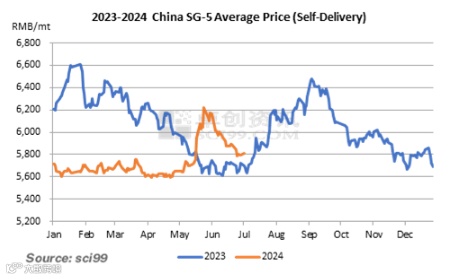
In H1, 2024, the average self-delivery price of SG-5 was RMB 5,740/mt, down 5.7% Y-O-Y. The highest self-delivery price of SG-5 price was RMB 6,224/mt, appearing in H2 May, while the lower one was RMB 5,592/mt in H1 April. From January to April, PVC powder fundamentals remained weak as PVC social inventory piled up notably during the Chinese New Year holiday and domestic demand failed to recover notably from March to April. Thus, PVC powder prices hovered at lows. In May, PVC powder fundamentals improved to some extent due to intensive unit maintenance and increased demand from the soft product industry. At the same time, the issuance of extra-long special Treasury bonds, lowering the personal housing provident fund loan interest rate, abolishing the lower limit of the loan interest rate, lowering the down payment ratio, and the government’s purchasing of some commercial houses with reasonable prices boosted market sentiments. Thus, the real estate industry-related commodity market mounted up. PVC futures prices moved up, followed by spot prices. In June, downstream demand entered the slack season, so downstream enterprises showed lower purchasing interest due to fewer orders. With the bullish effect being digested, PVC prices moved down.
The factors affecting the PVC powder market in H1, 2024 are mainly micro and macro aspects. The PVC powder market registered an oversupply. High inventory restricted the market increase. Bullish factors in the macro market drove the PVC price occasionally.
The PVC powder market faced an oversupply.
China PVC Powder Market Key Index in H1, 2024
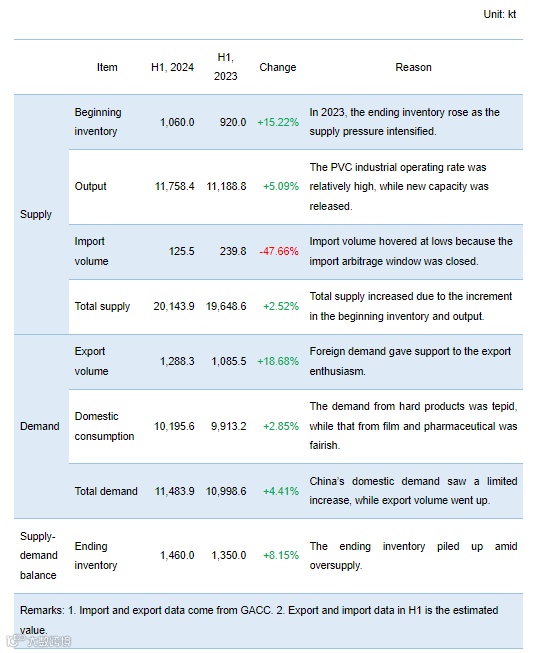
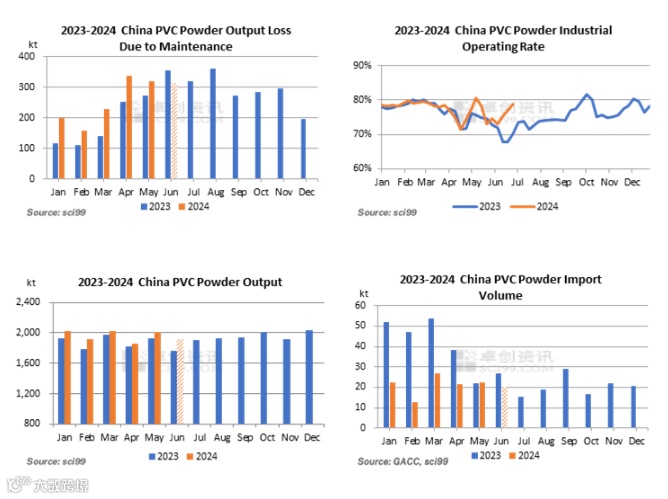
From the perspective of supply: The total PVC powder output from January to June was 11,758.4kt, up 5.09% Y-O-Y. From January to April, the PVC powder industrial operating rate was largely unchanged compared with the same period of 2023 due to severe profit losses. From end-April to end-June, the PVC powder industrial operating rate saw a Y-O-Y rise with the profit improving. The 300kt/a ethylene-based unit at Zhejiang Oceanking Development and the calcium carbide-based 300kt/a unit at Shaanxi Jintai Chlor-Alkali Chemical were rolled out.
From the perspective of import: In H1, 2024, the total import volume is estimated at 125.5kt, down 114.3kt Y-O-Y. Due to the low import base, the import reduction had a limited impact on the overall market.
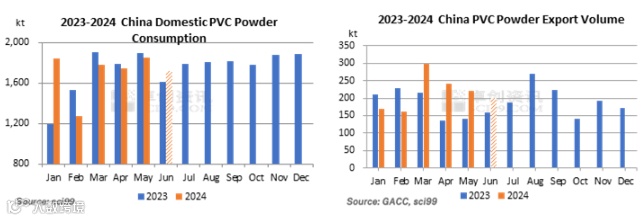
From the perspective of demand: In H1, 2024, China’s total domestic consumption was estimated at 10,195.6kt, up 2.85% Y-O-Y. The demand from the hard product industry was weak, while orders at film, sheet and medical enterprises were decent. In 2024, as China’s real estate market remained in the doldrums, orders at hard product enterprises underperformed, and operating rates at some profile enterprises were lower than in the same period in 2023. The consumption from other industries was passable, driving up the total demand slightly. In H1, PVC powder export volume remained high. In end-February, Indian buyers’ intensive purchasing propped up the export volume in March and April. From May to June, as freight surged, export orders dropped. On the whole, the demand for PVC powder went up mildly in H1. However, the growth rate of demand was lower than that of supply, so the inventory remained high.
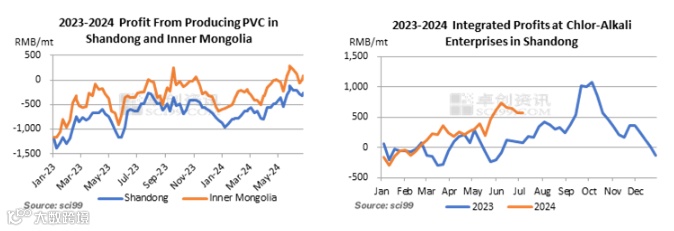
In H1, 2024, PVC powder prices were under pressure. Profits from producing PVC powder were negative most of the time, and its assessment value was relatively low.
Profits from producing PVC powder were negative most of the time, and costs supported the market from the bottom.
Profits from producing PVC powder were negative most of the time. Profits in Inner Mongolia turned from negative to positive. Integrated profits at chlor-alkali enterprises were positive, supporting the PVC powder industrial operating rate to some extent.
In June, with the bullish effect in the macro market fading, fundamentals became the major price driver for the PVC powder market. With the improvement in integrated profits, the support from costs dented.
Macro expectations affected the market sentiment.
In H1, though there were bullish expectations for the economic recovery, the recovery pace underperformed. In May, the PVC market price moved up backed by loose policies. However, with no policy impetus, weak macroeconomy data led investors to return to reality.
Impact of Macro Events on China PVC Market in H1, 2024
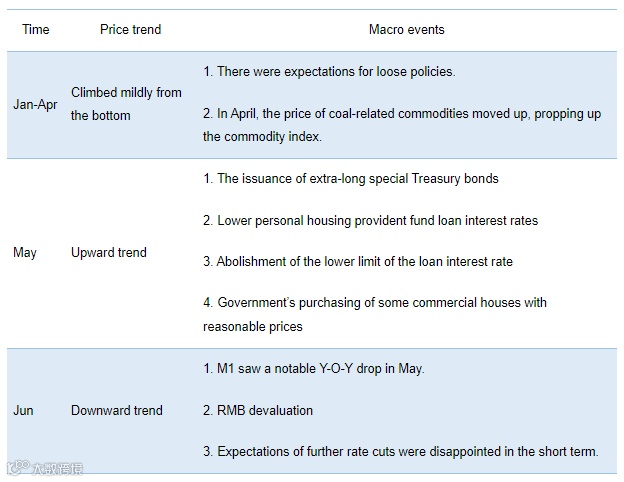
Though PVC powder prices moved up in May as macro policies supported the market sentiment, PVC prices fell due to weak fundamentals. The bullish effect brought by the macro market failed to last.
In H2, macro atmospheres may improve slightly, which may boost the commodity market. PVC fundamentals may remain weak, weighing on the market price. The new start data in the real estate industry may hover at lows, so rigid demand may stay soft, while the PVC supply will likely be ample. In H2, the PVC powder market may fluctuate upward.
Macro atmospheres may improve as the market will possibly register an active replenishment cycle.
China’s commodity market will possibly register an active replenishment cycle, propping up the macro atmosphere. Supported by policies, the growth pace of China’s domestic infrastructure and real estate is expected to accelerate, while China’s domestic consumption may see a mild recovery. In addition, there are expectations for more loose policies, while the Fed will possibly cut interest rates in Q4, which may support the market increase.
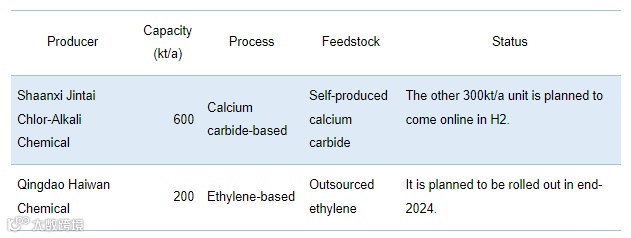
New units are planned to be put into operation in H2, but more units may undergo maintenance.
In May, the 300kt/a unit was put into operation, and the capacity is expected to be released fully in H2. 800kt/a units are planned to be rolled out in H2.
H2, 2024 China Newly Constructed PVC Powder Units
Most PVC powder units need to undergo overhaul at least once a year. In H1, 11,440kt/a units had undergone maintenance. Except for 2,130kt/a units that are shut down for the long term, 14,330kt/a units are planned to be shut down for maintenance in H2. Thus, the output loss in H2 may rise from H1.
China’s domestic consumption may remain weak, while there will possibly be uncertainties in exports.
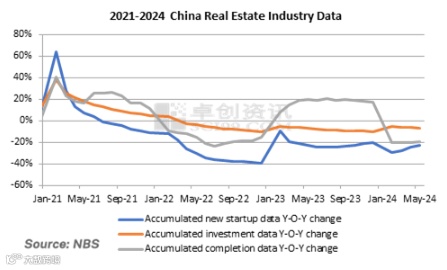
Around 60% of the end products of PVC powder are used in real estate-related industries, so the demand for PVC is closely related to the operation of the real estate industry. From Q3, 2021, the real estate industry has entered an adjustment cycle, and relevant data has begun to move downward. Entering 2023, the real estate market showed a certain improvement, mainly reflected in the continuous positive Y-O-Y cumulative growth of the floor space of completed buildings. However, the investment and new startup data underperformed. In 2024, data related to the real estate market still underperformed. In H2, the demand from the real estate-related industry can hardly increase.
As for exports, Since the expiry of India’s anti-dumping policy on PVC powder in China, the export volume of PVC powder in China has increased, and India has become the largest trading partner of China’s exports. The proportion of resources exported to India from January to May reached more than 50%. China’s PVC powder exports in H1, 2024 may be higher than in the same period last year. However, in H2, 2024, Affected by India BIS certification, Chinese-made resources exported to India may be restricted.
In H2, PVC fundamentals may remain weak. China’s commodity market will possibly register an active replenishment cycle, propping up the macro atmosphere. In addition, there are expectations for more loose policies, which may boost the macro market. SCI reckons that the average self-delivery price of SG-5 will possibly hover at RMB 5,650-6,200/mt.
All information provided by SCI is for reference only, which shall not be reproduced without permission.
Please click "Read more" for the full article.