

China MEG Import Volume Analysis in Jan-Jul 2024
Preface: From January to July 2024, China’s MEG import volume was 3,752.3kt, up 2.97% Y-O-Y. The main origins were Saudi Arabia, Canada, and the U.S. Among these, Saudi Arabia accounted for 50.07%. Zhejiang, Jiangsu, and Hainan are the top three receiving provinces, but the proportion of imports in Zhejiang and Jiangsu has declined, reflecting the impact of domestic MEG supply on the import market share.
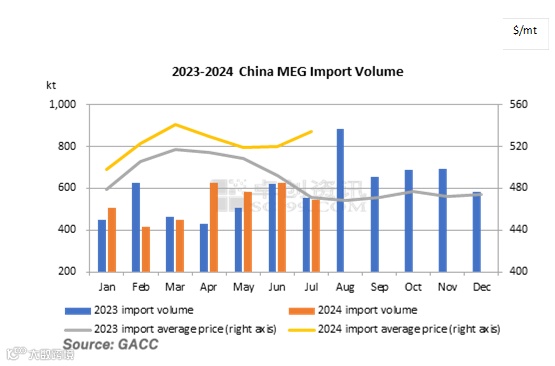
From January to July 2024, China’s MEG import volume was 3,752.3kt, up 2.97% Y-O-Y. The monthly average import volume was 536kt. In 2024, due to tepid industrial profits and the rapid increase in China’s domestic MEG output, some overseas MEG plants cut production or halted production. China’s overall MEG imports in 2024 hovered at a relatively medium level. In April, MEG imports rose to 623.6kt, mainly due to the recovery in imports after the restart of overseas units at the beginning of the year, and PET plants’ increased procurement of imported resources during intensive unit maintenance in March-April.
From January to July 2024, there was no significant change in the share of China’s MEG imports by trade partners compared to 2023. The top three trade origins were Saudi Arabia, Canada, and the United States. Currently, China’s MEG imports are still concentrated in the Middle East, with Saudi Arabia accounting for 50.07%. SABIC in Saudi Arabia remains the largest supplier of MEG to China. North America follows, with Canada accounting for 15.83% and the United States for 12.32%. Companies such as MEGlobal, Shell, Dow, Lotte, and Formosa from Canada and the U.S. are also key suppliers of MEG to China.
In Asia, South Korea continues to export a significant amount of MEG to China, accounting for 3.80%, while MEG producers in Taiwan of China and Japan cut or halted production, leading to a noticeable decline in their exports to China.
From January to July 2024, the distribution of MEG imports by receiving regions in China has changed slightly compared to 2023. The top three receiving regions remain Zhejiang, Jiangsu, and Hainan, with Zhejiang accounting for 32.70%, Jiangsu 28.13%, and Hainan 8.07%.
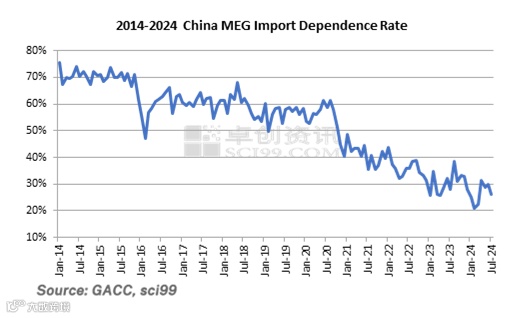
However, it can be observed that the import share in Zhejiang and Jiangsu has significantly decreased in 2024. The main reason for this is the significant increase in domestic capacity during the 2020-2023 expansion period, especially with the launch of integrated refining and chemical projects in coastal areas and large-scale coal chemical projects in inland regions. Most of the resources were directed towards PET plants in Zhejiang and Jiangsu. As a result of competition from domestic supplies, the market share of imported MEG has declined significantly, with this trend being more pronounced in Zhejiang and Jiangsu.
All information provided by SCI is for reference only, which shall not be reproduced without permission.
Please click "Read more" for the full article.