

Influence of Trump Re-Election on SBS Downstream Shoe Industry
Introduction: On November 6, 2024, U.S. Republican presidential candidate Donald Trump declared victory. The U.S. is about to enter the Trump era again. The potential policy of enhancing the tariffs on commodities is expected to have an impact on SBS and its downstream industries.
Through the analysis of Trump’s policy during his first administration, the impact on the commodity market was the increase in tariff rates, aggravating the trade friction between China and the U.S.. With the re-election of Trump on November 6, 2024, Trump’s economic policy is expected to be more of a continuation of his previous policy, which may have a greater impact on the end shoe industry.
The potential tariff policy is likely to have a direct influence on the SBS end shoe market.
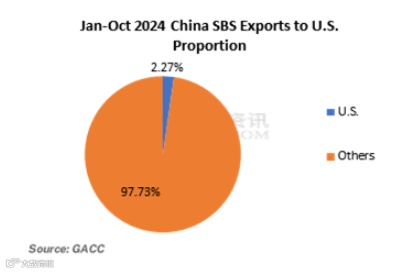
In the past few years, China has been actively developing SBS exports in the wake of an SBS overcapacity and a slower growth rate of demand, but the exports to the U.S. were relatively low. According to GACC, China’s SBS exports to the U.S. were only 1,619mt from January to October 2024, accounting for only 2.27% of China’s total SBS exports. If Trump’s potential economic policy aggravates the trade friction between China and the U.S., it may have a limited impact on China’s SBS industry but have more influence on the SBS downstream and end products, especially on the shoemaking industry.
China is the largest shoemaker in the globe. According to the data in World Footwear Yearbook, the total shoe output in the globe was 22.4 billion pairs, and China’s output was 12.3 billion pairs, accounting for 55% of the global total. Yet, China’s total shoe consumption volume accounted for only 17.1% of the global total. It is estimated that over 60% of China’s shoe output has been exported, indicating the significance of exports on China’s shoemaking industry. In the future, the potential policy of enhancing tariffs in the U.S. is expected to have a direct influence on China’s shoe exports. As a result, more export orders may transfer to emerging economies including Southeast Asia and South Asia.
The shoemaking industrial chain is likely to transfer to emerging markets.
From the perspective of the feedback from the SBS and downstream industrial chain, Trump’s victory has successively brought a greater impact on the flow of shoe orders in 2025. As more local buyers in the U.S. are worried about the tariff increase, they tend to place orders in Southeast Asia. At the same time, players worry that the influence scope of the tariff increase may gradually extend to the sole and upstream shoe material industry. Besides, China’s shoemakers may be required to build plants in emerging economies including Southeast Asia to avoid the risk of tariff increase. The shoemaking industrial chain may transfer to emerging markets more rapidly.
In terms of the SBS downstream TPR shoe material industry, the TPR shoe material market maintained a large scale bolstered by China’s strong shoe exports. Besides, the TPR exports also ramped up year by year, which was another reason for the high SBS consumption.
In recent years, although the shoemaking industry in Southeast Asia and other emerging economies has shown rapid development, the upstream supporting facilities of the entire shoemaking industry are not complete enough, and there is a lack of large petrochemical industries to rely on. Except for the natural rubber, the main feedstock of shoemaking relies on imports. However, with the re-election of Trump, the potential tariff policy and the general concern of the industry are likely to accelerate the process of China’s upstream material producers building plants in Southeast Asia. Besides, the relevant upstream supporting facilities may develop more rapidly in Southeast Asia, which is expected to weigh on the development of China’s TPR shoe material industry.
The influence on the future SBS market pattern
The TPR shoe material industry is one of the major downstream industries of SBS. Trump’s potential policy is expected to curb the shoe material market. For China’s SBS industry, the overcapacity and slower demand growth may accelerate the adjustment in the SBS capacity structure, product structure, and trade flow. Thus, the SBS exports are expected to increase, so as to deal with the unfavorable factors in the market competition caused by changes in the external environment.
All information provided by SCI is for reference only, which shall not be reproduced without permission.
Please click "Read more" for the full article.