

Impact of Sino-US Tariff Hikes on Propylene
Keywords: Tariffs, Propane, Crude Oil, Costs, Operating Rates
Introduction: The recent reciprocal tariff hikes between China and the US have significantly impacted certain propylene feedstocks, with divergent bullish and bearish effects of propane and crude oil on propylene prices. In the short term, propylene prices are trending slightly upward with limited momentum, while the long-term outlook hinges on sustained crude oil price adjustments and China’s PDH enterprises’ strategies to mitigate reduced propane supply.
On April 2, 2025, US President Trump signed two executive orders on so-called “reciprocal tariffs” at the White House, announcing a 10% “minimum baseline tariff” on trade partners and imposing higher tariffs on certain countries, including a 34% reciprocal tariff on China.
In accordance with Customs Tariff Law of the People’s Republic of China, Law of the People’s Republic of China, Law of the People’s Republic of China on Foreign Trade, and other regulations, as well as fundamental principles of international law, the Customs Tariff Commission of the State Council has decided to impose additional tariffs on US-origin imported goods, approved by the State Council. Effective 12:01 PM on April 10, 2025, all US-origin imports will face an additional 34% tariff on top of existing applicable rates.
The reciprocal tariff hikes between China and the US have limited impact on propylene products.
In 2024, China’s propylene production and consumption both exceeded 50 million mt, with imports reaching approximately 2.02 million mt and exports totaling less than 80,000 mt. China’s import dependency on propylene stood at just 3.47%, and exports were negligible. From a trade-partner perspective, the US accounted for less than 1% of China’s total propylene imports and exports. Given China’s low import/export reliance on propylene—with limited inbound shipments from the US and minimal outbound flows to the US—the reciprocal tariffs have an almost negligible effect on China’s propylene trade.
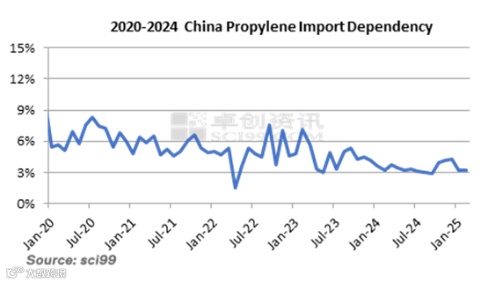
Reciprocal tariffs may lead to higher propane prices and reduced supply, benefiting propylene prices.
Regarding the China-US reciprocal tariffs, industry participants are more focused on the potential for imported propane prices to rise while supply shrinks, which could lead to lower operating rates at domestic PDH plants—ultimately supporting propylene prices. China’s propane supply primarily relies on refinery by-products, but domestic production is relatively limited. Therefore, most PDH plants source their feedstock from imported propane, with PDH demand accounting for nearly 50% of China’s total propane consumption. Notably, a significant portion of China’s propane imports originates from North America. In 2024, US-sourced propane imports reached 17.3159 million mt, representing 59.23% of China’s total propane imports.
In recent years, China’s PDH capacity has expanded rapidly, becoming a major driver of propylene capacity growth due to its large-scale production and high-yield advantages. By 2024, PDH officially became the largest contributor to China’s propylene capacity. As of this report, China’s total PDH and mixed alkane capacity stood at 23.975 million mt, accounting for 32.56% of the country’s total propylene capacity. The booming development of deep-processing projects, particularly PDH, has also increased reliance on imported propane, driving continuous growth in propane imports.
Since PDH plants typically have large single-unit propylene capacity and relatively flexible adjustments in the operating rate, their unit restarts and shutdowns have become a key factor influencing propylene supply and prices. However, starting from the second half of 2021, PDH margins shifted from profit to loss, leading to a downward trend in operating rates, and cost pressures have also increased the volatility of PDH unit operating rate. Especially in 2024, the correlation between cost/demand and propylene price trends weakened, making PDH plant operations the dominant factor in determining propylene price movements.
China’s additional tariffs on US imports will undoubtedly increase the cost of imported propane, leading to reduced propane imports. In the short term, the supply gap from lower propane imports will be difficult to fill quickly. Higher production costs for propane-based propylene may force some domestic PDH plants to reduce operating rates or even shut down, tightening propylene supply and supporting prices. However, most domestic PDH plants are integrated with downstream units, primarily PP units. Given that key downstream sectors like PP and some chemical derivatives are already at profit losses, if PDH plants cut production, triggering propylene price increases, downstream plants may struggle to sustain external propylene procurement for downstream production. In summary, the propane price increase caused by tariffs on US imports will provide some bullish support to the propylene market, potentially lifting prices in the short term—though the magnitude may fall short of market expectations. The longer-term implications warrant closer attention.
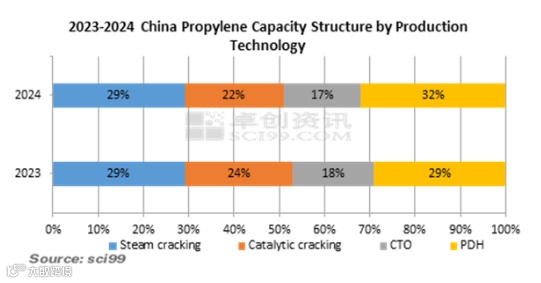

Crude oil price plunge from reciprocal tariffs dragged down the propylene market
In addition to the propane supply-demand dynamic, the impact of Sino-US tariff hikes on crude oil prices cannot be overlooked. The recent reciprocal tariffs coupled with production increases by Saudi Arabia and its allies weighed down the crude oil market. As of April 4, Brent crude prices for June 2025 tumbled to 65.58/bbl, marking two consecutive days of declines exceeding 6% and accumulating a nearly $10/bbl drop over the two-day period.
Beyond propane, crude oil serves as another critical feedstock for propylene—arguably exerting greater pricing influence than propane in certain contexts. Long-term analysis reveals propylene as a cost-driven commodity, with crude oil dictating its broad pricing trajectory. In some years, the propylene-crude price correlation exceeds 0.9. In the short term, daily crude oil settlement prices serve as a key reference for producers’ pricing adjustments. Particularly when overnight crude price fluctuations exceed normal ranges, these movements can directly dictate directional changes in propylene pricing. While FCC process accounts for a smaller share of propylene production compared to PDH, this conventional technology still represents over 20% of total domestic propylene capacity. Although PDH producers have gained greater pricing influence with recent capacity expansions, crude oil price movements continue to impact pricing mechanisms for certain players in the Shandong refinery-dominated market. This crude-linked pricing dynamic partially explains the restrained upward movement in Shandong’s propylene prices in recent trading sessions.
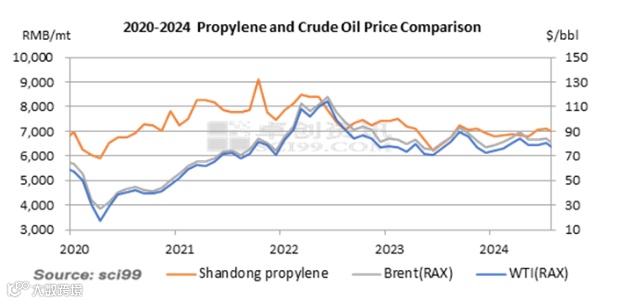
In summary, the reciprocal China-US tariffs have minimal direct impact on propylene import/export flows, while their primary effect manifests through feedstock channels—influencing propylene production costs and supply availability, thereby indirectly impacting propylene prices. Both propane and crude oil serve as equally critical feedstock drivers for propylene prices, with crude oil’s bearish pressure partially offsetting propane’s bullish support. Although the tariffs also affect other feedstocks like naphtha and derivatives including ethylene and PP, their spillover effects on propylene remain relatively limited. In the near term, the opposing forces from crude oil and propane create divergent price influences, and the boost from the fundamentals may remain somewhat but is limited, so propylene prices may be stable-to-slightly increasing. Over the longer horizon, market attention should focus on sustained crude price adjustments and domestic PDH plants’ strategic responses to potential propane supply constraints.
All information provided by SCI is for reference only, which shall not be reproduced without permission.
Please click "Read more" for the full article.