

2024 China SBR Import & Export Data Interpretation
Introduction: In 2024, China’s total SBR import volume was around 392.4kt, up 7.39% YoY. The export volume was 201.9kt, up 25.01% YoY. The imports and exports both leveled up. The increment in the imports from Russia ranked first. The increment in exports to Thailand and Vietnam rose notably.
SBR imports hit a five-year high in 2024.
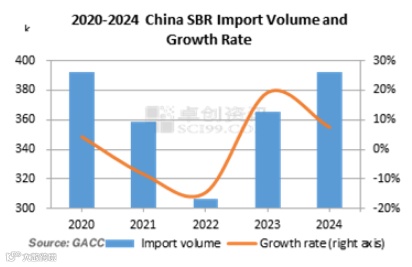
China’s SBR import volume continued to rise to 392.4kt in 2024, up 7.39% YoY and accounting for 21.5% of China’s total supply. Affected by the international situation, some trade partners exported their low-priced SBR to China as the arbitrage window opened under the price advantages. Against the backdrop of cost decreasing and benefit increasing, buyers showed high interest in low-priced SBR resources.
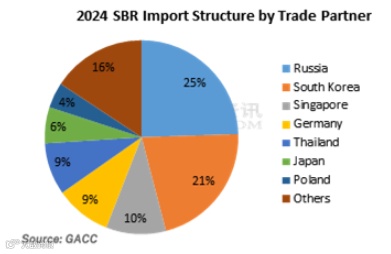
In 2024, China’s top 5 import origins were Russia, South Korea, Singapore, Germany, and Thailand. Therein, the import volume from Russia was the largest at 96.1kt, taking up 25% of the total and up 6.55% YoY. The SBR resources from Russia had strong price advantages, and the arbitrage window opened, so traders showed high interest in operation. Some of the SBR resources imported from Russia were consumed in China, and others were re-exported to other countries and regions. South Korea ranked second. The import volume of SBR from South Korea was 84.1kt, accounting for 21.43% of the total, up 1.03% YoY. In 2024, the average price of SBR imported from Russia was $1,514.87/mt. Those from South Korea, Singapore, Germany, and Thailand were $2,299.06/mt, $2,435.86/mt, $2,109.94/mt, and $2,473.54/mt. There were some differences in the prices based on the properties of imported resources.
In 2024, the SBR exports hit a five-year high.
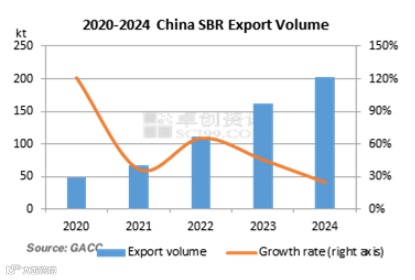
According to GACC, in 2024, the export volume of SBR was 201.9kt, up 25.02% YoY, marking the highest point in five years. The main reasons are as follows: Firstly, China’s SBR has a strong price advantage globally, which created opportunities for its exports. Secondly, the global trade flow of SBR changed under the influence of the international situation, resulting in re-exporting operation orders. Thirdly, there was some fixed rigid demand at tire enterprises and shoe material enterprises in Southeast Asia, relying on SBR with price advantages to meet the production needs. In terms of the global supply and demand relationship, the SBR resources in some of the major European SBR exporters have changed since H2 2022. Thus, some traders chose to seek SBR resources from China instead and exported them to other countries and regions.
Southeast Asia was still the main destination of China’s SBR exports.
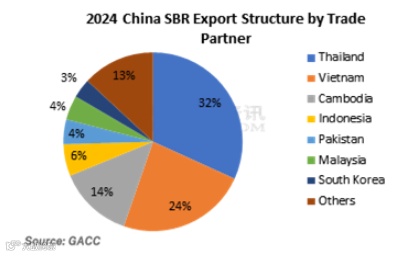
According to GACC, in 2024, China’s top 5 SBR export trade partners were Thailand, Vietnam, Cambodia, Indonesia, and Pakistan. Therein, the SBR exports to Thailand, Vietnam, and Cambodia ranked top three, accounting for 68.6% of the total. The main reason was that the plants in Southeast Asia built by China’s tire enterprises were mainly located in Thailand, Vietnam, and Cambodia. In 2024, the exports to Thailand, Vietnam, and Cambodia were 64kt, 47.3kt, and 27.2kt respectively, accounting for 31.72%, 23.42%, and 13.48% of the total exports respectively. The SBR exports to Cambodia rose by 85% YoY. The main reason for the YoY rise was that a branch of a tire enterprise in Cambodia continued to release its capacity in 2024, resulting in some rigid demand for SBR. Besides, there were some price advantages for China’s SBR resources in the global SBR supply.
Since 2014, China’s tire enterprises have built plants overseas. Thailand, Vietnam and other Southeast Asian countries, with their rich natural rubber resources, have undertaken the main capacity of the overseas plants of China’s tire enterprises. According to SCI, Thailand’s SBR capacity is only 175kt/a, including 75kt/a of ESBR and 100kt/a of SSBR. There is no SBR unit in Vietnam. However, leading tire enterprises such as Zhongce Rubber Group, Shandong Linglong Tire, Qingdao Sentury Tire, Double Coin Group, Jiangsu General Science Technology, and Prinx Chengshan (Shandong) Tire have all established their first overseas factories in Thailand. Sailun Group, Guizhou Tyre, and Shandong Jinyu Tire built their first overseas factories in Vietnam. Local SBR output is unable to meet the demand, resulting in a high dependency on imports.
All information provided by SCI is for reference only, which shall not be reproduced without permission.
Please click "Read more" for the full article.