

PBR Cross-Regional Price Spread Change from Supply and Demand Perspective
Introduction: Affected by the supply and demand characteristics of different regions and the characteristics of the trade flow, the PBR market price in East China is higher than that in North China most of the time. Since the listing of PBR futures, especially since H2 of 2024, the PBR price in East China has narrowed and was even once lower than the price in North China. The main reasons are the changes in regional supply and demand and the diversified development of market trade modes.
The cross-regional price spread narrowed. The price in East China got closer to that in North China.
From a regional perspective, the PBR market price trends in various regions were basically the same, but the price spreads were gradually narrowing. First, in terms of the formation of regional PBR prices, more than half of the supply came from PetroChina and Sinopec. These two companies balance production and sales in various regions through internal allocation. In the pricing process, the listing prices of the three major sales areas were basically kept flat, but due to different transportation distances, the price in South China was slightly higher than that in North China and East China. Therefore, the overall price in the South China market was higher than that in the other two markets. According to the characteristics of transactions, we divide Shandong into the North China region. Shandong has more than half of China’s tire capacity, so North China is the largest PBR consumption region in China. East China ranks second, and South China ranks third.
Under this supply and demand pattern, there have been some differences between the prices in different regions, especially in that the price in North China remains lower than that in East China and South China for most of the time. On the one hand, North China had the largest supply. In addition to the allocation of supply by Sinopec and PetroChina, the concentrated private units were also important sources of supply supplement. In addition to meeting regional demand, North China also had some PBR resources flowing into East China and South China. The different transportation distances resulted in slightly higher prices in East China and South China than in North China. On the other hand, tire enterprises had a large demand, while the batches of hoses, tapes, shoe materials, etc. in East China and South China were relatively small. The batch advantage also made the prices in North China lower than those in East China and South China most of the time.
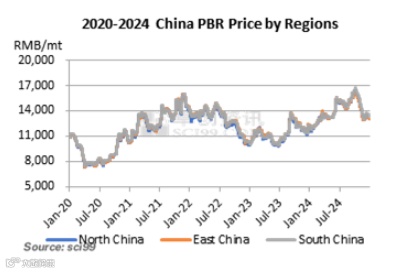
The increase in low-priced sources in East China dragged down the price.
In H2 2024, the commissioning of a new 120kt/a unit in Zhejiang brought new vitality to the East China market, and the supply in East China has increased significantly. The supply growth in East China has broken the situation of supply shortage, and China’s PBR trade flow has been reconstructed. Based on the stability of the regional allocation volume of Sinopec and PetroChina, East China achieved a balance of supply and demand. With the advantage of transportation distance, the dependence on private sources in North China was reduced. The low-end prices moved down in the region, leading to the price in East China gradually shifting from higher than North China to flat or lower than North China. In addition, the widespread use of futures tools also weakened the impact of transportation distance to a certain extent.
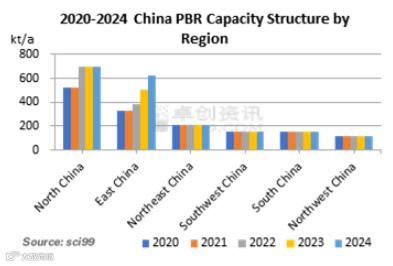
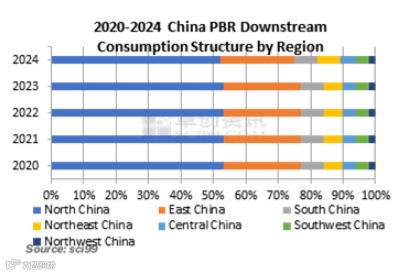
With new capacity coming on stream, the cross-regional price spread is likely to further narrow.
From the perspective of future new capacity, except for LCBR, new PBR capacity may be mainly concentrated in North China, South China, and Northwest China. The new capacity in Shandong is expected to be still relatively concentrated, and the oversupply situation in the region may be severe. The price in North China will possibly remain low. East China is also currently in a state of loose supply. The influx of North China’s supply may lead to a fully competitive market. In addition, the participation of arbitrageurs will also possibly break regional barriers, and the price spread between the two regions is expected to narrow further. In South China, local supply mainly comes from local production (Sinopec Maoming Company), regional allocation, and low-priced private resource inflows. At present, only the self-produced resources see an obvious price advantage compared to other channels. Other sources are subject to long transportation distances. The market price in South China ranked first among the three major regions. With the addition of new capacity at Zhongke (Guangdong) Refinery & Petrochemical, Sinopec’s market share of PBR resources may be further improved, and the supply gap in South China will likely be supplemented. Thus, the price spread between regions is expected to further narrow. It is worth noting that although the supply of goods may rise, the characteristics of different customer groups and low transaction batches may still support the overall dealing price in South China to be higher than those in other regions.
All information provided by SCI is for reference only, which shall not be reproduced without permission.
Please click "Read more" for the full article.