

PBR Price Rebounds with China-U.S. Tariff Issue Easing
Introduction: Recently, in Joint Statement on China-U.S. Economic and Trade Meeting in Geneva, it was proposed that China and the United States both cancel 91% of tariff rates, the 24% of the tariff rate will be suspended for 90 days, and the remaining 10% of the tariff rate will be retained. With the easing of China-U.S. trade relations, the commodity market sentiments improved. With the support of the positive fundamentals, the PBR price rebounded notably, but the weak demand may put pressure on the market price to continue to rise. It is expected that the PBR price may ebb after rising in May and gradually stabilize in June.
Background: On May 12, 2025, Beijing time, China and the U.S. jointly issued the “Joint Statement on China-U.S. Economic and Trade Meeting in Geneva”, in which the tariff issue was substantially eased. The U.S. canceled a total of 91% of the tariff rate, and China correspondingly canceled 91% of the counter-tariff rate. The U.S. suspended the implementation of 24% “reciprocal tariffs”, and China also suspended the implementation of 24% counter-tariffs. Since the announcement of the tariffs, the market sentiment of the commodity market has improved significantly, and the prices of spot PBR and PBR futures rose for two consecutive days, with a cumulative increase of more than 5%.
The PBR price grew beyond expectations with the improvement in the macro atmosphere and the rise in cost.
The PBR price moved up notably. According to SCI, as of May 22, the HCBR market price in North China was RMB 12,150/mt, up RMB 700/mt from May 9. The butadiene market price in Jiangsu-Zhejiang market was RMB 10,600/mt, up RMB 1,275/mt from May 9. Recently, the macro atmosphere improved, and the market dealing price of butadiene ramped up continuously, so the price of synthetic rubber futures trended up and increased by over 5% in two days, boosting the spot PBR market. Thus, the spot PBR price also moved up, but the increment in the spot PBR price was smaller than that in cost. Under profit losses, private PBR producers lowered their operating rates. Buyers made inquiries on rigid demand. Overall, the average dealing price of PBR went upwards.
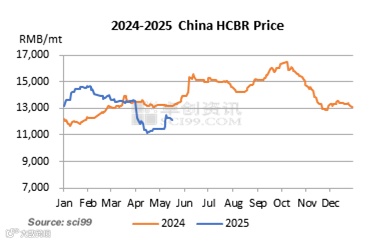
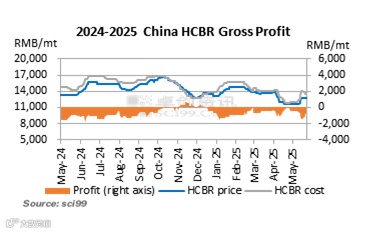
The negative feedstock of demand curbed the PBR price.
After a rise in two days, the PBR price cooled down, mainly due to the negative feedstock of demand. China’s tire exports account for over 40% of the tire consumption, so the export market is significant to the development of China’s tire industry. According to statistics from the China Rubber Industry Association, after the China-U.S. consultations, tire enterprises still face tariff rates ranging from 89% to 251%, so tire exports remain difficult. Players still lack confidence in the future market, which curbed the rubber market trends.
On May 21, the European Commission officially launched an anti-dumping investigation into the tires imported from China, with a focus on passenger car tires and light truck tires. The expected hampered exports continue to dampen market demand confidence in China.
The PBR price is expected to drop in May and bottom out in June.
In the short term, the PBR market is expected to be mainly affected by fundamentals with the influence of macro factors waning. As for cost, the butadiene inventory may continue to decrease until the end of May. Attention should be paid to the butadiene unit restart and shutdown in the coming days. In June, with some butadiene units being restarted, the supply is expected to curb the butadiene price, but the decrement may be limited. Under profit losses, the cost is likely to underpin the bottom of the PBR price. Regarding supply, the PBR unit at Sinopec Beijing Yanshan may begin to take maintenance, and the operating rates of private units are expected to stay low, leading to a slight fall in the PBR supply. Besides, the concentrated cancellation period of expired warrants of PBR coincides with the overhaul period of Sinopec Beijing Yanshan, so players are likely to worry about the supply stability of standard PBR products, which may bolster the price bottom of spot PBR and PBR futures. In terms of demand, the end demand for downstream products may be weak and there may be some uncertainties in exports, so the downstream operating rate is expected to be mainly stable. Thus, the supply-demand gap of PBR will likely narrow somewhat. Overall, SCI reckons that the PBR market price is expected to mainly bottom out and trend sideways in June.
All information provided by SCI is for reference only, which shall not be reproduced without permission.
Please click "Read more" for the full article.