

China PC Price Expected to Fluctuate at Lows in Q1 2025
In Q4 2024, China’s PC market showed an M-shape movement on the whole. The imbalance between supply and demand lasted, with PC price drops seen frequently. Looking ahead to Q1 2025, market supply is expected to remain abundant, while downstream users may maintain just-needed purchases, leading to low-level price fluctuations.
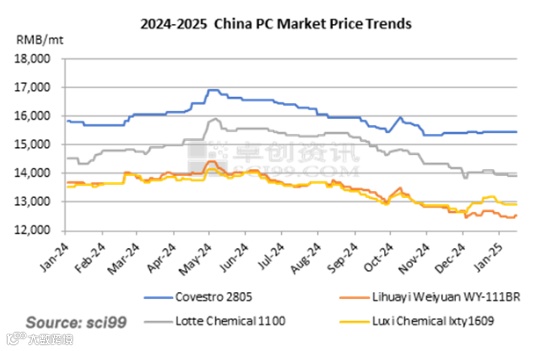
PC prices fluctuated downwards amid plenty of supply while cautious downstream purchasing.
In Q4 2024, China’s PC industrial operating rate hovered around 76%, and the domestic total supply increased by 20kt or 2.01% compared with Q3, indicating relatively sufficient supply. On the demand side, the implementation of home appliances trade-in and other policies brought more orders to some large modified PC plants, so they showed high PC purchasing positivity. Medium and small plants ran at 30%-60% and maintained purchases on rigid demand. In early October, the market continued the upward trend from the end of September, but as downstream buying enthusiasm waned at higher prices, the market could not sustain the highs and began to fall. From mid-October to early December, market prices fluctuated downwards, and cautious downstream users mainly purchased on a need-to basis, resulting in sluggish market trading. In early December, as the gross profit of PC gradually turned negative, suppliers were unwilling to sell at low prices. Coupled with rising prices of feedstock BPA, downstream users gradually entered the market with a bullish outlook, leading to an increase in market transactions. PC prices rallied, and some producers experienced short-term shortages of spot goods. However, facing constant price rises, downstream buyers began to show resistance, inhibiting PC prices from rising further.
Feedstock price rises surpassed product price growth, narrowing PC gross profits.
In December 2024, feedstock BPA prices climbed on tight supply. In East China, the monthly average price was RMB 9,538.6/mt, up 4.53% MoM. In early December, BPA costs advanced due to benzene and phenol price rises, and BPA producers generally had low inventories, supporting BPA prices to climb slowly. In the middle of December, some BPA producers cut loads or shut down units, and some paused sales. The supply tightness aggravated, pushing up BPA offers constantly. Under cost pressure, PC producers raised offers gradually. However, the price increase of PC was far less than that of BPA, squeezing PC profits. Taking a certain mainstream grade in East China as an example, the gross profit ran in the range of RMB -298/mt to RMB 83/mt within the month.
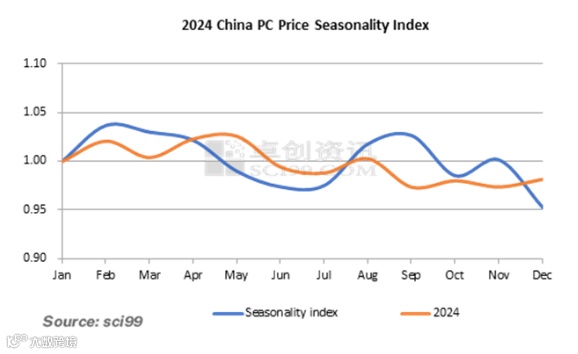
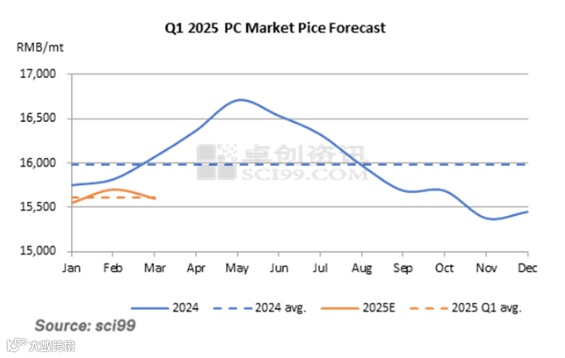
Forecast: Q1 2025 may see an inverted N-shape movement for the PC price, with small price volatility.
It is predicted that in Q1 2025, China’s PC market prices may rally after edging down and then fall again. On the supply side, only Sichuan Tianhua Chemical plans to take maintenance in March. The PC industrial operating rate is projected to hover around 80%, ensuring plentiful supply. On the demand side, some large downstream plants have relatively ample orders, while medium and small plants have slightly fewer orders, and their feedstock purchasing may be mainly on a need-to basis. On the cost side, feedstock BPA prices may mainly fluctuate within a narrow range in Q1, exerting limited direct influences on the PC market. Based on seasonal patterns, during January and February, which involves the Spring Festival holiday, downstream users usually stock up before the holiday, and sellers may surrender some profits to reduce inventory. From mid-January, downstream plants will gradually enter the Spring Festival holiday and return to the market by mid-February. During this period, overall downstream consumption will be reduced, negatively affecting industry sentiment. After the holiday, with the recovery of production, sellers may hold offers firm, supporting market prices to rally from lows, but the rising extent may be limited. Afterward, the prices are expected to gradually slide again. On the whole, SCI reckons that the PC market will continue to face oversupply and small profits, with a price fluctuation range of RMB 500/mt or so.

All information provided by SCI is for reference only, which shall not be reproduced without permission.
Please click "Read more" for the full article.