

PP Industry Pattern Variation Amidst Long-Term High Feedstock Costs
Introduction: Since 2022, China’s domestic polypropylene (PP) producers have fully entered a situation of profit loss, and the competition within the industry has intensified. Up to now, more than half of the domestic producers are still facing negative profits. In the face of the all-round and long-term suppression brought about by high costs, producers actively adjusted their production strategies, which further triggered changes in the industry landscape.
Profit loss become the norm gradually in the PP industry.
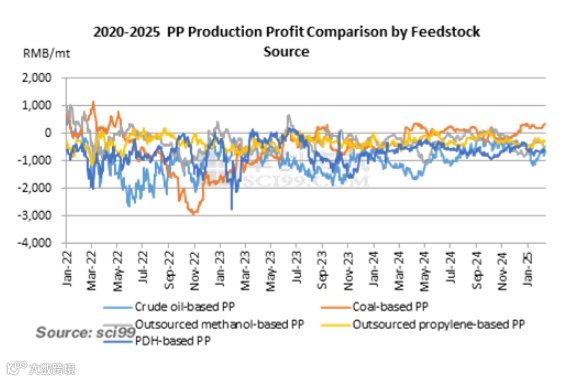
PP production costs rose at first but then fell from 2020 to 2024, and most gross profits from PP production turned from positive value to negative value. Except for outsourced propylene-based PP, other feedstock-based PP production profits dropped more notably. Before 2021, feedstock prices were relatively low, leading to low production costs and favorable profits. Since H2 2021, PP production costs ramped up because economic improvement and surged industrial demand pushed up prices of major feedstock such as crude oil and coal. Therefore, most PP producers experienced negative profits, especially coal-based and outsourced methanol-based PP producers, and profits hit the past five-year low at the end of October 2021. After 2021, negative profits became common. In 2024, PP production profits mostly remained negative, even though coal-based and outsourced methanol-based PP production profits revived. After propane prices ramped up, PDH-based PP production costs remained high, leading to more serious profit losses. China’s PP capacity grew by 20,850kt/a between 2019 and 2024, with an average growth rate of 11.58%. With continuous capacity release, PP supply climbed notably, and its growth rate was higher than that of demand, pressuring the PP price. Higher feedstock costs and lower PP prices led to profit losses for a long time.
Producers adjusted operating rates flexibly amid high feedstock costs.
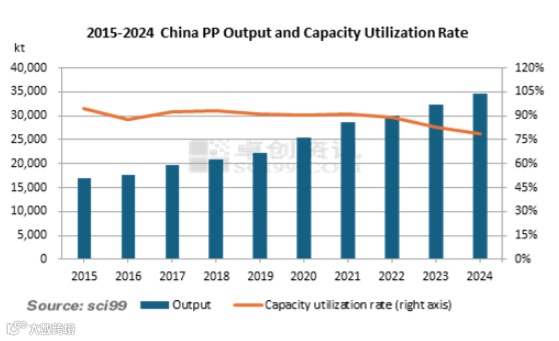
Facing high costs, PP producers adjusted operating rates agilely so as to alleviate the profit loss. Over the past decade, China’s domestic PP output has shown a steady growth trend, but the growth rate began to slip in the past five years. The PP capacity utilization rate was 79.03% in 2024, down 12.3 percentage points from 2020, mainly because of profit losses. Between 2020 and 2021, producers maintained high operating rates due to relatively high profits, and the output growth rate was faster. However, enterprise profits turned into losses from 2022, and the growth rate of downstream demand did not keep up with the supply growth rate, leading to a decline in the overall operating rate at producers, and output growth was suppressed. Until 2023, although the pressure from the demand side still existed, corporate profits began to recover, resulting in a slight increase in the growth rate of output compared to 2022. In 2024, pressure from both the cost side and the demand side persisted, limiting the growth rate of output. In the future, with the continuous start-up of new PP units, the market may face unabated supply pressure. Given that the profit situation of enterprises has not improved, it is expected that production suspension and operating rate adjustment will become a regular operation for enterprises.
PP producers adjusted the supply structure flexibly as well.
In 2024, operating rate cut, accidental unit shutdown and unexpected maintenance became normalized because profit losses prevailed most of the time. Under this background, the growth in PP output slowed down. Meanwhile, producers showed a higher passion for research and development of high-value-added products, in pursuit of higher profit margins. Producers paid more attention to cost control and product structure optimization, striving to maintain their market share amidst intense competition.
In 2024, PP producers continued to face significant profit pressure, which was mainly related to the substantial fluctuations in prices of feedstock such as crude oil and the price reduction of PP in a fully competitive market. The changes in the gross profit of producers also affected their decision-making behavior, involving the scheduling of production units. In 2024, considering limited profits, PP producers arranged many temporary shutdowns and unplanned unit turnarounds, reflecting the severe challenges that producers face in the current market environment.
Generally, with the increasingly fierce competition, the involution has intensified, and PP enterprises are still unable to get rid of the loss-making situation in the short term. However, enterprises are also actively taking self-rescue measures, including the adjustment of production rates in stages and the continuous optimization of product structure. Meanwhile, during the production adjustment, enterprises are also actively making changes in sales channels. Currently, there are various sales models for PP, such as the combination of unified sales and distribution sales, auctions and tenders. At the same time, enterprises also attach importance to maintaining relationships with downstream customers to further increase market share, thereby further enhancing the competitive advantages of products and further easing profit losses. Overall, PP enterprises are actively responding to fierce industry competition. In the future, the PP industry will usher in a new pattern under continuous development.

All information provided by SCI is for reference only, which shall not be reproduced without permission.
Please click "Read more" for the full article.