

H1 EPDM Prices Fell After Rising, H2 Downtrend Expected
Introduction: In the first half of 2025, the EPDM market prices exhibited a rise-then-fall trend. In the second half of the year, with increasing supply releases, mounting sales pressure across the supply chain, and the anticipated commissioning of new units, EPDM prices are expected to fluctuate downwards.
In H1 of 2025, the EPDM market experienced alternating phases of tight and easing supply. In Q1, unplanned maintenance shutdowns at the SABIC-ExxonMobil joint venture plant in Saudi Arabia, combined with scheduled maintenance at the Rabigh plant from April to June, provided strong support for domestic spot prices. Meanwhile, domestic producers also announced price hikes during the same period, driving a short-term market price rally.
However, with the early restart of Saudi Arabia’s plant and the gradual increase in imported supply, market tightness began to ease, particularly as shipments from Saudi Arabia surged, shifting the supply-demand balance from tightness to equilibrium, and even oversupply. This shift led to a price pullback starting in late March, with prices of some high-priced EPDM grades seeing declines, reflecting weakening supply-side support.
From late March onward, EPDM market prices entered a downward trend. By April, with supply further loosening and downstream demand softening, prices continued to decline. Saudi-origin cargoes saw continuous price drops, widening the price gap between domestic and imported resources. Downstream buyers adopted a cautious procurement approach with stronger price bargaining, further dragging down the market price.
By June, demand weakened further as the wheat harvest season approached in North China, which reduced downstream operating rates. These bearish factors intensified the downward pressure on prices.
Taking the market average price of EPDM as an example, from January to June 2025 (as of June 20), the market average price was RMB 23,252.96/mt, up 2.15% YoY. On June 20, the market average price of EPDM closed at RMB 22,762.5/mt, down 2.2% from the beginning of the year. In terms of long-cycle product prices, the current EPDM price is lower than the average price, and it is expected that the future price level will continue to decline.
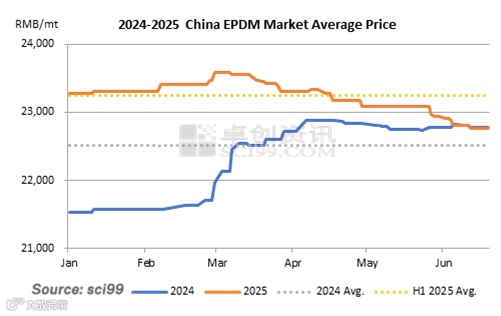
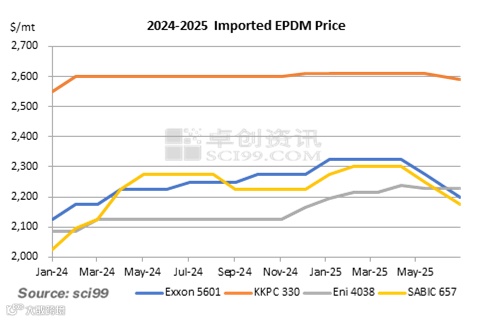
The EPDM market exhibited a “rise-then-fall” price trajectory in H1 2025, with fundamental dynamics exerting significant influence.
Supply tension gradually eased, while demand showed a weakening trend
EPDM is currently in a capacity release cycle. In H1 2025, the operating rates of EPDM units at domestic producers remained at relatively high levels. Domestic EPDM output is expected to increase by 9.67% YoY in H1. Maintenance shutdowns of domestic EPDM units were limited in H1: only Arlanxeo’s 160kt/a unit underwent short-term maintenance, and Shaanxi Yanchang Petroleum Yan’an Energy and Chemical’s 25kt/a unit had irregular shutdowns, while other units maintained stable high-load production, leading to a significant YoY increase in H1 output. The current increase in domestic EPDM output has improved the domestic self-sufficiency rate to some extent, thereby boosting market share. The price increase in H1 was also supported by producers’ low inventory, which reduced sales pressure and provided strong upward momentum. Even as market conditions softened, the persistently low factory inventory levels prevented sharp price declines, instead creating a gradual downward adjustment with firm underlying support.
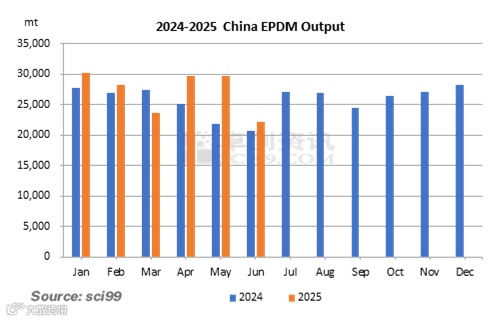
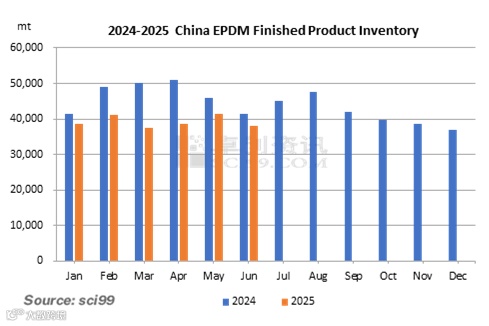
China’s EPDM Import Volume Increased in Jan-May 2025
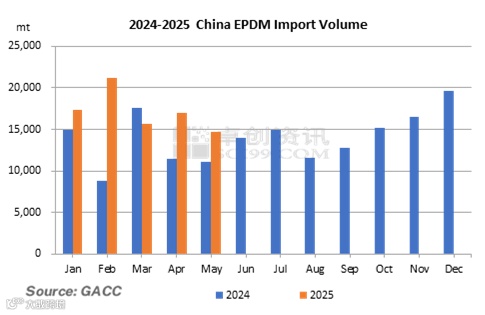
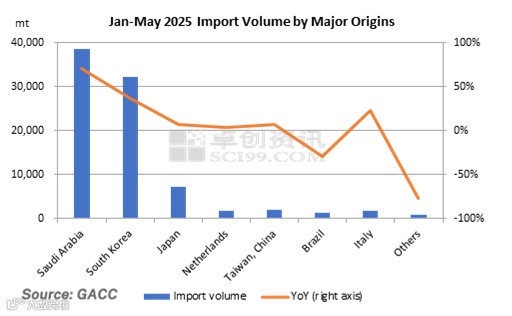
According to data released by GACC, China’s total import volume of EPDM from January to May 2025 was approximately 85,823.32 tons, a YoY increase of 35.54%. This growth stemmed from multiple factors: Saudi Arabia’s concentrated shipments to China were attracted by relatively higher USD-denominated prices amid weak overseas demand elsewhere, coupled with increased exports from South Korea following the startup of Kumho’s new 70kt/a unit. Additionally, Mitsui Chemicals also redirected a moderate volume of resources to the Chinese market.
Top Import Origins:
Saudi Arabia led with 38,506.99mt (up 70.62% YoY), followed by South Korea at 32,182.29mt (up 36.94%), and Japan at 7,209.43mt (up 7.27%).
Saudi Arabian Supply Surge Analysis:
The significant increase from Saudi Arabia contrasts with 2024’s reduced exports during extended maintenance at the Rabigh plant. In H1 2025, Saudi plants operated stably except for brief outages at the SABIC-ExxonMobil joint venture. This production consistency, combined with promotional shipments from late 2024 arriving in Q1 2025, created substantial import volume growth.
The import surge significantly pressured domestic supply conditions, exerting downward pressure on EPDM market prices.
Domestic Demand Was Relatively Weak in H1 2025
Automotive sector data - EPDM’s primary end-use market - reveals mixed demand signals. China’s total vehicle output from January to May 2025 was 12.826 million units, a YoY increase of 12.7%. During January-May, the total output of new energy vehicles (NEVs) was 5.699 million units, up 45.2% YoY, with NEV sales accounting for 44% of total new vehicle sales. For EPDM, the increase in total vehicle output and the rapid growth of NEVs continued to provide some positive demand-side drivers. However, for direct downstream sectors of EPDM, falling end product prices pressured rubber products to reduce prices, weakening downstream enterprises’ order-taking capabilities and squeezing profits. As a result, their ability to accept price increases for rubber feedstock was limited, causing high-price transactions in the EPDM market to face pressure.
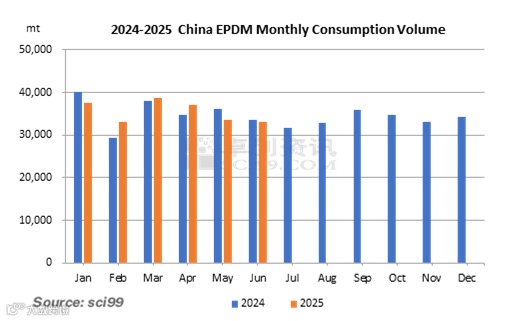
Other downstream sectors, such as hoses and sealing products, showed weaker demand, particularly among small-scale enterprises operating at reduced rates due to order shortages and profit pressures. This broad-based demand softness continued to exert downward pressure on EPDM market prices.
China’s EPDM Export Volume Decreased in Jan-May 2025
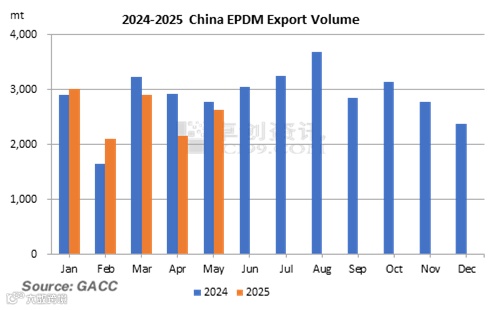
China’s EPDM export volume declined to approximately 12,818.29mt during January-May 2025, down 4.68% YoY, according to data from GACC. The reduction stemmed from two key factors. First, overseas demand overall decreased, particularly in Southeast Asia, South Korea, and India, where downstream producers operated at limited capacity, leading to sustained decreases in both demand and export orders for China’s EPDM. Second, comparatively higher domestic prices created stronger profit incentives for producers to prioritize local market sales over exports, thereby stabilizing domestic supply. The export contraction effectively transferred partial sales pressure to the domestic market, significantly diminishing the export support for market demand.
During the first half of 2025, market performance remained predominantly weak across most sectors except the automotive industry. Notably, small-scale downstream enterprises operated at reduced capacity levels, resulting in insufficient feedstock procurement that contributed to overall demand falling short of expectations. The YoY decline in exports further compounded these demand-side challenges, creating additional downward pressure on the market.
H2 2025 EPDM Market Outlook: The EPDM market will primarily be shaped by supply-demand dynamics, with bearish pressures dominating.
Supply-Side Pressures:
Saudi Arabia: Ample supply persists with significant spot sales pressure. The restart of the Rabigh plant will further increase shipments, weighing on price floors.
South Korea: Kumho’s new 70kt/a unit is expected to stabilize production, boosting exports to China.
Domestic capacity expansion: PetroChina Jilin Petrochemical’s new 40kt/a unit is scheduled to start up in July, which will add supply pressure.
Maintenance impact: Planned maintenance at Shanghai Sinopec Mitsui Elastomers and Arlanxeo may not tighten supply significantly, as regular sales volumes should remain stable.
Demand-Side Challenges:
Domestic demand: The seasonal “Golden September-Silver October” peak season for demand may bring slight demand improvement in H2. However, compressed end-product prices will limit downstream acceptance of feedstock prices under thin profits.
Export: Export prospects remain dim with weak global demand, likely forcing more cargoes to target China’s domestic market. Therefore, China’s EPDM exports may decrease.
Overall, EPDM market prices are predicted to trend downwards amid expanding supply and constrained demand in H2 2025.
Risk Reminder: Worse-than-expected global economic slowdown or recession; escalating geopolitical disruptions
All information provided by SCI is for reference only, which shall not be reproduced without permission.
Please click "Read more" for the full article.