

EPDM: Limited Direct Tariff Impact, End Effects Emerge
Introduction: On April 3 (Beijing time), U.S. President Donald Trump announced the imposition of “reciprocal tariffs” on global trade partners, prompting China to respond with corresponding countermeasures, further escalating trade tensions. Currently, the mutual tariff hikes between China and the U.S. have a minimal impact on China’s EPDM imports and exports, with a greater effect on end-product export demand than on the rubber itself.
Background: On April 2, the U.S. issued an executive order imposing “reciprocal tariffs” on major trading partners, including an additional 34% tariff on Chinese-made goods. By April 8, the U.S. further raised tariffs on Chinese imports by 50-84%, pushing the cumulative rate on some products to 104%. In response, China announced on April 9 that it would increase tariffs on all U.S.-origin imports from 34% to 84%, effective April 10 at 12:01 PM. The U.S. retaliated immediately on April 10 by hiking tariffs on Chinese goods to 125%, effective immediately.
Additionally, a 25% auto tariff will take effect on April 3, followed by auto parts tariffs on May 3. Certain products-including gold bars, copper, pharmaceuticals, semiconductors, and lumber-remain exempt from the reciprocal tariffs.
Tariff Adjustments Show Negligible Direct Impact on China’s EPDM Imports and Exports
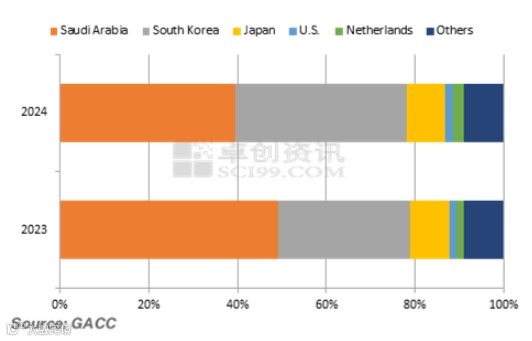
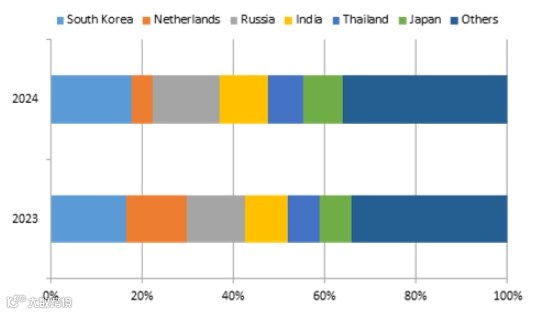
The latest tariff adjustments have minimal direct impact on China’s EPDM imports and exports. From the import perspective, China’s main EPDM origins are Saudi Arabia, South Korea, and Japan, which accounted for about 87% of total imports in 2024. Imports from the U.S. represented less than 2% of China’s total EPDM imports. Growing domestic capacity under anti-dumping policies has improved supply reliability, with some downstream users already shifting to local alternatives amid sluggish end-demand growth. From the export perspective, China exported 34.5kt of EPDM in 2024, with less than 0.5% destined for the U.S. market. Therefore, the actual impact of this tariff adjustment on China’s import and export of EPDM is very limited.
2023-2024 China EPDM Import Structure by Trading Partner
2023-2024 China EPDM Export Structure by Trading Partner
Upstream Impact: Broad Tariff Coverage, Certain Effect on EPDM Feedstock
The main feedstock for EPDM is ethylene, propylene, and ENB, with ethylene and propylene accounting for the majority. In recent years, domestic EPDM price fluctuations have been minimally affected by feedstock costs, leading to limited short-term focus on upstream dynamics. In 2024, China’s propylene output and consumption both exceeded 50,000kt, with imports at 2,020kt and exports below 80kt. China’s propylene import dependency stood at just 3.47%, while exports were negligible. Both imports from and exports to the U.S. accounted for less than 1% of China’s propylene trade. Therefore, the reciprocal tariffs have an almost negligible impact on China’s propylene imports and exports.
Since May 2024, the arbitrage window between China and the U.S. has remained closed. In 2024, China imported a total of 78.7kt of ethylene from the U.S., accounting for only 3.54% of domestic ethylene imports-a significant decline from the 22.29% share in 2023. As more domestic ethylene producers expand their sales abroad, China’s reliance on U.S. ethylene monomer has decreased. Given the long shipping cycle and high freight costs between China and the U.S., the only opportunity for U.S. cargoes to enter the Chinese market lies in low pricing. Furthermore, in 2024, the main export destinations for U.S. ethylene were concentrated in Southeast Asia and Europe, such as Indonesia, Belgium, and Portugal, with limited relevance to China’s ethylene trade market. Therefore, after the imposition of additional tariffs on ethylene, the likelihood of U.S. ethylene entering the Chinese market will further decrease, though the overall impact remains minimal.
Downstream Impact: Increased Export Costs to the U.S. Affect Some End Demand
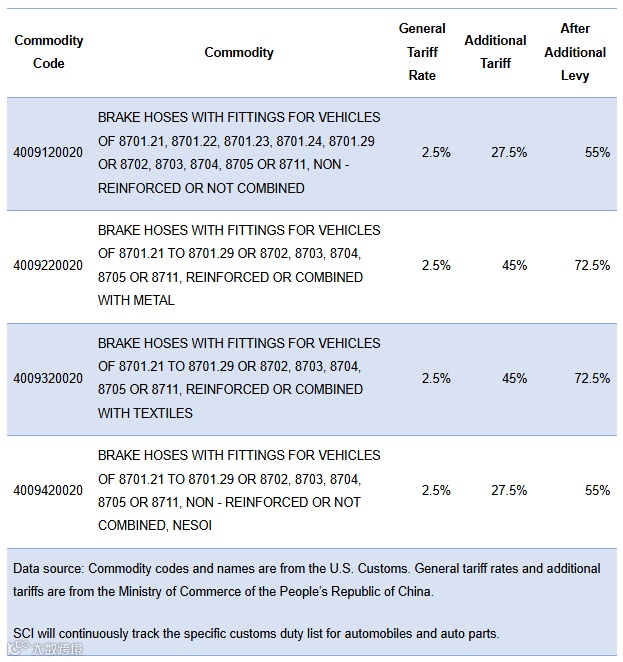
EPDM boasts excellent sealing properties and physical-mechanical performance, finding wide applications across various sectors. The automotive industry serves as one of the primary demand drivers for EPDM, where it is mainly used to manufacture various components such as hoses, belts, and sealing products. On April 2, the Trump administration confirmed that its 25% tariff on global automobiles and light trucks would take effect at 00:01 AM Eastern Time on April 3, while the 25% tariff on auto parts would be implemented at 00:01 AM Eastern Time on May 3. The tariffs cover nearly 150 categories of auto parts, including engines, transmissions, lithium-ion batteries, and other major components, as well as lower-priced parts such as tires, shock absorbers, spark plug wires, and brake hoses. Starting May 3, these imported parts will be subject to the new tariffs. Taking brake hoses as an example, in 2024, U.S. imports of brake hoses from China accounted for about 10% of its total imports. After the tariff hike, the duty rate on Chinese exports to the U.S. will surge to 55%-72.5%, significantly increasing export costs. Some companies may face risks such as order losses and profit declines, which could ultimately impact the demand for EPDM.
Overview of Tariffs on China’s Brake Hose Exports to the U.S.
The recent U.S. tariff hikes on automobiles have minimal impact on China’s vehicle exports. In 2024, China exported only 116,000 vehicles to the U.S., representing just 1.81% of China’s total automobile exports. Chinese auto exports to the U.S. account for a negligible share, particularly since domestic Chinese brands have virtually no presence in the American market. As such, China’s indigenous automotive industry remains unaffected by these U.S. tariff measures. China’s main automobile export destinations include a certain European country, Mexico, Brazil, and the United Arab Emirates, among others.
In summary, the recent tariff adjustments have exerted a greater impact on end-use applications than on EPDM itself. Nevertheless, China maintains its robust position in global supply chains, supported by the world’s most comprehensive industrial ecosystem, which continues to provide substantial opportunities for export markets. While the tariff hikes may create transitional challenges for China’s automotive components sector, they will ultimately accelerate the industry’s transition toward higher value-added segments, enabling it to overcome tariff constraints through technological advantages and globalized operations. During the U.S.’s 90-day tariff suspension period, alternative markets outside China have experienced a temporary adjustment phase for automotive and rubber product sales. This interim period has created additional breathing space and strategic timing for downstream EPDM exports to optimize their market positioning.
All information provided by SCI is for reference only, which shall not be reproduced without permission.
Please click "Read more" for the full article.