

Pulp Price Hikes Restricted by Insufficient Demand Recovery
Introduction: Since early August, China’s pulp market has shown slight divergence, with HWP prices remaining relatively firm. Some domestic and international pulp mills have raised prices, providing slight support to domestic spot market sentiment. While the downstream paper industry may gradually enter its traditional peak season in September, paper mills’ profitability remains weak, and their cautious stance toward high-priced pulp persists. It is expected that the upside for HWP prices in September may be relatively limited.
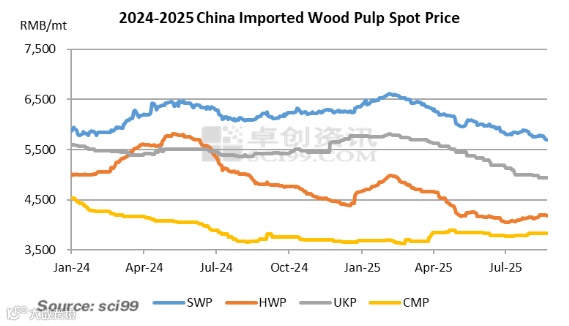
Divergent pulp price trends in August
As of August 22, the average market price for imported SWP was RMB 5,695.18/mt, down 2.87% MoM. The average market price for imported HWP was RMB 4,177.89/mt, up 1.70% MoM. Downstream paper mills faced challenges in maintaining firm prices amid weak profitability, and some optimized raw material furnish, resulting in lower demand for SWP. For HWP, Brazilian pulp mills raised offers consecutively by $40/mt in total. Additionally, a certain paper mill made necessary procurement to prepare for the restart, leading to better market activity and pulp prices.
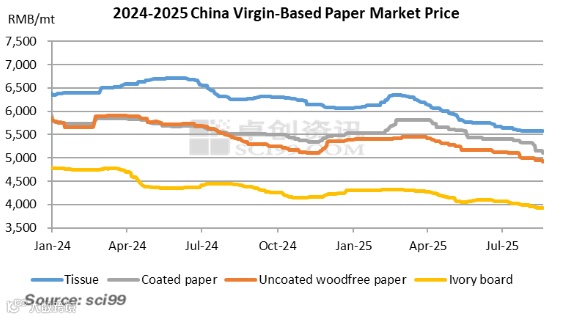
Weak paper prices in August, mills maintain rational pulp procurement
As of August 22, the average market price for wood pulp tissue was RMB 5,583.33/mt, down RMB 16.67/mt or 0.30% MoM. High-white uncoated woodfree paper averaged RMB 4,925/mt, down RMB 175/mt or 3.43% MoM. Coated paper averaged RMB 5,110/mt, down RMB 270/mt or 5.02% MoM. Ivory board averaged RMB 3,930/mt, down RMB 85/mt or 2.12% MoM. The data shows that prices of virgin-based paper products continued to decline in August, with coated paper experiencing the largest drop. Paper mills faced persistent sales pressure, and their enthusiasm for pulp procurement remained subdued, with purchases mainly driven by essential demand.
High import offer coupled by limited domestic demand recovery, the pulp price saw modest upward momentum
Supply-side support for the pulp market remains weak. Based on July shipment data, Chile’s SWP shipments to China rose 24.83% MoM, while HWP exports increased 52.37% MoM. Brazil's HWP exports to China rose 4.88% MoM. Considering a roughly two-month shipping period, China’s pulp import volume in September may slightly increase compared to August, with a limited boost to the price performance. For domestic pulp, some idled capacity in Shandong may resume production in September, while newly added capacity in South China continues to ramp up, further increasing domestic wood pulp supply and restricting HWP price recovery.
Downstream demand recovery expectations provide slight support to pulp prices
Traditionally, September marks the start of the peak season for China’s paper industry. The tissue sector may see demand rebound due to back-to-school demand hike and restocking before the “Double 11” shopping fest, potentially leading to more active pulp procurement. For ivory board, Mid-Autumn Festival gift box orders may emerge in September, but new capacity in Fujian and Hubei could outpace demand growth, keeping ivory board prices under pressure and limiting support for pulp prices. For cultural and printing paper, new publishing tenders in September may not be concentrated, and terminal demand recovery may remain weak, making it difficult to effectively boost pulp prices.
In summary, pulp supply may increase in September, while demand recovery varies across paper grades, with procurement remaining rational and driven by essential restocking. Thus, the supply-demand condition may lend limited support to pulp prices. Although overseas pulp mills are actively pushing for higher prices, domestic demand recovery will take time. It is expected that downstream demand growth in September may be relatively limited, with some pulp grades potentially strengthening slightly but with narrow gains. The average market price of HWP is expected to rise by about 1.41% MoM in September.
All information provided by SCI is for reference only, which shall not be reproduced without permission.
Please click "Read more" for the full article.