
H1 2025 South Korea NBR Export Volume Edges Up
Introduction: South Korea is one of the major exporters of NBR in the world, and its NBR export volume inched up in H1 2025. The volume exported to China showed a relatively noticeable YoY increase. Conversely, exports to the U.S. slumped.
In H1 2025, the export volume of NBR from South Korea increased slightly.
According to GACC, South Korea exported 65.9kt of NBR from January to June 2025, up 1.85% YoY. The export volume saw limited fluctuations overall.
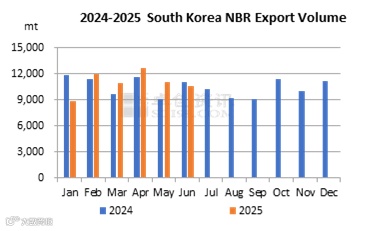
Source: Korea Customs Service
Looking at export destinations, from January to June in 2025, the overall flow of goods remained stable, but the volume exported to various destinations changed. Specifically, China remained the top destination, with exports totaling 14.0kt, up 18.89% YoY. India ranked second, receiving 11.0kt, up 2.49% YoY. The U.S. held third place but saw a significant decline in trade volume, with exports falling to 6.8kt, down 18.52% YoY. The U.S.'s reciprocal tariffs impacted South Korea's NBR exports.

Source: Korea Customs Service
With the implementation of the U.S.-South Korea trade deal, export pressure may ease in H2.
On July 30 local time, US President Trump posted a statement saying that the U.S. has reached a “comprehensive and complete” trade agreement with South Korea. Under the agreement, South Korea will allocate $350 billion to the U.S. for investment projects owned and controlled by American entities. Additionally, South Korea will purchase $100 billion in LNG or other energy products and commit to a substantial additional investment for domestic purposes. These figures are expected to be officially announced during President Lee's state visit to Washington in two weeks. Trump stated that the U.S. and South Korea have reached an agreement: the U.S. will impose a 15% tariff on South Korean imports, while the U.S. itself will remain exempt from South Korean tariffs. South Korea will fully liberalize trade access for U.S. products, including automobiles, trucks, and agricultural goods.
The finalized tariff rate of 15% on U.S. imports from South Korea is significantly lower than the previous 25%, providing South Korean enterprises with a relatively stable export environment. However, the specifics of how South Korea will implement its pledge to invest substantial funds in the U.S. remain unclear, and potential risks in the execution process still merit close attention. For NBR, in H2 2025, the confirmed and relatively lower tariff rate may boost South Korea's exports of NBR to the U.S. Yet, South Korea's NBR export markets are relatively diversified. At present, the U.S. has set “reciprocal” tariff rates for multiple countries and regions, ranging from 10% to 41%, which has affected demand in some export destinations for South Korean NBR. Close attention should be paid to subsequent international macroeconomic developments.
All information provided by SCI is for reference only, which shall not be reproduced without permission.
Please click "Read more" for the full article.