

Q4 HWP Price to Maintain High Correlation with Downstream Paper
Intro: Since the start of the year, the pulp and paper prices have been mostly bearish, with slightly higher price correlation. Therein, the downtrend in HWP price was more notable. In addition to the low substantiality in paper production, its price correlation with downstream paper was relatively high. In Q4, both pulp and paper prices may fluctuate narrowly, and the HWP price may maintain high correlations with downstream paper prices.
Price correlation between HWP and downstream paper is enhanced
During the first 3 quarters of the year, the HWP price maintained relatively high correlations with downstream paper prices. As of late September, the market average prices of coated paper, uncoated woodfree paper, ivory board and tissue had dropped by 11.39%, 11.14%, 7.70% and 7.97% respectively from those at the start of the year, and the trends were in line with HWP market price during most of the time. The price correlations between HWP and coated paper, uncoated woodfree paper, ivory board and tissue were 0.62, 0.78, 0.90 and 0.90, respectively.
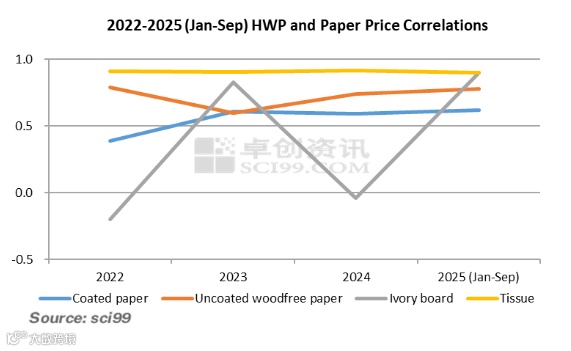
Despite slightly lower price correlation between HWP and tissue YoY, it remains at a 0.90 level. The price correlation between HWP and ivory board turned from negative to positive. As seen from pulp prices, aside from a minor bump-up in the HWP price, the market remained mostly on a downward slope. The ivory board market lacked upward momentum, and the price mostly went bearish. The ivory board market demand was insufficient, coupled with the release of massive new capacity, the market trend was dragged down by low-priced competition. The price correlations between HWP and cultural printing paper were relatively stable.
Pulp and paper price trends to remain highly correlated
Pulp price may see narrow downward adjustments in Q4. Despite consecutive hikes in HWP import offers from August to October, the price hikes were only implemented partially. However, with the restart of a large-sized integrated player in China, the market supply is expected to remain loose, which may affect the sales of high-priced pulp. On the other hand, the release of additional and restarted paper capacity will boost the theoretical pulp consumption and buffer the pulp price downtrend.
Downstream paper price trends may vary.
For ivory board, the 1.2 million tons/a new capacity in central China may reach full production in October, further bolstering market supply. Ivory board mills are showing more resolute attitudes in upholding prices, the ivory board price may rise first before falling in Q4, but the velocity of price changes may be limited. For cultural printing paper, although some publishers will organize tenders in October, the actual volume pick-up may occur in November and December, which will provide some support to paper prices. However, the supply hikes from newly added capacity may cap effective price rises. As for tissue, some downstream converters may stock up in October, but the market demand tends to soften in November and December, so the tissue price may suffer downward pressure. In general, the paper prices are expected to rise first and then drop, providing brief support to pulp prices.
In conclusion, the HWP spot market may first rise and then drop in Q4, while downstream paper markets tend to display similar patterns. With limited changes in pulp and paper prices, the price correlations between HWP and coated paper, uncoated woodfree paper, ivory board and tissue are expected to remain high at around 0.65, 0.79, 0.91and 0.92, respectively.
All information provided by SCI is for reference only, which shall not be reproduced without permission.
Please click "Read more" for the full article.