

Outlook for PE Industry During 15th Five-Year Plan Period
Introduction: Over the past five years, continuous capacity expansion in the PE industry intensified oversupply pressure, and fierce internal competition led to a sustained decline in producers’ gross profits. The forthcoming 15th Five-Year Plan period emphasizes the optimization and upgrading of traditional industries. Supported by “anti-involution” policies, backward PE capacity is likely to undergo technological upgrades or be phased out, potentially alleviating some supply-side pressure. Meanwhile, as industrial transformation progresses, emerging sectors and high-end markets are poised to offer new growth opportunities, steering the PE industry toward diversified, high-quality development.
Rapid Capacity Expansion Amplifies Structural Oversupply
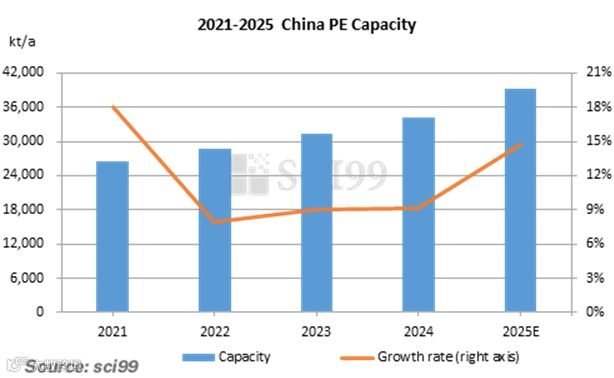
From 2021 to 2025, China’s total PE capacity showed stepwise growth, reaching 39,128kt/a in 2025. This represents a net increase of 16,570kt/a over the five years, achieving a compound annual growth rate (CAGR) of 11.64%. The capacity growth trajectory featured a V-shaped recovery, with the growth rate rising by 5.63 percentage points YoY in 2025. The industry remains firmly within a capacity expansion cycle.
The development of China’s PE industry is being profoundly shaped by national industrial policies, which are steering the industry from past scale expansion toward a new phase of quality-driven high-quality development. The dual carbon goals have accelerated industrial upgrading, with new units increasingly characterized by larger scale, integrated operations, and lower carbon footprints. The expansion of individual unit capacity has driven the overall capacity base upward. Meanwhile, strategies to substitute imports continue to drive China’s domestic investment, enhancing the self-sufficiency rate and securing the industrial chain, thereby providing a long-term rationale for capacity expansion.
In 2025, new units at producers such as Inner Mongolia Baofeng Coal-Based New Materials, ExxonMobil (Huizhou) Chemical, and PetroChina Guangxi Petrochemical were put into operation, driving capacity expansion across all categories. The capacity of LLDPE, LDPE, and HDPE increased to 15,648kt/a, 4,635kt/a, and 18,845kt/a, respectively. HDPE capacity remained the largest, accounting for 48.16% of total PE capacity. LLDPE recorded the most substantial capacity increase, facing particularly pronounced supply pressure. Standard-grade products (e.g., 7042) showed significant supply growth, exerting downward pressure on prices. LDPE faced pressure from supply and inventory, while HDPE exhibited structural supply variations across segments due to seasonal demand fluctuations, demonstrating relatively stronger resilience against price declines. Amid intensive capacity expansion in 2025, the market faced significant supply pressure, suggesting a new normal of prices facing downward pressure.
Output Rises Amid Falling Operating Rates
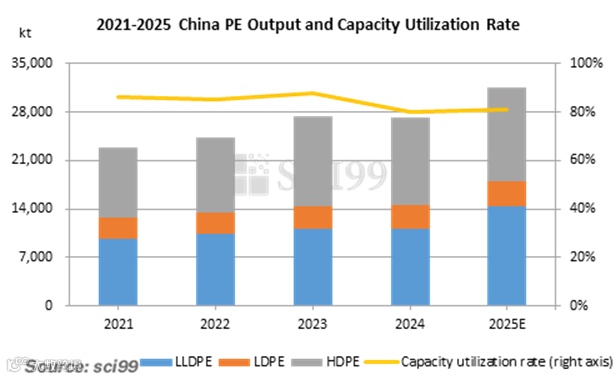
Against the backdrop of continuous capacity expansion in China’s PE industry, China’s PE output demonstrated robust growth from 2021 to 2025, achieving a CAGR of 9.18%. The year 2025 recorded the highest growth rate and absolute increment in recent years, with total PE output reaching 31,530.1kt. As a peak year for new capacity commissioning, 2025 saw 5,030kt/a of capacity addition. The intensive startup of these new units was the primary driver of the output ramp-up. On the domestic demand side, resilient consumption from sectors including packaging, express delivery, and new energy (e.g., photovoltaic film materials) provided market space to absorb the increased output. Meanwhile, improvements in domestic product quality and portfolio diversification accelerated the substitution of certain mid-to-high-end imported grades. As a result, domestic production further encroached on the market share of imported products, continuously expanding the market presence of locally produced materials.
The industry’s capacity utilization rate shifted from operating at high levels to facing downward pressure. From 2021 to 2023, the average capacity utilization rate remained above 85%, reflecting relatively healthy supply-demand dynamics. However, in 2024 and 2025, the rate dropped sharply to 80%–81%, indicating persistent overcapacity pressure in China's PE industry, particularly in the general-purpose and low-end product segments. Although the capacity utilization rate in 2025 showed a 1 percentage point increase compared to 2024, which was achieved despite a substantially expanded capacity base, this improvement was partly attributable to recovering downstream demand and the phase-out of some inefficient older capacity, allowing the market to gradually absorb the new supply. Nevertheless, with the utilization rate remaining low for two consecutive years, the industry continued to operate under a structurally ample supply environment.
On the demand side, the sustained boom in e-commerce provides resilient support for traditional PE consumption, while emerging sectors, including new energy, photovoltaic industries, and agricultural modernization, are creating new growth frontiers for high-end PE products.
Cost Structure Evolves as Upstream Competition Intensifies
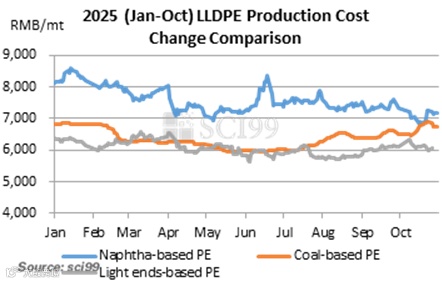
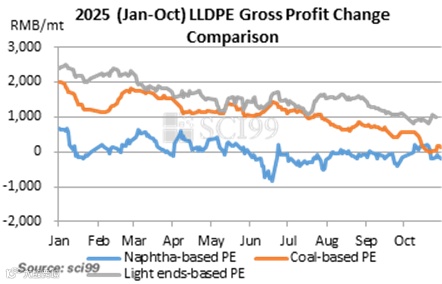
Light ends-based PE: Ethane has emerged as a competitive feedstock in recent years, offering cost and profit advantages. From January to October 2025, the average gross profit from producing LLDPE based on light ends stood at RMB 1,582/mt, substantially exceeding the gross profits from producing LLDPE based on coal and oil.
In 2025, the gross profits from producing LLDPE based on light ends were impacted by Sino-US trade friction, which elevated import costs for ethane. Coupled with declining domestic LLDPE prices, light ends-based PE producers saw their profits contract overall. The gross profits peaked at RMB 2,497/mt in January 2025 but fell to a yearly low of RMB 803/mt by October, as higher ethane costs coincided with the downturn in LLDPE prices.
Naphtha-based PE: From January to October 2025, naphtha-based LLDPE gross profits averaged RMB 12/mt, up RMB 125/mt YoY, allowing producers to return to profitability. The 2021-2025 period witnessed a full cycle for naphtha-based PE gross profit, shifting from profit to loss and back again. The average gross profit over these five years was RMB 85/mt. The highest point was recorded in 2021 at RMB 2,525/mt, while the lowest occurred in May 2022, at RMB -2,308/mt.
Coal-based PE: From January to October 2025, coal-based LLDPE gross profits averaged RMB 1,093/mt, an increase of 216/mt or 24.93% YoY. After transitioning from profit to loss between 2021 and 2022, coal-based PE profits gradually recovered to positive territory from 2023 onward, with profitability expanding further in 2025. The five-year average gross profit was RMB 456/mt.
15th Five-Year Plan to Stimulate Domestic Demand, Steering PE Industry Toward Diversified, High-Quality Development
Against the backdrop of escalating Sino-U.S. trade tensions in 2025, China introduced policies focused on expanding domestic demand, fostering emerging industries, and optimizing the export structure. Given continued domestic PE capacity growth, a dual strategy emphasizing both domestic demand and exports will be crucial to managing domestic and external challenges. In the face of trade pressure, domestic consumption is set to become the primary engine of economic development. The 15th Five-Year Plan outlines specific requirements and recommendations for optimizing and upgrading traditional industries. A series of measures aimed at stimulating consumption and boosting domestic demand is being rolled out to fuel economic growth. Consequently, the PE industry’s domestic and international trade patterns will undergo continuous adjustment. Technological innovation is being encouraged, and industries such as high-end manufacturing, advanced packaging, and biopharmaceuticals are poised for further development. Meanwhile, the impact of “anti-involution” policies is expected to persist.
Over the next five years, China’s vast population base will continue to support steady growth in rigid demand from traditional PE-consuming sectors. Policy focus will increasingly shift toward cultivating long-term consumption, emphasizing more structural and targeted support. Demand recovery in segments like pipes and blow molding may remain gradual. Greater emphasis will be placed on R&D in specialized grades and high-end plastics to meet market needs created by emerging industries. Rising consumption levels and ongoing industrial transformation are expected to unlock new growth opportunities in emerging sectors and high-end markets, driven by the rapid development of industries such as new energy, medical aesthetics, and prepared foods. However, technological breakthroughs in these nascent fields are still required. Deepening R&D investment in high-value-added products will be crucial for future development.
Overall, the continued expansion of domestic demand is expected to provide a stable foundation for the PE market. Accelerating the development of a unified national market will also help reduce logistics costs and improve distribution efficiency. Nevertheless, these dynamics may intensify regional competition, driving further differentiation and upgrading of the industrial chain structure. In summary, while traditional packaging, electronics, and agricultural film applications maintain demand resilience, the continuous emergence of new industries makes the development of specialized materials and high-end products a critical priority for producers undergoing transformation.
PE Producers Face Mounting Competition, Aging Capacity Set for Retrofitting or Phase-Out
In recent years, intensified internal competition has been impeding the healthy development of the petrochemical industry. In June 2025, the government initiated its first comprehensive assessment of aging units, focusing on refining, fertilizer, and other units that have been operational for over 20 years. This initiative aims to facilitate the exit and replacement of inefficient capacity, thereby optimizing the industrial structure.
By 2030, the total capacity of PE units in China that have been in operation for 20 years or more may reach approximately 10,568kt/a. Given that most oil-based units were commissioned earlier than their coal-based and light ends-based counterparts, nearly all of these aging units rely on naphtha as their primary feedstock. Geographically, South China hosts the largest share of aging capacity at 2,540kt/a, followed by East China (2,320kt/a), North China (1,960kt/a), Northwest China (1,830kt/a), and Northeast China (1,718kt/a), with relatively minor disparities between these regions. By product type, aging LDPE capacity accounts for 1,995kt/a, approaching half of the existing capacity. Aging HDPE and LLDPE capacity stand at 5,195kt/a and 3,378kt/a, respectively. However, given their substantially larger total capacity bases, the relative impact is less pronounced for these two product categories. PE production units at Sinopec Yanshan Petrochemical, Sinopec Zhongyuan Petrochemical, Shenyang Chemical and Heilongjiang Haiguo Longyou Petrochemical have been completely idled and are likely candidates for future retrofitting or dismantling. Close monitoring of developments regarding aging units is advised.
Looking ahead, if new capacity continues to come online much faster than outdated units are retired, supply-side pressure will persist. Intense competition would then limit any price support gained from phasing out older units. Conversely, if new projects are delayed or cancelled, allowing capacity retirements to effectively offset additions, the industry would achieve a more balanced transition. This approach would better facilitate supply-side reforms, help avoid severe overcapacity, and support a smoother shift between traditional and new growth drivers.
......
All information provided by SCI is for reference only, which shall not be reproduced without permission.
Please click "Read more" for the full article.