

Prospects for Orderly, High-Quality Growth in China's PX During the 15th Five-Year Plan
The concentrated launch of large-scale private refining and chemical projects drove a leap in industry capacity, accompanied by distinct development characteristics such as scaling, integration, and centralization. Looking ahead to the 15th Five-Year Plan period (2026–2030), China’s PX industry will witness simultaneous capacity expansion and structural optimization, gradually moving toward a supply-demand balance, and achieving high-quality development through tight supply-demand equilibrium and technological breakthroughs.
Integrated Development Model: Significant Increase in China’s PX Self-Sufficiency Rate
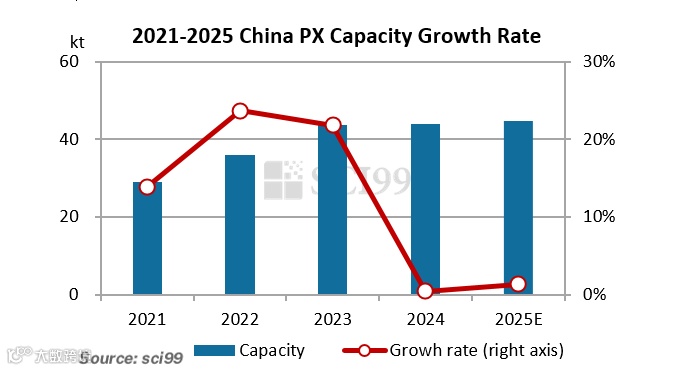
Over the past five years, China’s PX capacity has grown steadily, with an average annual compound growth rate of 11.81%. With the implementation of the national large-scale refining and chemical industry layout—such as the launch of leading projects like Hengli Petrochemical, Zhejiang Petroleum & Chemical, and Shenghong Petrochemical—China’s PX industry has formed a dual development model of “full-industry-chain layout by private enterprises” and “refined development by traditional refining enterprises.” Meanwhile, the industry’s self-sufficiency rate has rapidly increased, with import dependency dropping from 61% in 2018 to 20% in 2025.
Slower Capacity Expansion During the 15th Five-Year Plan Period: Transition to Orderly, High-Quality Competition
To avoid secondary overcapacity caused by homogeneous projects clustered in the refining sector, clear restrictions have been imposed on new projects such as atmospheric and vacuum distillation units with less than 10 million mt/a and continuous catalytic reforming units with less than 1 million mt/a. It is expected that over the next five years, China’s PX industry will bid farewell to rapid expansion and enter a new stage of “stable growth and structural adjustment.” The growth rate of new PX capacity in China will slow down, with new capacity mainly concentrated in benchmark projects aimed at “reducing oil output and increasing chemical production.” Moreover, industry concentration will further increase. Currently, most producers adopt an integrated upstream-downstream production model, so the incremental supply from domestic production will primarily come from enhancing existing output capabilities.
Entities with core competitive advantages mainly fall into three categories. The first category is new entrants such as Yulong Petrochemical, North Huajin Chemical, and Gulei Petrochemical, whose core development goal is “reducing oil output and increasing chemical production,” aligning with industry transformation trends. The second category is leading existing enterprises such as PetroChina and Sinopec, which continue to expand their capacity through expansion projects to consolidate market share. The third one is enterprises like Gulei Petrochemical that comprehensively cover aromatics and olefins businesses, enhancing risk resistance through full-industry-chain layouts. Enterprises facing elimination typically exhibit three characteristics: outdated equipment and facilities with long-term shutdowns, significant cost disadvantages in short-process units, and incomplete upward and downward integration. It is estimated that approximately 1 million mt of capacity will be phased out over the next five years, with short-process enterprises with capacity below 600kt/a being the first to be eliminated.
During the 15th Five-Year Plan period, against the backdrop of an optimized market supply structure and increased industrial concentration, China’s total PX supply will show a moderate and stable growth trend. The launch of new projects and stable production from existing enterprises will steadily increase the industry’s self-sufficiency rate, thereby systematically reducing reliance on external imports. However, driven by market gaps, the decline in import dependence will be gradual to ensure market stability and meet actual demand. From 2026 to 2028, it is estimated that China will still need to import 9–10 million mt of PX annually. Subsequently, as enterprises with outdated equipment and lacking regional advantages are gradually phased out, industrial concentration will further increase, and the import share will steadily decline again. By 2030, China is expected to achieve self-sufficiency.
Transition from Supply-Demand Imbalance to Balance Under Mismatched Development Patterns
In contrast to the supply side, new capacity in the downstream PTA sector will taper off by 2026. Industry optimization and upgrading will intensify competitive pressure. It is predicted that 6 sets of outdated PTA units, totaling 9.6 million mt/a, may be phased out between 2026 and 2030. These units mainly include long-idled facilities and old units replaced by new ones. Thus, over the next five years, both domestic PTA capacity and its consumption of PX are expected to grow at a slower pace. By 2030, PX demand is projected to exceed 56 million mt, but the growth rate will fall below 3%. In the polyester sector, however, with upgrades in the domestic industrial structure, increased applications in textiles, apparel, new materials, and emerging industries, and a decline in the proportion of home textiles under macroeconomic adjustments, the apparent demand growth rate of the polyester industry chain will exceed China’s GDP growth. Overall, terminal demand for PX remains positive.
During the 15th Five-Year Plan period, under the mismatched development model, China’s PX market will gradually transition from a supply-demand imbalance to balance. From 2026 to 2030, the PX industry will maintain a steady pace of capacity expansion, with an estimated five-year compound annual growth rate of 5.22% in output. Although this is 8.52 percentage points lower than the growth rate during the 14th Five-Year Plan period, the total volume will continue to increase, reaching 48.18 million mt by 2030. Driven by the upgrading and optimization of the PTA industry, downstream consumption is expected to reach 56.44 million mt by 2030. Over the next 2–3 years, PX imports will fluctuate moderately, stabilizing with a slight increase to ensure market stability and actual demand. Overall, China’s dependency on PX imports will continue to decrease. As outdated facilities and enterprises lacking regional advantages gradually exit, industrial concentration will further increase, enabling the PX industry to achieve a leap from “scale leadership” to “quality and efficiency leadership.”
All information provided by SCI is for reference only, which shall not be reproduced without permission.
Please click "Read more" for the full article.