



Methanol Downstream Industry Development Analysis
With the rapid growth of the emerging downstream industries represented by the CTO/MTO industry, China’s methanol demand structure has experienced profound changes in recent years.
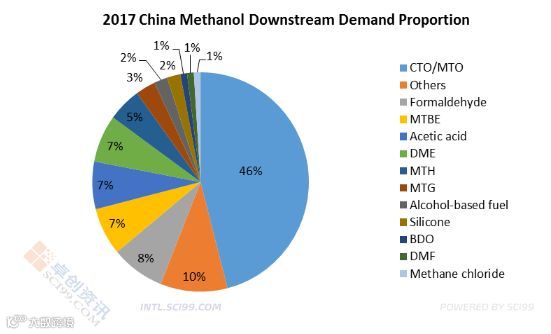
In China, nearly 50% of the downstream demand for methanol came from the CTO/MTO industry in 2017. The unit consumption of methanol was around 3mt in the CTO/MTO industry whose development remained as the important factor promoting the methanol demand growth in China.
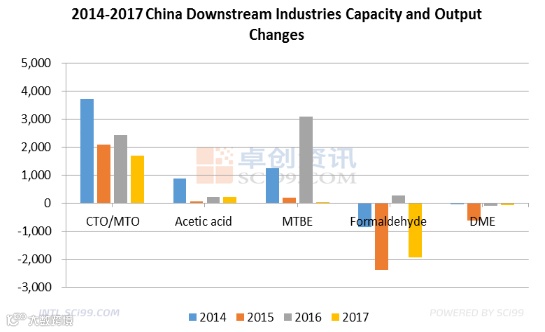
Remarks: The data in the above chart is capacity for CTO/MTO, but output for the others.
The growth of the olefin capacity is quick, and the future demand is optimistic. Taking ethylene as an example, with newly added PE, MEG and Styrene units putting into operation, the demand for ethylene is increasing. Meanwhile, benefiting from the fast development of online shopping, the demand for packaging materials, the end product of olefin, is bullish in the long term. In addition, the demand from agriculture film and lightweight automobile fields is also rising.
For acetic acid and MTBE, although their capacity grew, but the growth rate slowed down somewhat. The industrial profit is fairish, and the future newly added demand is predicted to be limited.
For formaldehyde, its main downstream filed is the decoration board industry. Influenced by the stricter air pollution treatment and higher health awareness, the content of formaldehyde in decoration board is reducing persistently. Thus, the demand for formaldehyde is shrinking, and the overall industrial profit is average. Consequently, the capacity and output of formaldehyde keep decreasing with some units shut down permanently, and there is no sign of obvious improvement in the future.
For DME, due to overcapacity and thin profit, the producers show low production positivity, and some units have been shut down intermittently. As for demand, the downstream industrial chain of DME is single, which is mainly civil-use gas. In recent years, the clean energy such as natural gas expanded fast in this field. Meanwhile, the high feedstock cost pushed up DME prices, which weakened the price advantage of DME. Thus, the demand for DME dropped notably. In addition, the stricter air pollution treatment curbed the operating rates at some DME producers.
The demand proportions of other downstream industries, such as silicone, BDO, DMF, etc., are relatively small and change limitedly. In addition, some focuses of attention, like MTH (methanol to hydrogen), alcohol-based fuel and methanol-fueled automobile industries still need the market’s test in the aspects of policy, economy and safety.

For more information please contact us at
overseas.sales@sci99.com
+86-533-6296499

If you want to see more, please click here!