

PX Market Price May Descend After Peaking in H2, 2024
Introduction: Wide-ranging volatility was observed in China’s PX market in the first half of 2024 due to the fluctuations in crude oil prices and the mismatch between supply and demand increases. The crude oil market is still somewhat unclear in the second half of 2024. Additionally, Asian PX supply and demand are expected to be in a tight balance as they both enter a rebounding phase. The PX market price is predicted to peak at $1,070/mt in August before going on a downward trend. Nonetheless, the PX price may receive bottom support from the PTA industry’s rigid demand, with the PX price’s magnitude tending to flatten out.
From January to June 2024 (as of June 19), the average price of PX was $1,032.36/mt CFR China, a decrease of 0.36% compared to the same period last year. As of June 19, the CFR China PX price closed at $1,039/mt, an increase of 0.68% from the beginning of the year.
The lowest price in the first half of 2024 occurred in early March at $1,003/mt. On the one hand, international crude oil prices fell to nearly five-month lows under pressure, leading to sluggish effective cost momentum for PX. On the other hand, domestic PX inventory reached a historic high. The bearish atmosphere in the market dominated, and PX prices fell to around $1,000/mt. In the second half of March, crude oil prices rebounded, driving the PX price to rise. At the same time, nearly 10 million mt/a of PX plants in China, such as Zhejiang Petroleum & Chemical, Hengli Petrochemical, and Ningbo Zhongjin Petrochemical, etc. shut down their units one after another, leading to a supply contraction exceeding expectations. Meanwhile, the 1.5 million mt/a new PTA unit at Formosa Chemical Industrial (Ningbo) and the 3 million mt/a PTA unit at Sinopec Yizheng Chemical Fiber were put into operation, improving the demand for PX. As a result, PX prices posted a rapid increase in late April, breaking through the annual high of $1,070/mt. From May to June, under the game between cost and fundamentals, Asian PX prices entered a broad consolidation channel.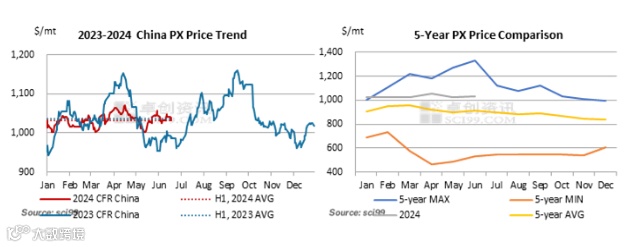
Weak feedstock market lent insufficient cost support to PX.
Crude oil and MX, as direct upstream feedstocks for PX in integrated refining and chemical units, have a crucial impact on the cost of PX. The correlation coefficient between crude oil and PX prices in 2023 is 0.64, while that between MX and PX prices is 0.90. In the first half of 2024, MX and crude oil markets were relatively weak most of the time, which resulted in insufficient cost momentum for PX and to some extent pressured the PX price.
In the first half of 2024, international oil prices first rose from $70.38/bbl on January 2 to $86.91/bbl on April 5, and then fell to around $77/bbl. From January to April, the crude oil price was mainly driven by geopolitical risks. The tense geopolitical situation in the Middle East since October last year has continued to this day, and the prospects for ceasefire negotiations are unclear. At the same time, a refinery in a certain European country has been repeatedly attacked by Ukrainian drones, which has boosted supply tension. The tense situation between Israel and an oil-producing country in the Middle East in April has further raised market concerns about the comprehensive escalation of the Middle East issue, pushing oil prices to a new high for the year. In May and June, demand was the main driving force of crude oil prices. Starting from the end of May, the market began to wait for positive news from US gasoline consumption for crude oil. However, under high operating rates, the accumulation of gasoline inventory suppressed the upward momentum of crude oil prices. The processing volume of Chinese crude oil was affected by the peak maintenance period of the main refineries, resulting in a decline in the second quarter. Local refineries, due to poor profits, often had low operating rates, resulting in a contraction in overall demand for crude oil and a decrease in international oil prices, thereby squeezing the cost from PX production.
In the first half of the year, the Asian xylene market showed a falling trend following an upward movement. The interruption of naphtha supplies at the beginning of the year increased worldwide crude oil and naphtha prices owing to geopolitical and other variables, raising the cost of producing xylene. Demand-wise, exports from Asia to the U.S. increased concurrently with an increase in American demand. Furthermore, Southeast Asia and other places saw a rise in the demand for high-octane gasoline. The demand grew steadily in tandem with the growth in benzene and other commodity prices. From the perspective of supply, due to extensive unit maintenance in Taiwan of China, Europe, South Korea, Japan, and other areas, the xylene supply shrank in the first half of the year. Multiple positive factors drove market negotiations to continue to rise, and by early May, the Asian xylene market price rose to a high level of approaching $1,000/mt. However, the market’s buying enthusiasm has diminished due to the drop in global oil prices and the progressive saturation of gasoline demand in Europe and America, which has resulted in a downward trend in negotiated prices.
Supply-demand growth mismatch exacerbated the PX market contradiction.
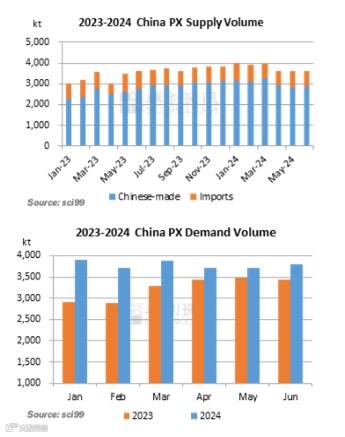
The Chinese PX market reached a capacity addition bottleneck in 2024. Only Hengli Petrochemical’s 5 million mt/a PX unit finished removing the bottleneck and increased its capacity to 5.2 million mt/a in the first half of the year. Amid significant processing costs, China’s overall operating rate in the first quarter hit a high level not seen in over five years, but there was a noticeable drop in output during the second quarter, which is the customary maintenance season. In comparison to the same period last year, the PX output increased by 19.21% to 18.217 million mt from January to June. In addition, the import volume of PX from January to June is expected to be 4.577 million mt (import volume in June is estimated), a decrease of 1.94% compared to the same period last year. The total supply reached 22.793 million mt, a Y-O-Y increase of 14.26%.
In terms of demand, the downstream PTA industry is at the end of the second round of capacity expansion peak, with a total of 4.5 million mt/a of new capacity added in the first half of 2024. Sinopec Yizheng Chemical Fiber and Formosa Chemical Industrial (Ningbo)’s new production lines were put into operation, which correspondingly increased domestic demand for PX. Furthermore, the demand in the terminal textile industry was also in a recovery channel, forming bottom-up demand support for PX. With no export share, the domestic downstream consumption of PX in the first half of the year was 22.786 million mt, up 17.70% over the same time the previous year. Overall, the demand growth rate in the first half of 2024 was higher than the supply growth rate. However, considering the mismatch of supply and demand increment time, the accumulation of inventory in the first quarter was more significant, squeezing the PX price. In the second quarter, the inventory reduction rate exceeded expectations as the supply-demand gap widened, especially in April, so PX prices rose strongly.
H2, 2024 outlook
Head towards the second half of the year, the factors affecting the operation of the PX market will focus on several aspects, including changes in crude oil prices, PX supply increment after the end of the maintenance period, the PTA unit operation under recovering processing cost, and the macro-environmental background.
Crude oil prices may stay strong but risks may escalate.
The crude oil supply elasticity still depends on some core production-reducing countries such as Saudi Arabia. The expectation of supply tightening in the third quarter still exists, and the recovery of oil production in the fourth quarter is a high probability event with voluntary production cuts gradually being canceled starting in October. The crude oil production in the U.S. remains high, but the growth space is limited, and its marginal impact on total supply is weak. The impact on U.S. crude oil supply in the second half of the year may mainly come from hurricane issues, and we need to be vigilant about the risk of a temporary upward trend of oil prices caused by hurricanes. Meanwhile, whether the demand during the summer consumption peak season can meet expectations has a crucial impact on the trend of oil prices.
It is expected that oil prices will ascend in the third quarter and decrease in the fourth quarter. In the third quarter, players should focus on the actual demand performance. If the demand in the peak season falls short of expectations, oil prices may move down. In the fourth quarter, with an increase in supply and a decrease in demand, oil prices may reach their lowest point of the year. Therefore, the operational risk of oil prices remains strong, and there may be more volatility in the second half of the year.
Limited supply increment and a large demand base will lead to a tight supply-demand balance.
In the second half of 2024, there will be no new capacity in the PTA and PX industries. Based on the current tracking of unit dynamics, there are still 4.6 million mt/a of PX capacity to be overhauled in China in the second half of the year, and 3.03 million mt/a of PX capacity in other regions of Asia, which are relatively concentrated from August to September overall. However, there is currently no clear arrangement for PTA unit changes. Apart from the PTA units with high turnaround possibilities mentioned in the below table, there are still over 10 million mt/a of PTA units in China with operating hours exceeding 12 months, and their stability has become a major variable on the demand side of PX. Therefore, the domestic PX supply and demand pattern may show a tight balance, which will have a phased boosting effect on PX prices.
From the perspective of the import market, the maintenance season in Asia has ended, and the future maintenance scale is far less than that in the second quarter. As the peak season for gasoline demand in the U.S. gradually comes to an end, some Japanese and Korean factories may adjust their oil and PX production ratios, thereby increasing PX output. Therefore, the PX supply in Asia is expected to gradually increase from a low level in the second half of the year, and China’s domestic import volume is likely to remain at the level of 680-780kt.
On the demand side, the processing cost of PTA may be further contracted, thereby weakening the production enthusiasm of some old units. The operating rate of China’s PTA industry is likely to hover around 80%. Furthermore, the polyester producers hold a relatively high inventory, and the cash flow of producers is poor, which may form a negative feedback to the PX demand.
Overall, the growth rate of the demand in the second half of the year is possibly equivalent to the growth rate of the PX supply. The total domestic PX supply from July to December is anticipated to be 23.09 million mt or so, and the total demand is expected to be 23.1 million mt. The PX market may first experience destocking, followed by inventory accumulation.
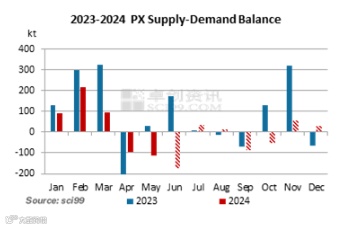
From the perspective of seasonal consumption, PTA is still by constrained the production of polyester and the demand in the textile industry. From the current market, the outlook for terminal demand is not positive, and it is difficult to see a significant recovery in the polyester industry’s operating rate under a loss situation. Considering that there is still export demand for polyester and holiday impacts in the second half of the year, September and October may become a key node for the recovery of demand in the PX market.
Macro fluctuations may increase the risk of price operations.
The signal of slowing US inflation in the second quarter and the central banks of major economies taking the lead in lowering interest rates have strengthened market expectations for the Fed’s interest rate cuts in the second half of the year. The Fed’s interest rate cut is highly possible to start in September or November, and it is expected that there will be no more than two rounds of rate cuts. The economic data of the third quarter is the key to guiding the opening of the final rate cut window. The US dollar index may first be strong and then weak, and macroeconomic policy may cause more frequent disturbances to international crude oil prices. Therefore, the impact of the macroeconomic environment on price changes may be amplified in the second half of the year.
In summary, the international crude oil price center is expected to shift upwards in the second half of the year, given that OPEC+ is likely to extend its production reduction until the third quarter of 2024 and the gasoline consumption in America may be boosted in peak summer demand season. However, due to concerns about a slowdown in global economic growth, the magnitude of oil price increases is limited. The WTI is likely to operate between $75/bbl and $84/bbl.
From the perspective of supply and demand, domestic supply is in the recovery stage, while August and September may experience unit maintenance. The demand is expected to increase due to the stable production of PTA factories, especially in the peak demand season of September and October. Overall, the demand outlook for PX in the second half of the year is still good.
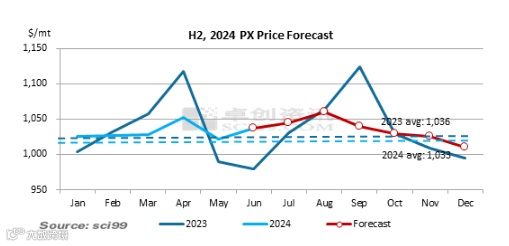
From the perspective of the inventory cycle, the inventory fluctuation space in the second half of 2024 will narrow and the period of passive destocking will come. Overall, it is expected that the PX price will experience a slight rebound followed by a downward correction in the second half of the year, with relatively limited amplitude space. The mainstream price may be in the range of $1,010-1,060/mt. Based on seasonal patterns, the highest price in the second half of the year is likely to be seen in July and August, and the lowest price may appear in December.
All information provided by SCI is for reference only, which shall not be reproduced without permission.
Please click "Read more" for the full article.