

Sep PBR Imports Edge Up While Exports Dip
Introduction: In September, China’s PBR imports and exports trended differently, but the fluctuations were limited. This article mainly analyzes the changes in PBR imports and exports in September and the reasons behind them.
In September, the PBR imports edged up.
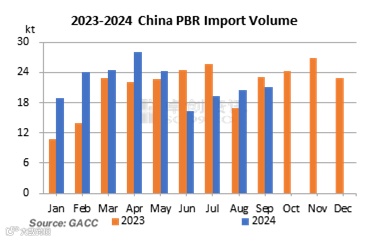
According to SCI, China’s PBR imports in September were 21,089.12mt, up 2.89% MoM but down 8.15% YoY. From January to September, the total PBR imports were around 196,917.73mt, up 8.05% YoY. In 2024, China’s tire capacity release hit a 3-year high, triggering a larger domestic demand for PBR. At the same time, China’s PBR price has been fluctuating upwards bolstered by cost and related products in 2024 and refreshed 3-year highs for many times. Thus, there were still some price advantages for the resources from Russia and UAE. China’s tire and rubber product enterprises preferred to use imported resources to lower their feedstock cost. Besides, there have been some fixed customers of some Russian resources with long-term contracts. Therefore, the import volume mainly hovered at highs. Additionally, China’s high-end PBR resources were in short supply due to the demand from high-performance tire production, which needed to be supplemented by imported resources. Thus, the import volume moved up. In September, the import contracts were mainly agreed in August affected by the shipping schedule, and the operating rate of China’s PBR industry trended at lows, so the PBR supply was relatively tight, which was an important reason for the rise in imports.
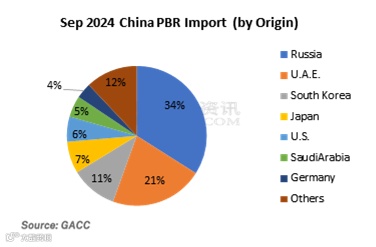
As for the import trade partners, the PBR import volumes from Russia, UAE and South Korea ranked top 3 in September. Among them, Russia ranked first. The import volume of PBR from Russia was around 7,169.4mt, down 8.64% YoY, which accounted for 34% of the total. UAE ranked second. That from UAE was around 4,536mt, up 38.46% YoY, which accounted for 21% of the total. South Korea ranked third. That from South Korea was around 2,272.34mt, down 35.24% YoY, which accounted for 11% of the total. The imports from UAE rose notably and took a higher proportion of the total imports.
The export volume dropped slightly.
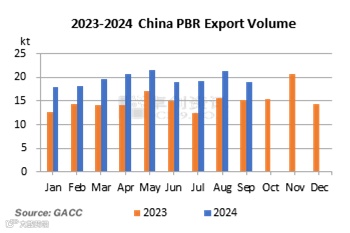
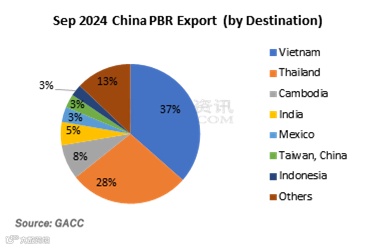
According to GACC, China’s PBR export volume was 19,026.10mt in September, down 11.11% MoM but up 26.6% YoY. From January to September, the total PBR export volume was around 176,440.15mt, up 35.56% YoY. As seen from the export trade partners, the export volumes to Vietnam, Thailand, and Cambodia ranked top 3. The export volume to Vietnam was around 6,942.35mt, accounting for around 36% of the total. Besides, the exports to Thailand witnessed a notable MoM growth.
October and November forecast:
Imports: Although the operating rate of China’s PBR units may ramp up, China’s PBR price is expected to trend at historically high levels. Thus, the price advantages of imported resources will possibly exist, boosting the demand for the imported PBR resources of ordinary grades. As for high-end-grade PBR, the imports are likely to rise limitedly affected by the startup of the new NdBR unit at Zhejiang Transfar Synthetic Materials. Thus, it is projected that China’s PBR import volume may be range-bound or even drop slightly in October and November.
Exports: China’s supply of spot resources is expected to increase, while the domestic demand may weaken. Additionally, the demand for PBR in Southeast Asia may be better than that in China. The previous stable contracts of PBR supply are likely to continue to be executed. Thus, the PBR export volume is predicted to rise somewhat in October and November.
All information provided by SCI is for reference only, which shall not be reproduced without permission.
Please click "Read more" for the full article.