

Impact of Escalating Sino-U.S. Tariffs on PE Imports
Introduction: On April 3, 2025 (Beijing time), U.S. President Donald Trump announced the imposition of "reciprocal tariffs" on global trade partners. In response, China promptly declared corresponding tariff countermeasures, adding 34% tariff on top of the existing rates for all imports originating from the U.S., further escalating the trade war. In terms of PE, China’s import dependence degree hit 34% in 2024. The U.S. remained China’s largest PE supplier in the first two months of 2025, contributing 17.99% of China’s total PE imports. The countermeasures by China are expected to impact the supply of PE from the U.S.
I. Tariff Policy Background
In the early hours of April 3, 2025, Trump declared a 10% baseline tariff on all imported goods, with additional punitive levies targeting countries exhibiting large trade deficits with the U.S., significant tariff disparities, or non-tariff barriers. Among these, the tariffs targeted at Chinese imports will be increased by 34%, which, combined with the two 10% increases implemented by the U.S. since February, brings the total tariffs to 54%.
In response, the Customs Tariff Commission of the State Council of the People’s Republic of China announced countermeasures on April 4, 2025. In accordance with the Tariff Law of the People’s Republic of China, the Customs Law of the People’s Republic of China, the Foreign Trade Law of the People’s Republic of China and other laws and regulations and the basic principles of international law, and with the approval of the State Council, additional tariffs will be imposed on imported goods originating from the United States from 12:01 on April 10, 2025.
All U.S.-origin imports will face an additional 34% tariff on top of existing rates.
Existing bonded and duty-free policies will remain unchanged, with no exemptions for the new tariffs.
Goods that are shipped from their place of departure before April 10 (12:01 p.m.) and imported between April 10 and May 13 will not be subject to the additional tariffs specified in the announcement.
II. China’s PE Imports from the U.S.
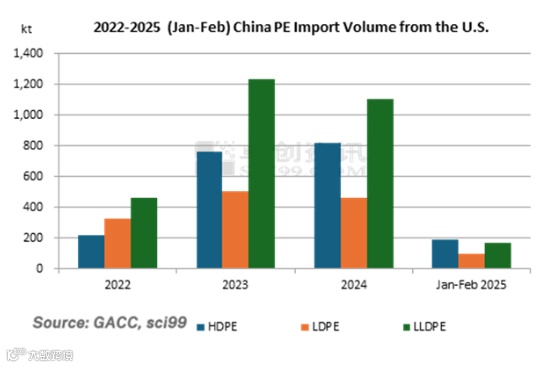
From 2023 to February 2025, the U.S. emerged as China’s top PE supplier, climbing from sixth place in 2022, driven by cost advantages and stable shipping conditions. In January and February 2025, U.S.-sourced PE accounted for 17.99% of China’s total imports and reached 456.3kt. Specifically:
HDPE: 187.1kt (18.11% of China’s total HDPE imports)
LDPE: 99.1kt (16.65%)
LLDPE: 170.1kt (18.74%)
Major U.S. suppliers include ExxonMobil, Dow Chemical, Formosa Plastics USA, LyondellBasell, and Chevron Phillips. By product structure, the imports are primarily general-purpose materials such as film, injection, and blow molding. As ExxonMobil’s Huizhou project comes into operation, supplies from ExxonMobil will gradually shift to domestic supply. Given that ExxonMobil, Dow Chemical, Formosa Plastics, LyondellBasell, and Chevron Phillips are global enterprises with a presence in Europe, the Middle East, and Southeast Asia, it is anticipated that supplies from these regions may increase after the tariff adjustments. However, considering that production costs in Europe and Southeast Asia are higher than those in the U.S., the supply of low-cost imports in China’s market is expected to decrease in the short term.
III. The U.S. Mainly Exports PE to China and South America
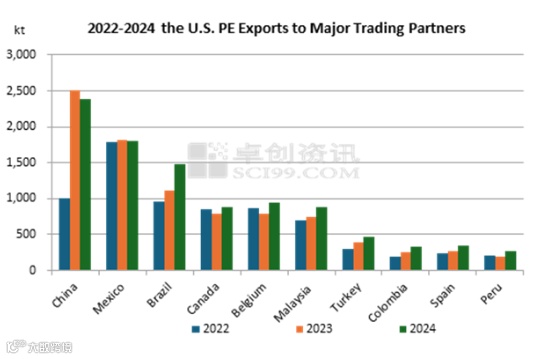
Since 2023, there has been economic slowdown and weak demand in the Euro-American markets due to high inflation, while China has benefited from the positive adjustment of macroeconomic policies, showing robust market demand. Moreover, low prices of U.S.-origin PE are favored by the Chinese market, leading to PE supplies flowing from the U.S. to China. In 2024, China became the most significant PE export partner for the U.S.
In recent years, with the gradual economic recovery in South America, demand has been increasing. ITC data indicate that in 2024, Brazil’s PE imports from the U.S. grew by 32.95% YoY. Although demand in South America has increased, the overall volume is limited, leading to slow absorption of PE resources from the U.S.
Following China’s tariff countermeasures, the tariff rate on PE imports from the U.S. will be adjusted from 6.5% to 40.5%, leading to an estimated cost increase of around RMB 2,480/mt. To maintain their market share in China, producers may consider increasing supplies from non-U.S. regions or lowering prices. However, the feasibility of reducing prices in the short term is low due to cost considerations. Hence, increasing supply from non-U.S. regions is a more viable short-term strategy. As a result, it is expected that the supply of PE imports from the U.S. may decrease in the short term.
Source: ITC, SCI
SCI will continue to follow up on subsequent tariff implementation, global resource flow, downstream demand, and China’s price changes.
All information provided by SCI is for reference only, which shall not be reproduced without permission.
Please click "Read more" for the full article.