

Q2 EPDM Price to Drop After a Strong Q1
Introduction: In Q1 2025, the EPDM market performed passably, with prices rising before experiencing a slight decline. In Q2, as supply tightness eases and downstream demand remains relatively weak, prices are expected to undergo a downward adjustment.
Prices Rise Then Retreat Amid Supply-Demand Tensions
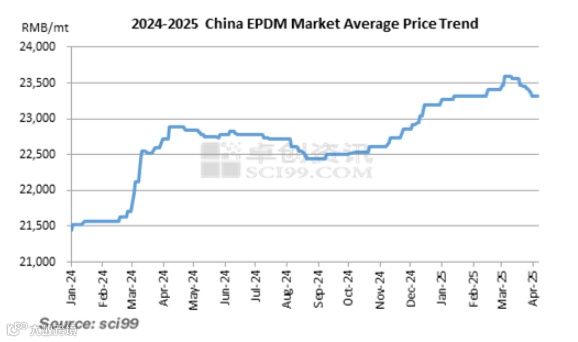
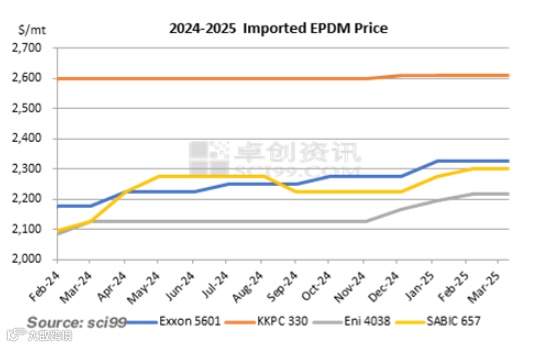
In Q1 2025, China’s EPDM market prices saw frequent fluctuations, with supply-demand dynamics exerting a stronger influence on prices. At the end of January, an unexpected shutdown for maintenance occurred at the joint venture plant of Saudi SABIC and Exxon, lasting about one and a half months. This overseas plant outage provided positive support for domestic spot prices. Coupled with the news of planned maintenance at the Rabigh plant from April to June, the domestic market received a further boost. Shortly afterward, domestic producers successively announced price hikes, leading to the first wave of post-Spring Festival price increases. However, by March, downstream demand fell short of expectations, with lower operating rates across industries. As a result, market sales slowed noticeably, prompting some traders to offer discounts, which in turn moderated the upward trend and led to price declines for certain grades.
Gradual Easing of Supply Tightness Weakens Support for High Prices
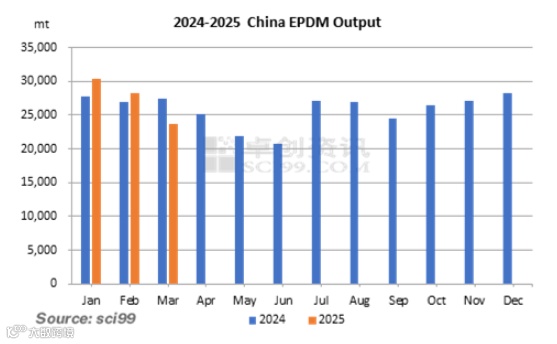
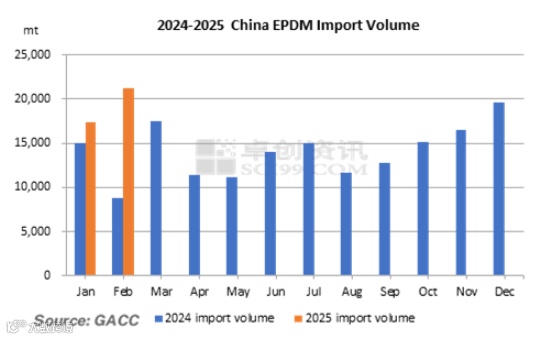
According to SCI, domestic EPDM output in Q1 2025 remained stable compared to the same period last year. Most of the five major producers maintained steady operations, with only short-term maintenance shutdowns at Shaanxi Yanchang Petroleum Yan’an Energy and Chemical’s 25kt/a EPDM unit and ARLANXEO’s 16kt/a EPDM unit. Other units operated at consistently high utilization rates, resulting in minimal year-on-year fluctuations in overall output. On the import front, China’s EPDM imports from January to February totaled 38,528.60mt, a 62.57% increase year-on-year. The substantial rise in imports began to exert downward pressure on domestic market prices by the end of Q1.
China’s EPDM output in Q1 2025 reached approximately 820kt. Despite temporary maintenance shutdowns at some units, most plants operated at high utilization rates, keeping overall output nearly flat year-on-year. Imports surged by 62.57% YoY in Jan-Feb, driven primarily by increased shipments from Saudi Arabia and South Korea. Saudi Arabia alone contributed 20,480.75mt, up 104.95% YoY, as all four major Saudi suppliers boosted exports to China. Following the unexpected shutdown of the SABIC-Exxon joint venture plant after the Spring Festival, domestic spot prices initially climbed, with traders holding firm on high offers. However, by mid-March, the Saudi Arabian plant resumed operations earlier than expected, shifting market sentiment. Facing weak demand and anticipating further price declines, some suppliers quickly slashed prices to accelerate sales, dragging down market bottom prices and triggering corrections in previously inflated quotes. Although the Rabigh plant’s scheduled maintenance from April to June remains a potential bullish factor, its impact on current prices appears limited, failing to halt the downtrend. Meanwhile, South Korean imports rose 48.32% YoY to 12,448.2mt, keeping the domestic supply of Korean-origin EPDM ample and prices range-bound.
Overall, with supply tightness gradually easing, traders increasingly adopted a fast-in, fast-out approach to mitigate risks from potential further weakness. Against a backdrop of sluggish demand, the support from supply-side constraints diminished, leading to a price decline in late March.
Weak Demand Fails to Sustain Floor Prices
In Q1 2025, China’s downstream demand for EPDM reached approximately 100kt, down 4% year-on-year. The Spring Festival holiday in Jan-Feb initially supported prices as downstream buyers stockpiled feedstock pre-holiday and consumed inventory post-holiday. However, demand recovery in March fell short of expectations, lagging behind 2024 levels. Traders widely reported slower sales and weaker procurement interest, amplifying downward pressure on prices. On the export front, China exported 5,111.92mt of EPDM in Jan-Feb, up 12.63% YoY. The increase in exports provided moderate support for domestic market prices.
Overall, domestic demand remained relatively sluggish. Most market participants reported weaker performance compared to previous years, mainly due to delayed post-holiday resumption at small-scale downstream enterprises. Two key factors are at play: persistently high feedstock prices and the concentration of end orders toward medium and large-scale enterprises, leaving smaller players with insufficient orders. These dual pressures significantly delayed production resumption at small-scale downstream operations, resulting in reduced feedstock procurement. While demand still provided some support for prices, its supportive effect diminished due to easing supply constraints and increased bearish sentiment.

As the largest downstream sector for EPDM, China’s automotive industry achieved output and sales of 4.553 million and 4.552 million vehicles respectively in Jan-Feb 2025, representing year-on-year growth of 16.2% and 13.1%. The output growth rate expanded by 14.5 percentage points compared to January, while the sales growth rate increased by 13.7 percentage points. During this period, the early implementation and expanded coverage of the vehicle trade-in policy, coupled with corporate technological upgrades and product renewals, stimulated demand and contributed to steady growth in automotive output and sales. Passenger vehicles maintained favorable performance, the commercial vehicle market showed signs of recovery, and new energy vehicles continued their impressive growth trajectory. This positive start laid a solid foundation for a strong first quarter performance. In January and February, output and sales of new energy vehicles reached 1.903 million and 1.835 million units respectively, both achieving 52% year-on-year growth. NEVs accounted for 40.3% of total new vehicle sales. Automotive exports totaled 911,000 units, up 10.9% year-on-year. The favorable year-on-year performance in vehicle output continued to provide fundamental demand support for EPDM.
Overall, the total demand for EPDM showed a slight year-on-year decline, leading to reduced consumption. With the gradual easing of supply tightness, demand-side support for price floors weakened.
Although domestic and overseas units underwent maintenance shutdowns, demand performance fell short of expectations. In the current supply-demand equilibrium, short-to-medium-term price increases appear unlikely.
As Q1 concludes, several EPDM plants globally are scheduled for maintenance in Q2, which may provide some price support in the near term. However, newly added capacity is expected to come online: PetroChina Jilin Petrochemical’s new 40kt/a EPDM line is anticipated to commence operations mid-year. Kumho’s 70kt/a EPDM unit in South Korea is scheduled to begin production in early April. The interplay between unit maintenance and new capacity additions will critically influence price trends at key market junctures throughout the year.
EPDM Market Outlook
In Q1 2025, China’s EPDM market showed fairish performance. Supply-side factors provided temporary support, driving a short-term price increase followed by a modest correction. Looking ahead to Q2, the market is about to enter a seasonally slower demand period, with overall consumption expected to weaken compared to Q1 levels. This demand softening will likely exert downward pressure on EPDM prices. On the supply side, while some unit maintenance shutdowns are scheduled, most producers have built regular pre-maintenance inventory reserves. As a result, market availability may remain relatively stable, and severe shortages are unlikely to occur. The strong supportive effect from supply constraints will diminish. Under continued supply-demand tug-of-war, the Q2 market is projected to weaken, with EPDM prices expected to undergo moderate downward adjustments.
All information provided by SCI is for reference only, which shall not be reproduced without permission.
Please click "Read more" for the full article.