

The PX Price May Continue to Go Range-Bound in Mar
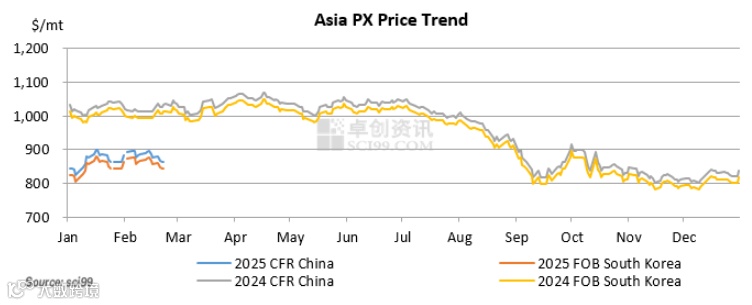
After the Spring Festival, the Asian PX price fluctuated upwards first and then declined. In February, the average PX price was $883.1/mt CFR China and $863.1/mt FOB South Korea, up 1.92% and 1.96% MoM, respectively.
During the Spring Festival, international crude oil prices fluctuated due to Trump’s tariff policies. Domestic PX units operated at high loads with stable demand. Subsequently, the U.S. new sanctions on a Middle Eastern country pushed crude oil prices up, boosting cost prices. Frequent planned and unplanned shutdowns of PX units domestically and abroad, along with the expected maintenance of Asian units in Q2, strengthened expectations of a tight supply-demand balance, activating buying interest and driving PX prices close at $900/mt. However, concerns over the implementation of additional tariffs and a surprise increase in the U.S. refined oil stocks led to a drop in international crude oil prices to the lowest level since December, squeezing PX cost supports. Additionally, stable operations of Asian PX units and the announcement of maintenance schedules and delayed restarts by some PTA plants weakened market confidence, leading to inactive trading and a decline in PX prices, with a single-day drop of up to $13/mt.
Unit change announcements within February intensified market fluctuations. For PX, the operating rate stabilized with a downtrend in February. The 800kt/a unit at Sinopec Zhenhai Refining & Chemical operated at 90%. The 2,000kt/a PX unit at Dongying Weilian Chemical operated at 80%. The 1,400kt/a unit at Dalian Fujia Dahua Petrochemical operated 70%. Two 2,000kt/a production lines at Shenghong Petrochemical Group operated below 95%. The 1,600kt/a unit at Ningbo Zhongjin Petrochemical cut the operating rate to 80%. The 1,500kt/a unit at CNOOC Huizhou Refining & Chemical was shut down for maintenance in March. The 900kt/a unit Sinopec Jiujiang Company was shut down on March 15. The 2,500kt/a unit at Zhejiang Petroleum & Chemical may be under maintenance in late March. The turnaround plan of the unit at Sinopec Yangzi Petrochemical was delayed to May. In addition, the reforming units at Hengli Petrochemical and Shenghong Petrochemical Group may be under maintenance in March.
For PTA, the operating rate was 81.29%, down 1.31 percentage points from January. Two units in South China totaling 5,000kt/a were undergoing planned maintenance and a 2,000kt/a unit reduced operating rate. A 3,300kt/a (design capacity, actual 3,600kt/a) unit in East China increased operating rate. Hengli Petrochemical (Huizhou)’s 2,500kt/a unit restart postponed, Hengli Petrochemical (Dalian)’s 2,200kt/a unit was shut for maintenance from March 1 to 15, Sinopec Yizheng Chemical Fiber’s 3,000kt/a unit was shut from March 3 to 17, Yisheng Dahua Petrochemical’s 3,750kt/a unit was shut from March 15 to April 15. Jiangsu Hailun Petrochemical’s 1,200kt/a unit may be halted in March and Hainan Yisheng Petrochemical’s 2,000kt/a unit announcing a 2-month maintenance for April.
Looking ahead, the PX price is expected to experience wide fluctuations due to unstable fundamentals and market sentiment. The overall average price in March may see a slight increase from February.
On the cost side, crude oil prices may continue to fluctuate downwards in March. Trump’s policies remain important in the crude oil market. First, in energy, Trump’s support domestically and pressure externally led to increased supply, which is bearish for the crude oil market. Second, international trade disputes, economic and demand concerns, and inflation persisting which slows down the pace of Fed rate cuts, all putting downward pressure on the crude oil market. Third, if progress in Eastern European peace continues steadily, the prospect of lifting sanctions on a specific country reduces supply concerns, further bearish market sentiment. However, during the weak run of crude oil prices, speculation about OPEC+ delaying its production increase plan and supply concerns from the U.S. sanctions on a Middle Eastern country provide ongoing support to the crude oil market.
On the supply and demand side, in January 2025, some domestic units reduced output, and some Japanese and Korean enterprises cut operating rates due to processing cost pressures. Imports falling to around 800kt. Meanwhile, PTA operating rates were high, leading to a destocking cycle for domestic PX. In February 2025, domestic PX units maintained stable operations, with imports expected to remain relatively stable. However, frequent planned and unplanned maintenance at PTA plants led to PX restocking. From March to May 2025, Asian PX units will enter a concentrated maintenance period, significantly reducing supply. However, PTA units may face operational stability concerns due to compressed processing margins.
In summary, with the market waiting for progress in the U.S. and European negotiations, and watching Trump’s tariff policy and the Fed’s rate cut pace, the crude oil market is likely to continue wide fluctuations, limiting the guiding effect of PX. From the fundamentals side, the concentrated maintenance schedule of Asian PX units in Q2 and the possibility of continued output cuts in some short-process units, along with the potential for more maintenance at PTA plants due to processing margin pressures, suggest a less optimistic outlook for the supply-demand landscape. However, the expected increase in oil blending demand may provide periodic support to the PX market.
All information provided by SCI is for reference only, which shall not be reproduced without permission.
Please click "Read more" for the full article.