

Jan-Feb PBR Imports & Exports Witness Growth
Introduction: From January to February, China’s PBR imports and exports rose YoY, while the net imports declined. This passage mainly analyzes the reasons for the changes in imports and exports from January to February.
From January to February, PBR imports and exports both increased.
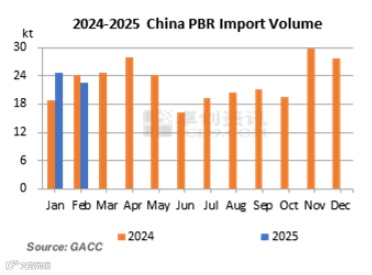
According to GACC, China’s PBR imports in January were 24,728.38mt, down 10.83% MoM but up 30.96% YoY. China’s PBR imports in February were 22,651.43mt, down 8.4% MoM and down 6.16% YoY. From January to February, the total PBR imports were around 47,379.81mt, up 10.13% YoY. In January and February 2025, China’s PBR total import volume grew notably. At first, after long-term channel building, some cooperation of imported resources was stable. Besides, the production profits at China’s PBR producers were low, and China’s PBR price remained over RMB 13,000/mt for the long term. Buyers worried about the feedstock supply in the future, which triggered the negotiation of imported resources. As some imported resources had price advantages, the overall import volume grew significantly YoY. During the Spring Festival holiday, China’s downstream plants suspended production, so the import volume edged down MoM.
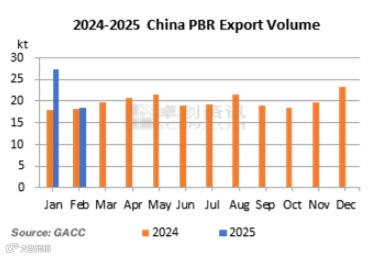
In terms of exports, according to GACC, China’s PBR export volume was 27,473.11mt in January, up 17.93% MoM and up 54.72% YoY. In February, China’s PBR export volume was 18,456.24mt, down 32.82% MoM but up 1.35% YoY. From January to February, the total PBR export volume was around 45,929.35mt, up 27.7% YoY. Since December 2024, the operating rate of China’s PBR units rose notably, so China’s PBR supply faced high pressure. Additionally, in January and February, the operating rate of China’s tire enterprises hit an annual low due to the Spring Festival holiday, and worker attendance was low. The end demand was weak. However, the overseas demand was better than the demand in China, and the export arbitrage window opened. Therefore, the export volume in January and February rose YoY. Besides, the export volume saw a notable YoY growth. Considering the tariff changes, the tire enterprises in Southeast Asia produced and exported intensively, driving up China’s PBR export volume.
The import structure changed limitedly. The imports from Russia still ranked first.
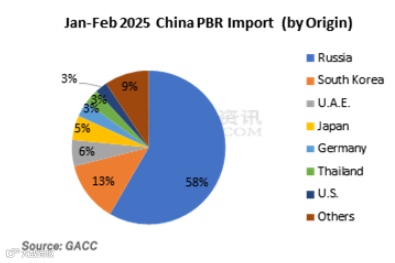
According to GACC, from January to February, the PBR imports from Russia, South Korea, and UAE ranked top 3. Among them, the PBR imports from Russia were around 27,666.18mt, up 43.82% YoY. They accounted for 58.39% of the total, up around 13 percentage points. Those from South Korea were around 6,001.68mt, down 9.91% YoY and accounting for 12.67% of the total, which ranked second. Those from UAE were around 2,620.8mt, down 12.61% YoY and accounting for 5.53%. Therein, Russia was still China’s largest PBR import trade partner, and the proportion of PBR imports from Russia increased. The relatively fixed channel and better cost performance resulted in a stable supply of Russia’s resources, which supplemented China’s PBR supply.
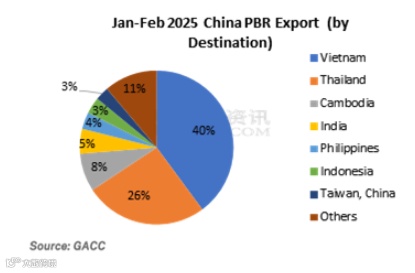
As for the exports, from January to February, the PBR exports to Vietnam surpassed Thailand to occupy the first place, which totaled 18,312.95mt, up 80.12% YoY and accounted for around 40% of the total. Those to Thailand ranked second, which totaled 11,867.94mt, down 13.71% YoY. Those to Cambodia ranked third, which reached 3,668.16mt, up 119.29% YoY. Driven by the demand in Southeast Asia, China’s PBR exports saw notable growth. From the perspective of the regional structure, the focus of China’s tire and other product enterprises building plants in Southeast Asia gradually changed from Thailand to Vietnam and Cambodia. Thus, the demand for PBR in Vietnam and Cambodia increased significantly.
Forecast:
Import: In March and April, the operating rates of China’s downstream tire and rubber product industries may hit the first peak. Besides, it may enter the PBR unit maintenance peak season in April. As the price spread between PBR and cost has not enlarged and PBR units may be shut down temporarily, the imported resources are likely to remain attractive. Therefore, China’s PBR import volume is predicted to continue to rise.
Export: The operating rate of China’s PBR units is at a high level of the year, while the demand grows limitedly. Against the enlarging supply-demand gap, China may still need exports to alleviate the supply-demand pressure. In March and April, China’s PBR export volume is expected to mainly climb fueled by overseas demand and the domestic supply-demand situation.
All information provided by SCI is for reference only, which shall not be reproduced without permission.
Please click "Read more" for the full article.