

Reciprocal Tariffs Series: Shifts in PE Supply-Demand Dynamics amid Escalating Tariffs
Introduction: On April 2, 2025, the U.S. government announced an additional 34% "reciprocal tariff" on Chinese imports, bringing cumulative tariffs on Chinese goods to 54%. This move expanded tariffs on most Chinese exports to the U.S. to a range of 60%-80%. On April 9, the White House press secretary indicated that a 104% tariff hike on Chinese goods would take effect. In response, China’s Customs Tariff Commission announced on the same day that tariffs on all U.S. imports would rise from 34% to 84%, effective April 10 at 12:01 PM. On April 11, China’s State Council Tariff Commission announced it would raise tariffs on U.S. imports from 84% to 125%, effective April 12, matching the US’s reciprocal tariff on Chinese goods implemented a day earlier. The announcement also noted that as U.S. exports to China are no longer viable under current tariffs, China will not respond to future tariff hikes. However, Foreign Ministry spokesperson reiterated that China is prepared to “fight to the end” if tensions escalate, while advocating for dialogue based on mutual respect.
The impact of these tariffs on the PE market manifests in four key dimensions:
I. Import Costs and Supply Restructuring
Import Costs
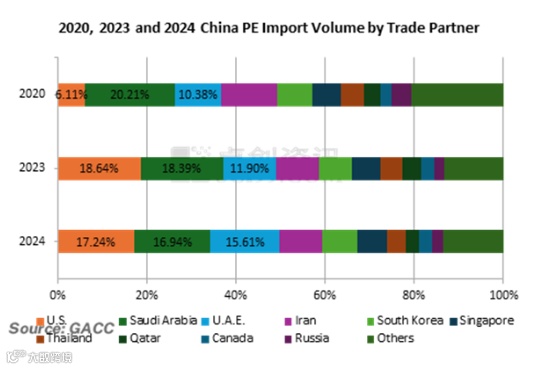
From 2020 to 2024, China’s PE imports initially declined before stabilizing, recording a compound annual growth rate of -3.63%. As China’s economy regained momentum, demand for high-end and specialized PE products grew, driving increased imports of these categories. In 2024, China’s PE import volume reached 13,850.9kt, up 3.05% YoY, with U.S.-sourced PE accounting for 2,387.4kt (17.24% of total imports). Post-tariff, the import cost of U.S. PE will surge significantly.
Supply Adjustments
Reduced imports from the U.S. are expected to be partially offset by increased supplies from Europe, the Middle East, and Southeast Asia. However, higher production costs in Europe and Southeast Asia compared to the U.S. may constrain the availability of low-priced imports in the short term.
The diminished price competitiveness of U.S. PE will accelerate domestic substitution in China. Local producers are likely to capture greater market share while ramping up R&D investments to develop high-end, value-added PE products. Concurrently, China’s expanding PE capacity will reduce inter-regional resource transfers. Self-sufficiency rates in major consumption regions (excluding Northwest China) are projected to rise, with declining reliance on imported and cross-regional supplies from Northeast China and Northwest China.
II. Market Price Volatility
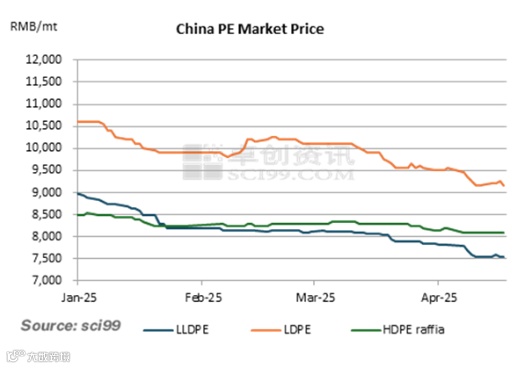
The reciprocal tariffs have dampened sentiment in global commodity markets, with futures markets trending downward. Producers have cut EXW prices, and traders adjusted their offers downward accordingly due to limited downstream demand. Expectations of reduced export orders for downstream producers due to tariff impacts further fueled bearish sentiment, intensifying price pressure.
However, a potential decline in low-cost imported resources may provide support for China’s PE prices. Meanwhile, international crude oil prices have retreated sharply amid US tariff hikes and OPEC production increases, reducing PE production costs.
In the near term, PE prices face continued pressure from recessionary fears, weaker agricultural film demand, and oil market headwinds. Yet from May onward, seasonal maintenance shutdowns, reduced imports, and e-commerce promotional activities for the June 18 shopping festival may boost consumption. Therefore, PE prices are likely to fluctuate with upward momentum in May.
III. Competitive Shifts Among Domestic Producers
U.S. Export Disruptions
The constraints on U.S. PE exports have indeed exerted significant pressure on global markets, particularly in Asia, where countries and regions previously reliant on the U.S. This has resulted in tightened market supply, while concurrent price surges in PE have further exacerbated market tensions.
Under such market conditions, China’s integrated ethane-to-olefins (C2) projects have reaped substantial benefits. The ethane prices have experienced relatively moderate increases compared to the more pronounced price escalation in PE products. Consequently, profit margins across the PE-ethylene production chain have expanded notably. The widening differential between production costs and product prices has delivered substantial economic advantages to relevant producers.
Enhanced Profitability
China’s ethane cracking-PE integrated units are benefiting from dual advantages: moderated feedstock cost pressure and substantial product price appreciation. While ethane prices have seen only modest increases, PE prices have risen more sharply, which significantly expanded profit margins across the ethylene-PE production chain.
Within regional markets, these integrated units now demonstrate superior earnings competitiveness. The economic viability of imported ethane continues to outperform locally sourced feedstock alternatives, solidifying Chinese producers’ strengthened competitive positioning in regional markets.
IV. Export Market Reconfigurations
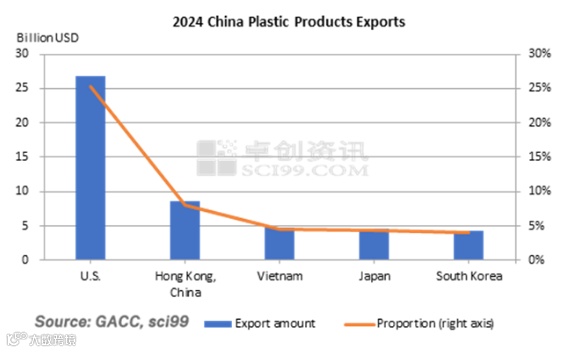
In 2024, China’s plastic product exports remained stable overall, with the U.S., Hong Kong of China, and Vietnam as key export destinations. While the U.S. is one of China’s largest markets for plastic products, its escalated tariff policies may increase export costs, squeeze corporate profit margins, and dampen demand for China’s plastics and downstream products—particularly mid- to low-end items like plastic daily necessities and packaging materials, which operate on thin margins and struggle to absorb higher tariffs.
Reduced demand from downstream industries: The contraction in plastic product exports risks triggering a demand reduction across multiple application sectors including packaging, electronics, and automotive industries. This weakening external demand could subsequently depress China’s PE markets.
Given the tariff impacts, major exporting provinces and municipalities along China’s coast-Jiangsu, Zhejiang, Guangdong, Shanghai, Hainan, Shandong, and Fujian-are implementing strategic adaptations. Enterprises are intensifying technological innovation in specialized segments like plastic films, artificial leather, and synthetic leather to enhance product quality and value-added features. Notable examples include producers refining production techniques to develop thinner yet more durable plastic films catering to premium market demands.
Simultaneously, certain enterprises are adopting geographical diversification strategies by relocating production phases to Southeast Asian nations. For instance, some toy manufacturers have transferred partial assembling operations to Vietnam and Cambodia, effectively circumventing tariff barriers while optimizing production costs.
Conclusion
While escalating tariffs present near-term challenges to the PE industry, they also catalyze structural upgrades and innovation. SCI will continue monitoring policy developments and market trends.
All information provided by SCI is for reference only, which shall not be reproduced without permission.
Please click "Read more" for the full article.