

Higher PVC Capacity Intensifies Market Competition
Introduction: In recent years, the commissioning of ethylene-based PVC units has accelerated, with the proportion of ethylene-based PVC capacity gradually increasing. Recently, some ethylene-based PVC units have successively started trial runs. It is expected that competition in the market supply will likely intensify, which may exert certain pressure on the calcium carbide-based PVC market.
Ethylene-based PVC: Its capacity proportion has gradually increased in recent years.
In recent years, as the approval of new calcium carbide-based PVC projects has been tightened, there have been fewer newly commissioned calcium carbide-based PVC units, while more enterprises have expanded ethylene-based capacity, leading to a yearly increase in the proportion of ethylene-based PVC capacity. According to SCI, as of the end of 2024, calcium carbide-based PVC capacity accounted for 73.39%, and ethylene-based capacity accounted for 26.61%. In 2025, the 500kt/a PVC units at SP Chemical were commissioned in Q1 2025, new capacity of 500kt/a at Wanhua Chemical (Fujian) was released in August. By late August, the proportion of ethylene-based PVC capacity has reached 29.06%. It is expected that by the end of 2025, the proportion of the ethylene-based PVC capacity may reach around 30%.
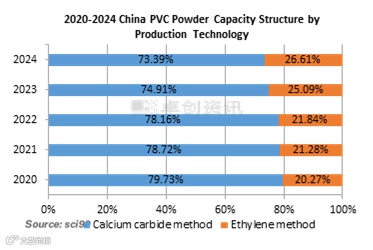
In recent years, more ethylene-based PVC units have been put into operation, while newly added calcium carbide-based PVC units have been relatively few. Moreover, there will continue to be more capacity expansions of ethylene-based PVC in the future, mainly due to the following reasons:
1. The ethylene-based production process is relatively more environmentally friendly, with relatively fewer policy restrictions.
According to the provisions in Industrial Structure Adjustment Guidance Catalog (2011 Version) (Decree No. 9 of 2011), calcium carbide-based PVC production using high-mercury catalysts will be phased out, and calcium carbide-based PVC enterprises using low-mercury catalysts are also subject to investment restrictions. For ethylene-based PVC units, only a minimum capacity requirement of 300kt/a is specified. In addition, since the Minamata Convention on Mercury officially took effect in China on August 16, 2017, no new calcium carbide-based PVC projects that had not been approved before August 16, 2017, could be approved thereafter.
In summary, although PVC was classified as an industry with strict control over new capacity in the Guiding Opinions on Restructuring the Petrochemical Industry to Promote Transformation and Increase Efficiency issued by the General Office of the State Council in August 2016, any newly approved PVC projects in the later period can only adopt the ethylene-based process or mercury-free production process. Relatively speaking, the ethylene-based process faces fewer restrictions.
2. Continuous extension of industrial chain integration enhances scale advantages and overall industrial chain competitiveness.
In recent years, the increase in PVC capacity has come from two sources: one is the continuous expansion of existing capacity, and the other is the improvement of the industrial chain. Specifically, for example, enterprises such as Wanhua Chemical, Tianjin Bohua Development, and Qingdao Haiwan have expanded their PVC capacity. As their plant scales expand, their market share has gradually increased, and their brand and scale advantages have been strengthened, enhancing their own competitiveness. Another example is SP Chemical, which originally had supporting feedstock plants, and it mainly extended the industrial chain downstream to optimize resource allocation, improve the industrial chain, and thereby enhance the overall strength of the enterprise.
In addition, with the successive launch of large-scale ethylene projects in China in recent years, the demand for ethylene has become a key consideration. The downstream conventional supporting products of ethylene, such as PVC, styrene, and PE, face fierce market competition. Thanks to its process advantages, ethylene-based PVC may become one of the choices for supporting products.
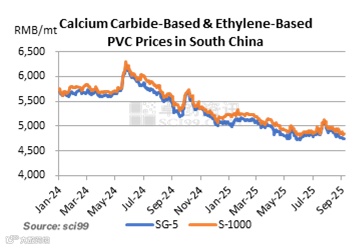
The price gap between Ethylene-based and calcium carbide-based PVC is narrowing. The calcium carbide-based PVC market may face higher pressure.
Due to differences in feedstock and processes, the price of ethylene-based PVC is generally higher than that of calcium carbide-based PVC, with a typical price gap of around RMB 100/mt in South China. However, as the proportion of ethylene-based PVC gradually increases, the price gap between them has gradually narrowed. Taking South China as an example, from July to August, the average price gap between ethylene-based and calcium carbide-based PVC narrowed to less than RMB 50/mt.
The phased narrowing of the price gap in South China is mainly due to the following factors: In July 2025, the new 500kt/a ethylene-based PVC units at Wanhua Chemical (Fujian) started trial production and gradually entered mass production, with its products launched into the market. At the same time, the original 400kt/a units at Wanhua Chemical (Fujian) resumed production after maintenance. As a result, the spot supply of PVC in South China increased compared with the previous period, and the supply of ethylene-based PVC sources expanded. Due to the slow circulation of spot goods in the market, some ethylene-based PVC resources also faced pressure in sales or inventory. Some traders reduced prices to cut inventory, leading to ethylene-based PVC prices approaching the prices of high-end calcium carbide-based PVC during certain periods, and the price gap narrowed significantly. With the increase in the self-sufficiency rate in South China, the inflow of calcium carbide-based PVC resources has also faced greater pressure.
The 400kt/a PVC capacity at Tianjin Bohua Development is expected to be released in September. In addition, the 200kt/a unit at Qingdao Haiwan is planned to come online in mid-September. Moreover, the 300kt/a unit at Zhejiang Jiahua Energy Chemical is also planned for commissioning in H2 2025. With the successive commissioning of ethylene-based units, the proportion of PVC capacity in coastal areas of China will likely increase. The PVC market supply in East China is relatively saturated, making it difficult for ethylene-based PVC from North China to flow into East China. Therefore, ethylene-based PVC from North China is likely to be diverted to South China. It is expected that competition for ethylene-based PVC supply in South China will likely become more intense, which will further squeeze the inflow of calcium carbide-based PVC.
Thus, with the successive commissioning of new PVC units, the flow direction of PVC supply in China is expected to change. For PVC producers, it is necessary to closely monitor price spread changes across regions and flexibly adjust the flow direction of their supply.
All information provided by SCI is for reference only, which shall not be reproduced without permission.
Please click "Read more" for the full article.