

How does Tighter Sino-U.S. Relation Impact the Butadiene Import?
China imported 91.8kt of butadiene in Q1, 2019, down around 30% Y-O-Y. From January to February, the import volume of butadiene was still low. However, the import volume of butadiene in March increased Y-O-Y, benefiting from the arbitrage spread between domestic and imported butadiene markets. The whole import volume increased notably. However, recently, the Sino-U.S. relation was getting tighter again. Thus, how does it impact the butadiene import market in China?
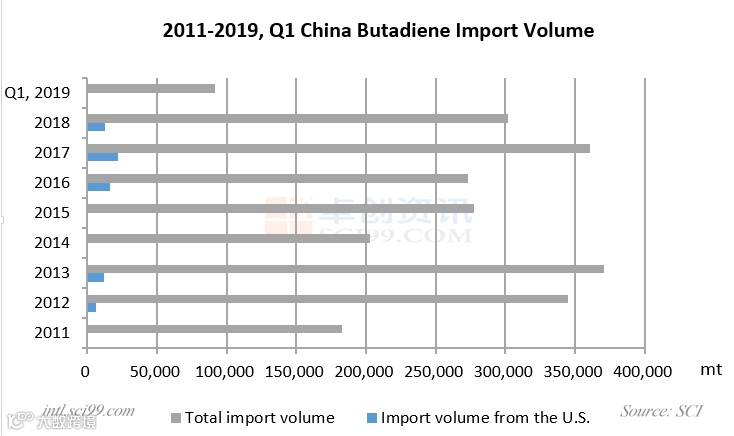
As seen from the import volume of butadiene, the butadiene imported from the U.S. accounted for a small proportion. The largest import volume from the U.S. was only around 20kt in 2017, accounting for around 6% of the total import volume. In some years, the import volume from the U.S. was only 0. Thus, China was not very dependent on importing butadiene from the U.S. As seen from the U.S., affected by the lighter feedstock, the demand for imported butadiene still trended up. Thus, the butadiene produced in the U.S. was mainly for the local enterprises. Besides, under proper price spread, China’s butadiene will be exported. If the exported butadiene will be imposed by tariff, the price spread will shrink notably. There will be little possibility for arbitrage to the Asia market.
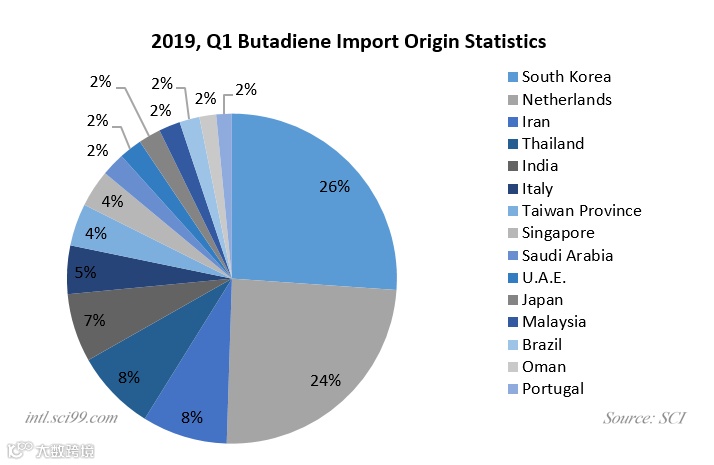
In Q1, 2019, the top 5 import origins of butadiene were South Korea, Netherlands, Iran, Thailand and India. Thereinto, the import volume from South Korea ranked first, and the import volume from Netherlands still accounted for a large proportion, ranking second. Other import origins were mainly from Asian surrounding areas, Europe and the Middle East. The imported butadiene in Q1 didn’t include U.S.-origin butadiene resources. However, the imported butadiene resources were still sufficient. Most countries adopted a cautious sentiment to Iran-origin resources. Thus, most Iran-origin butadiene resources flowed into China’s market obviously. So whether or not to import butadiene from the U.S. has little effect on the domestic market
From May to June, there will be 170kt/a new butadiene units going into production, replenishing domestic market to some extent. In late 2019 or early 2020, the 200kt/a butadiene unit at Zhejiang Petrochemical, the 120kt/a butadiene unit at Liaoning Bora Petrochemical and the 120kt/a butadiene unit at Hengli Petrochemical will be put into operation. The self-sufficiency degree of butadiene will improve notably in China. Thus, the import dependence degree will decline somewhat. In Asia, there will be some new butadiene units and its downstream units added. Imported butadiene resources will be relatively sufficient.
As seen from the export, China’s butadiene export market is not mature for the time being. Besides, there are not sufficient butadiene resources for export. In the short run, China still needs to import parts of butadiene resources. A few domestic butadiene resources will be exported to surrounding Asian countries such as South Korea. Thus, this tariff rate increase will not impact the export market notably. In the coming days, with the domestic butadiene supply increasing, it may be exported to surrounding countries in Asia.
……
More detailed information, please click "Read more".

For more information please contact us at
overseas.sales@sci99.com
overseas.info@sci99.com
+86-533-6090596