

Better Tissue Trading in Nov Bolstered by Price Hike Attempts
Intro: In mid-November, some tissue mills issued price increase notices, which improved the market trading slightly. However, due to limited downstream acceptance, tissue prices did not show a significant upward trend. In late November, the tissue market still faces a widening supply-demand gap, while cost increases driven by higher pulp prices may lead to a standoff between upstream and downstream players. Under the dual impact of resistance to cost conditions and weak market demand, the tissue price is expected to remain stable.
Tissue mills in northern China raised prices, bolstering market trading
Tissue mill |
Price hike (RMB/mt) |
Planned date |
Baoding Dayi Paper |
100 |
12-Nov |
Henan Hulijia Paper |
100 |
12-Nov |
Baoding Xiaoshanfu Paper |
100 |
12-Nov |
Baoding Juxing Paper |
100 |
12-Nov |
Baoding Hua'ao Paper |
100 |
15-Nov |
Hebei Chensong Paper |
100 |
12-Nov |
Baoding Zhongxin Paper |
100 |
12-Nov |
Shandong Kunsheng Environmental Technology |
100 |
15-Nov |
Hebei Yufa Paper |
100 |
15-Nov |
Dezhou Shenggang Paper |
100 |
15-Nov |
However, as the timing for planned implementation varied among tissue mills, and downstream players showed limited acceptance, the overall market price has remained relatively stable. As of November 20, the wood pulp tissue market average price remained at RMB 5,583/mt.
Market feedback indicates that the price hike attempts somewhat promoted market trading. SCI data shows that as of November 20, the operating rate of sample tissue enterprises showed a marginal increase WoW of 1.12pp to 68.36%, while the inventory also edged down with accelerated destocking.
However, finished product orders at downstream converting plants were mediocre, and end-consumer acceptance of price increases still needs improvement. The combined effect of these factors prevented market prices from showing a clear upward trend in the short term.
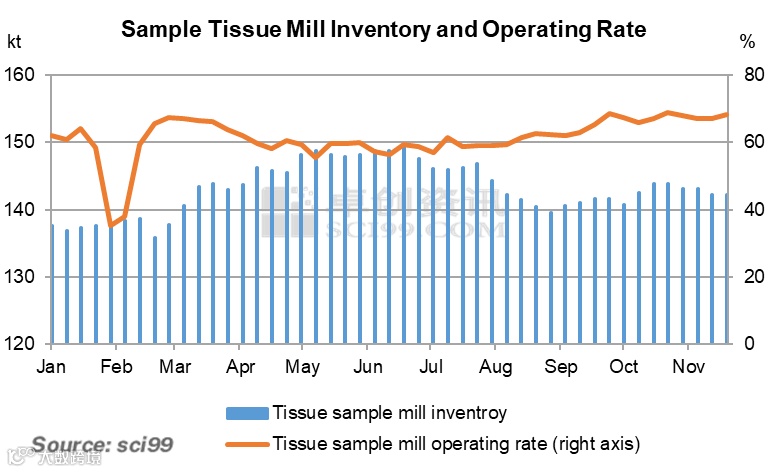
Insufficient demand support may restrict momentum in late November
Despite rising pulp prices is likely to restrict tissue mills’ production enthusiasm, the market supply may still be abundant. Currently, tissue mills still consume previously purchased low-priced materials and show wait-and-see sentiment toward high pulp prices. The theoretical wood pulp tissue gross profit rate has dropped constantly in November. By November 20, the gross profit rate dropped to 2.49%, down 1.71pp from that at the start of the month. In the future, with more pressing cost support, some medium and small-sized tissue mills may become less active in production, but considering the relatively ample inventory within the industry and stable production at integrated players, the market supply is not expected to drop notably.
On the other hand, the order books of finished tissue products are insufficient, and downstream converting plants' purchasing enthusiasm has slowed down slightly. The historical seasonality tends to suggest a general decline in late November. Currently, with limited finished product orders, and end-users are showing limited acceptance to higher prices, converting plants may show less appetite for more expensive tissue jumbo rolls.
The pulp price is still elevated, lending cost support. Currently, pulp and paper players show a strong intention to improve profitability, and import traders tend to hold pulp prices firmly, which will continue to provide cost support to the tissue market.
In conclusion, in late November, despite the expanding supply-demand gap in the tissue market, tissue mills may become less willing to sell at low prices due to rising costs. The standoff between tissue mills and downstream buyers may lead to relatively stable tissue prices.
All information provided by SCI is for reference only, which shall not be reproduced without permission.
Please click "Read more" for the full article.