Low Crude Price to Affect PP Price Limitedly
In the short run, crude oil prices fluctuate at lows, but the price co-movement between crude oil and polypropylene (PP) weakens in April. In other words, the change of PP prices is more affected by supply-demand fundamentals. Compared with other commodities in the industry chain, if PP fundamentals are better, spot PP prices will be affected a lot by the futures.
Recently, crude oil prices hovered at low levels, and the prices of WTI May futures collapsed unprecedentedly on April 20, resulting in negative settlement prices. On April 21, the closing price of Brent oil decreased to $19.33/bbl, mainly impacted by public health event and unexecuted OPEC crude oil production cut. The supply of global crude oil was surplus severely. How much does the crude oil price decline impact PP prices?
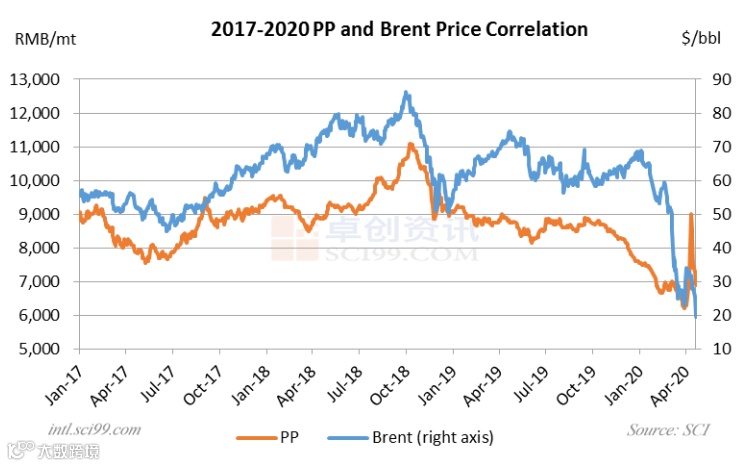 As seen from the above chart, there was a strong correlation between PP and crude oil prices in 2019. The capacity of oil-based PP accounted for 58% of the total PP capacity. As the representative company of oil-based PP, PetroChina had a major speaking right, reflecting the strong correlation between PP and crude oil prices. In 2020, especially in April, the correlation between the PP price and crude oil price weakened. Thus, the PP price was mainly impacted by the demand for PP fiber from the mask field. Later, it is more important to focus on the change of PP supply-demand fundamentals, which will be the key price driver.
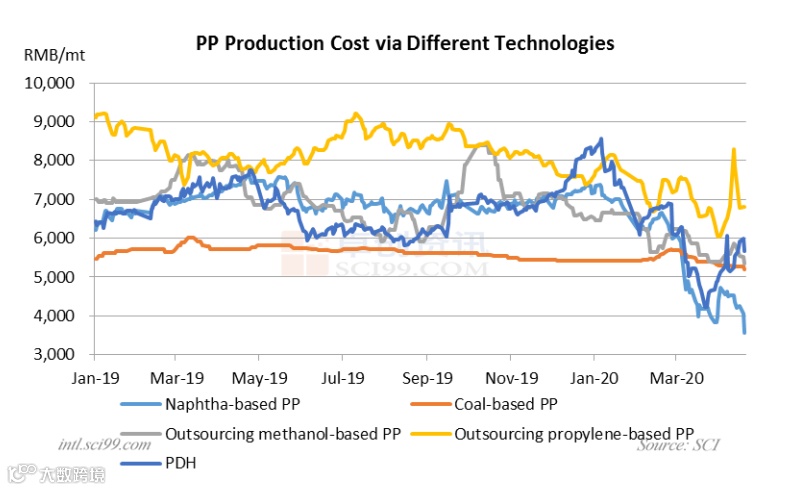
If Brent oil prices hover around $20-30/bbl, the cost from oil-based PP production will be RMB 3,500-4,500/mt. Although the cost decreases obviously, the PP prices will be more affected by supply-demand fundamentals.
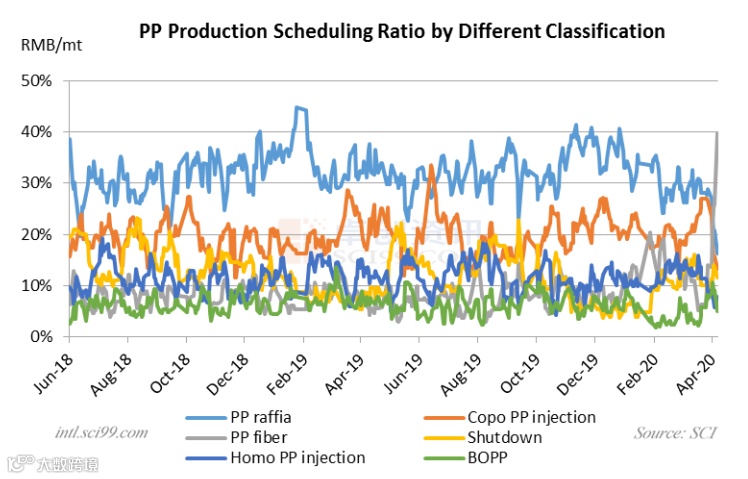
In April, the production scheduling ratio of PP fiber was relatively high, while that of other PP materials declined. In particular, that of PP raffia declined notably. With the market hype for PP fiber softened, the production structure was adjusted gradually. On April 23, the production scheduling ratio of PP fiber decreased from 47.93% to about 37%, and that of PP raffia increased from 11.89% to 22%. But that of PP fiber was still higher than the average ratio in 2019, which was only 7.92%. That of PP raffia was lower than the average ratio in 2019, which was 32.99%.
The reasons are as follows. First, PP fiber prices have dropped greatly, but those are still higher than PP raffia prices, so its production profits are favorable. Secondly, in terms of demand, the demand for PP fiber from mask and protective product industries is fairish. Thirdly, for some PP producers, they need to maintain high fiber output to satisfy the previous orders. Thus, the production scheduling ratio of PP fiber will not decline sharply. As for the PP raffia supply, it will not rise a lot, which will alleviate some sales pressure. That will support PP market, even if the downstream demand for PP raffia is a little weak.
Generally speaking, even if crude oil prices are relatively low at present, the probability that PP prices will decline sharply in the short run is small. It is mainly because that there is rigid demand for PP fiber. Besides, the high production scheduling ratio of PP fiber ease the supply pressure of PP raffia. When the PP fundamentals are better than other bulk commodities, market players are recommended to focus on the impact of the PP futures market on spot market.
Please click "Read more" for more information
For more information please contact us at