

Apr China EPS Export Volume Declined M-O-M & Y-O-Y
In April 2022, China’s EPS export volume declined both M-O-M and Y-O-Y. The import volume climbed M-O-M while continued the downtrend Y-O-Y. In April, China’s EPS demand was in recovery, especially in the northern plate market. However, the recovery underperformed and downstream consumption was limited.
From January to March 2022, China’s monthly EPS export volume showed a year-on-year uptrend, while it declined in April both M-O-M and Y-O-Y. Meanwhile, the import volume continued the downtrend in April, while kept rising M-O-M. All these changes were related to the demand, sea transportation and prices.
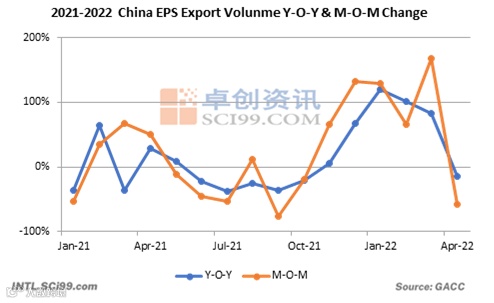
In April, China’s EPS export volume was 16.3kt, down 43.37% M-O-M and 14.42% Y-O-Y. The average export price was $1,718.91/mt, up 8.48% M-O-M and 21.27% Y-O-Y. In the first four months of 2022, China’s total EPS export volume was 84.8kt, up 58.46% Y-O-Y.
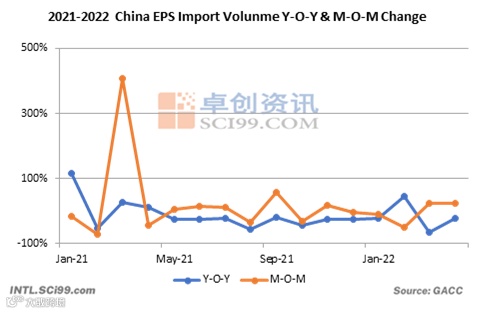
In April, China’s EPS export volume was 1.7kt, up 25.45% M-O-M while down 22.53% Y-O-Y. The average export price was $2,208.4/mt, up 22.50% M-O-M and 15.57% Y-O-Y. In the first four months of 2022, China’s total EPS import volume was 6.3kt, down 33.84% Y-O-Y.
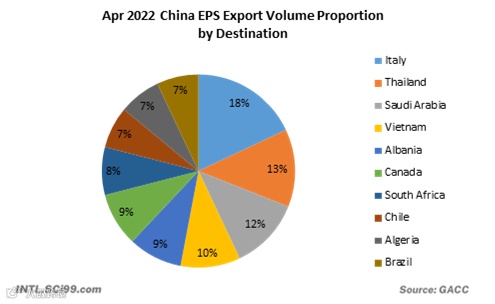
In April, China mainly exported EPS to Asia, Europe and Africa. Italy imported the largest volume (1,635.02mt) of EPS from China, accounting for 18% of the total. Thailand ranked second with 1,164.5mt (13%).
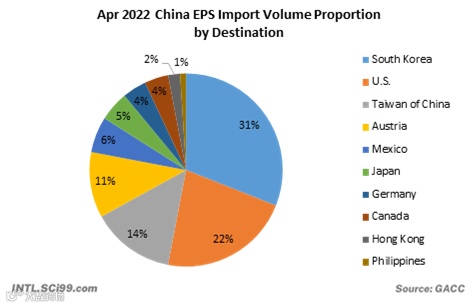
In April, China mainly imported EPS from Asia, North America and Europe. China imported the largest volume (535.5mt) of EPS from South Korea, accounting for 31% of the total. The U.S. ranked second with 379.25mt (22%).
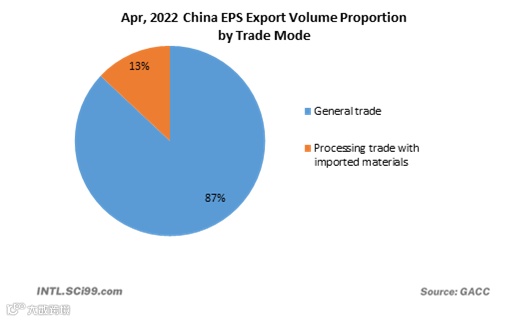
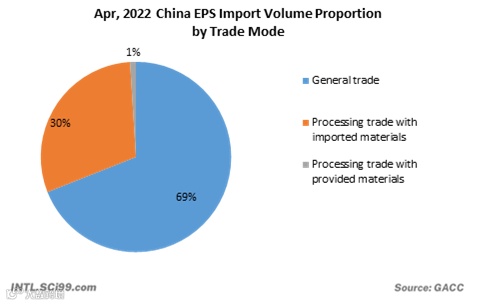
In April, the main trade mode of China’s EPS export was general trade, with a total of 14,279.77mt and taking up 87%. Another one was processing trade with imported materials (2,059.3mt), accounting for 13% of the total. Meanwhile, 1,187.77mt of EPS was imported via general trade, accounting for 69% of the total, followed by processing trade with imported materials (505.69mt; 30%).
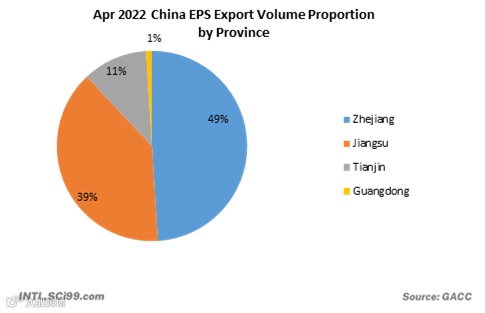
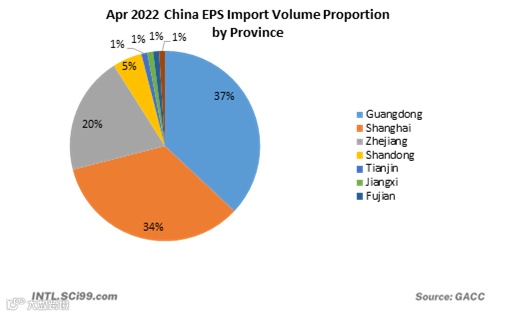
In April, from the perspective of receipt and delivery places, as for exports, Zhejiang ranked first with a total of 7,976mt, taking up 49%, followed by Jiangsu (6,306.3mt; 39%). As for imports, Guangdong ranked first with an import volume of 628.76mt, taking up 37%, followed by Shanghai (578.5mt;34%).
In May, China’s EPS demand will remain weak, and the consumption will improve limitedly. Therefore, the downstream purchases will be insufficient. In addition, the sea transportation will also affect the import and export of EPS. On the whole, the EPS import and export volume will likely improve in May.
All information provided by SCI is for reference only, which shall not be reproduced without permission.
Please click "Read more" for the full article.