

Methanol Market Bullish in Traditional Peak Season
In September, China’s methanol market ushed in a good start, with both the spot and futures prices rising over RMB 100/mt within the first 7 trading days within the month. Demand recovery, effective profit transmission, inventory declines and improved mentality together supported the market to climb steadily.
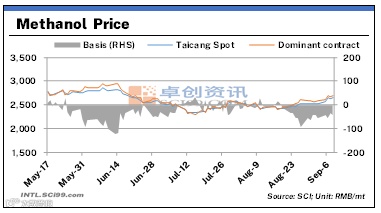
From early September, China’s methanol market prices began to rise steadily. Up to September 9, the methanol price averaged RMB 2,608/mt in Taicang, up nearly 5% from the monthly average in August. The uptrend met the market expectation and was consistent with the seasonal law of price fluctuations over the years.
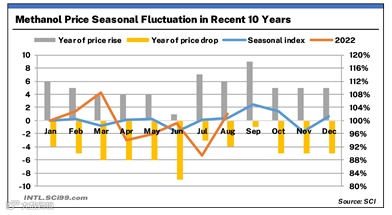
In general, China’s methanol market has relatively obvious peak and slack seasons in consumption, and the methanol price also shows some seasonal fluctuations. Based on the price trend in the past ten years, September usually saw a price rise in the methanol market. The major reason was that the methanol consumption, especially in traditional downstream industries, increased gradually with the end of hot and rainy weather.
Methanol demand improved with the increases in the operating rates of downstream units.
Major Methanol Downstream Industry Weekly Operating Rate
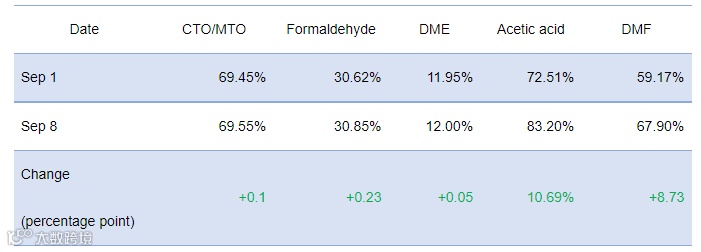
In September, the operating rates of methanol downstream industries advanced successively. On the one hand, the operating rates of most downstream industries were below the normal level in August. For example, some MTO units in East China were shut down for maintenance due to low profitability, and the production in some traditional downstream industries was also affected by the hot and dry weather to different extents. On the other hand, September is selling season for most downstream industries, so downstream plants show high production positivity so as to ensure their sales targets.
Smooth cost transmission in the industrial chain favored downstream acceptance to methanol price rise.
Major Methanol Downstream Product Price Changes
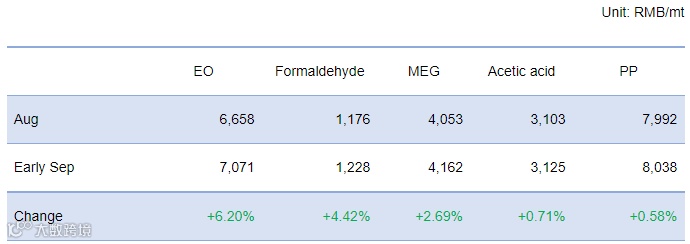
As shown in the above table, the prices of most methanol downstream and related products also rose somewhat, easing the cost pressure from the methanol price growth. In East China, the prices of PP were stable-to-rising in September, and those of EO and MEG, the derivatives of ethylene, also went higher from August. In addition, the prices of formaldehyde and acetic acid also increased. Thus, downstream buyers were able to accept methanol price rises to some extent.
Feedstock prices climbed, providing cost support to methanol prices.
In recent years, cost has played an increasingly stronger influence on methanol prices. For example, China’s methanol prices hit a historic high in 2021 when the coal prices rose notably on tight supply. However, with the feedstock prices softening against the measures of guarantee supply and stabilizing prices, the methanol prices also stepped on a downtrend. Entering September, the prices of coal used in the non-power fields rose somewhat, lifting the production cost at methanol producers. In early September, the feedstock prices in the major methanol producing areas increased by 13.3% from August.
Port inventory kept sliding, easing the supply pressure in the coastal market.
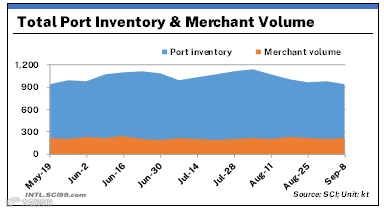
As shown in the above chart, the methanol port inventory presented a downtrend from August. On the one hand, the import volume in August dropped noticeably. On the other hand, downstream buyers picked up goods actively. Although the import volume in September was expected to rally with the transport capacity recovery in certain country of the Middle East and the restart of overseas units, the actual arrival in early September was slightly below expectation, as the bad weather resulted in temporary closure at some ports. Afterwards, the import arrival may increase marginally, but methanol sellers have no heavy pressure given the normal downstream delivery.
The possibility of methanol price rise is large in spite of some risks.
Expect the above bullish factors, China’s methanol market also faces some risks in September. The constant supply recovery may offset the favorable influence from the demand recovery to some extent. Moreover, the changes in the freight of individual transportation lines will affect market prices. In addition, with methanol prices rising, downstream acceptance will gradually weaken. At present, the market is still amid bullish and bearish factors, but the possibility of price rise is relatively large from the perspective of seasonality law.
All information provided by SCI is for reference only, which shall not be reproduced without permission.
Please click "Read more" for the full article.