

Ivory Board Market to Trend Narrowly Upwards in H2, 2022
Intro: In H1 2022, the ivory board market first rose and then declined, and the velocity of price change narrowed apparently from last year. Higher production costs and fairish export orders provided bullish support to the market. However, the market demand came below expectations, and the influence of the demand factors became more influential during the industry slack season in Q2. In H2, with the demand recovery, the cultural paper price may rebound under the pressure of high production costs and low industry profits. But as the market supply remains abundant, the price hike may be limited.
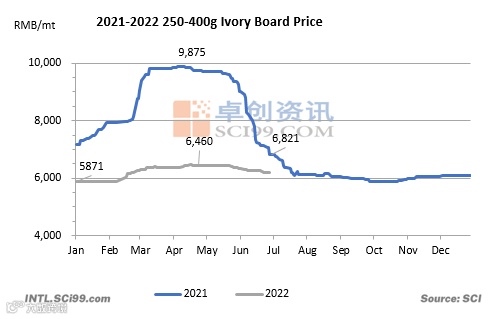
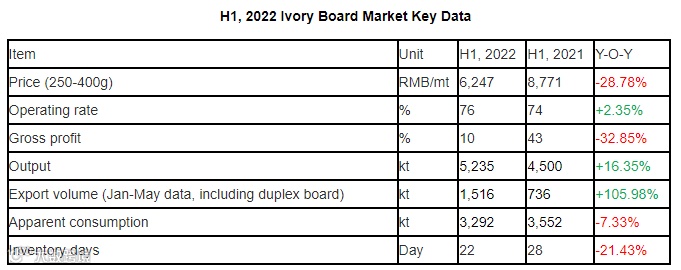
The market trend moved in line with the seasonality pattern, but the velocity of price change was not high. In H1, the ivory board market price first rose and then started to decline after May. According to SCI, the average market price of 250-400g ivory board in H1 of 2022 was RMB 6,246.56/mt, down RMB 2,524.25/mt or 28.78% Y-O-Y. The highest price appeared in late April at RMB 6,460/mt, while the lowest one appeared in late June at RMB 6,200/mt. The spread between the highest and lowest prices was RMB 260/mt or 4%. In contrast to H1 of 2021 during which the price change was as high as 31%, the price adjustments were less apparent this year.
Factors affecting the ivory board market include the following four aspects.
First, the global economy faced heavier downward pressure, and China put more effort into stabilizing economic growth. In addition to the influence of the previous force majeure factor on the supply chain, the market demand was generally weak. Second, the energy price surge was a double-edged sword for the paper market in China. On the one hand, the rising fuel and feedstock prices had put heavier cost pressure on domestic paper mills. On the other hand, the subsequent paper shortage in overseas markets also stimulated paper exports. Third, the previous round of ivory board capacity expansion aggravated market competition, and the market oversupply saw no improvement. Last, due to low market prosperity, the circulation of goods and funds had slowed down, leading to heavier downward pressure on the market, and the market sentiment was also restricted. In specific:
The market demand was tepid overall, and the peak season market performance was below expectations. In Q1, the market demand recovery after the Spring Festival holiday was interrupted by the domestic force majeure factor. Logistics in several regions had been restricted since mid-March, and some downstream players had to shut down, leading to weak market demand during the traditional peak season. The logistics recovery in the Yangtze River Delta region, which is an important consumer market, was slow. The logistics hindrance that lasted as long as 2 months not only created order losses within the region but also affected surrounding areas. Affected by that, the overall ivory board consumption was relatively weak. During the first 5 months of 2022, the ivory board apparent consumption volume was 3,291.7kt, down 7.33% Y-O-Y.
Feedstock costs remained high, squeezing the industry profit. Imported wood pulp prices first rose and then declined in H1 of 2022, leading to notably higher production costs Y-O-Y. Take SWP price as an example, according to SCI, the average imported SWP spot market price in H1 of 2022 was RMB 6,914.77/mt, up 2.28% Y-O-Y. The highest price appeared in May at RMB 7,478.57/mt, up 23.98% from the lowest one in January at RMB 6,032.14/mt. The rising wood pulp prices had driven up the ivory board production costs by 16.09% Y-O-Y, whereas the ivory board price was 28.78% lower Y-O-Y. As a result, the industry gross profit rate fell sharply by 32.85% Y-O-Y during H1 of 2022. Even though leading ivory board mills posted price increase notices 6 times in H1, the implementation had been poor due to insipid market demand.
Market supply picked up, but domestic sales pressure was eased by rising export volume. Aside from a few ivory board lines which went under maintenance, other ivory board lines maintained normal production. After two 900kt/a ivory board lines were put into production in Guangxi, the market supply went up apparently. In H1 of 2022, the ivory board output rose by 735.8kt to 5,235.3kt. The export volume rose by 834.1kt Y-O-Y, which was 98.3kt higher than the output increase. Therefore, due to decent exports, the domestic sales pressure on ivory board mills was counterbalanced. As of late June, the inventory at major ivory board producers was lower Y-O-Y. However, in H2, the boost from fairish exports diminished as the domestic demand became more insipid.
Futures market drivers:
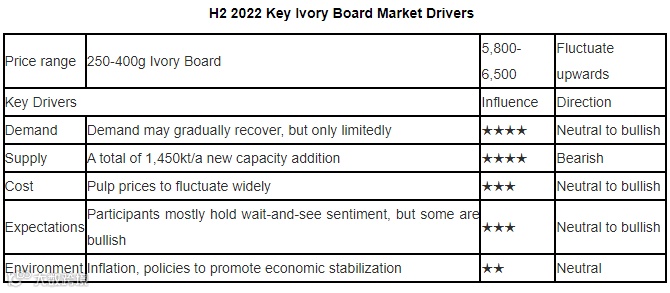
On the demand side, as the economy is on the mend, the market demand for paper packaging may recover with more festival consumption during H2 of the year. Orders may pick up in July ahead of the Mid-Autumn Festival holiday, and the market demand is expected to improve further during the traditional autumn peak season in September and October. But as the basis for economic recovery is not solid, the demand recovery may be limited against the background of economic stabilization.
On the supply side, the short-term inventory pressure on paper mills is not high, and the inventory levels of mainstream players are still manageable. Thus, they may continue to hold the price firmly. However, a 300kt/a ivory board capacity is expected to be launched in Shandong during H2, while a total of 1,150kt/a duplex board capacity in Guangdong and Chongqing may be switched to produce ivory board. Therefore, the supply pressure may continue to affect the market trend.
In terms of cost, the pulp market may become more volatile. The pulp market is more likely to fall in Q4 of the year but remains relatively firm in Q3. Therefore, the cost pressure on ivory board mills may be alleviated in H2, especially in Q4.
In conclusion, the ivory board market demand may recover in H2, but with the release of new capacity, market competition will be fierce. The industry profitability may improve as the pulp market goes on a downtrend. Ivory board mills are more eager to raise the price due to the slim profits in H1 and the expected demand recovery in H2. Thus, the ivory board market may fluctuate upwards in H2, but affected by the supply ramp-up, the space for price rise may be limited.

All information provided by SCI is for reference only, which shall not be reproduced without permission.
Please click "Read more" for the full article.