

China Methanol Market Influence on Global Methanol Trade Flow
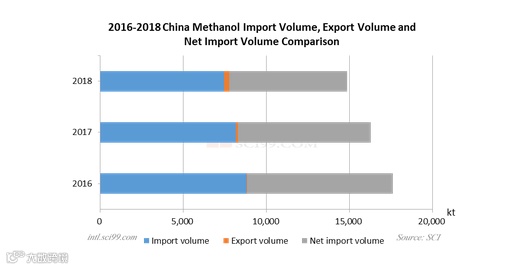
According to authoritative data, China’s annual methanol import volume was 7430kt, down 8.77% Y-O-Y, while the annual export volume was 312kt, up 146.64% Y-O-Y. The net import volume in 2018 dropped notably in from 2016 and 2017. What’s the major reason for this change, and how the global trade flow direction will vary? Here SCI will make a brief analysis.
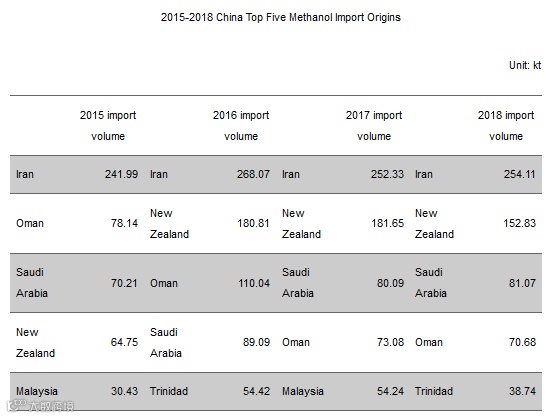
As seen from the above chart, the top five methanol import origins for China in 2018 were Iran, New Zealand, Saudi Arabia, Oman and Trinidad. The rankings had some changes from 2015 to 2018. The import volume from New Zealand has surpassed that from Oman and Saudi Arabia gradually, ranking the second. In addition, Malaysia was edged out of the top five. One of the reasons was that the methanol supply in the U.S. had become sufficient since the newly added methanol units with the capacity of 3,365kt/a were put into operation from end-2015 to early 2016. Thus, China has become the major export destination for the methanol resources from New Zealand since 2016.
In 2018, there was a newly added 1750kt/a methanol unit put into operation in the U.S., so its annual export volume increased notably from 2017. From 2020 to 2023, there still will be newly added capacity of 5,300kt/a, and the capacity of most methanol units is over 1,700kt/a each. At that time, the export volume from the U.S. is predicted to rise further. However, the export volume to China may be limited by the additional tax on the U.S.-origin methanol in the near term, and the ideal sales regions for the U.S.-origin methanol will still be Europe, South Korea, etc.
Influenced by the rising methanol supply in the U.S., the resources from South America (Trinidad and Venezuela) to the U.S. also declined. More resources were delivered to Asian regions for arbitrage, especially China. In December 2018, a shipment of Chile-origin cargoes (39.7kt) were delivered to China for the first time. In the following period, with the newly added methanol units in the U.S. put into operation intensively, the resources from South America to Asian market will continue to increase, which is needed to be monitored continuously.
In addition, the import volume from Malaysia to China also declined greatly to 336.5kt in 2018, only taking up 4.53% of the total and down 2% from 2017. It is predicted that Petronas will continue reducing the amount of long-term contracts in 2019, as it plans to extend its methanol industrial chain.
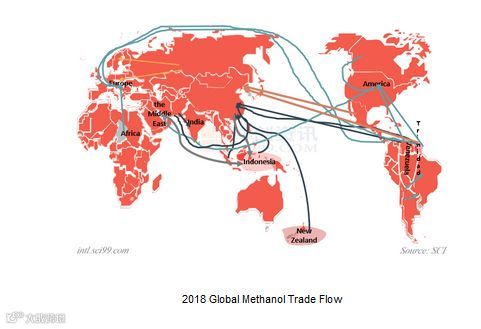
In 2018, the top five methanol export destinations for China were Indonesia, South Korea, India, Malaysia and Vietnam. The demand from the biodiesel field is still growing stably in Indonesia and Malaysia, so there will still be methanol resources delivered to these regions for arbitrage in 2019. However, the premium for the long-term contracts rose notably from 2018 in Southeast Asia, and the resources from the Middle East also increased. Thus, the market players still need to pay attention to the methanol demand and supply changes in Southeast Asia in 2019. In addition, the methanol adding proportion in fuel is rising in Vietnam and Cambodia, which will also bring some methanol demand.
On the whole, the global methanol trade flow directions may have no large change in the near term, but will be influenced by the newly added methanol resources in the U.S., the trade flow direction of South America-origin resources and the demand increase in Southeast Asia in the future.
……
More detailed information, please click "Read more".

For more information please contact us at
overseas.sales@sci99.com
overseas.info@sci99.com
+86-533-6296499