

China Butane Market to See Minor Recovery H2, 2023
China’s butane prices moved downward in H1, 2023, curbed by costs and supply and demand fundamentals. In H2, 2023, it is estimated that the international crude oil prices will probably move upward, underpinning China’s butane prices. Moreover, given the tug of war between supply and demand increments, it is predicted that China’s butane prices may hover at lows at first and then rebound in H2, 2023. With bullish impacts of demand peak season weakening, the overall butane prices are likely to go down.
According to SCI’s data, China’s butane prices moved downward in H1, 2023. Therein, the iso-butane prices dropped below RMB 5,000/mt, as the newly added iso-butane supply was higher than expected. As for the n-butane market, the overall n-butane market was tepid due to the limited downstream demand recovery. In H1, 2023, n-butane prices in Shandong averaged RMB 5,176/mt, down 21.05% Y-O-Y. As of June 30, 2023, the n-butane price in Shandong was RMB 4,200/mt, down 17.40% from the beginning of 2023. Besides, iso-butane prices in Shandong averaged RMB 5,684/mt in H1, 2023, down 17.00% Y-O-Y. As of June 30, 2023, the iso-butane price in Shandong was RMB 4,625/mt, down 24.37% from the beginning of 2023.
In H1, 2023, the highest n-butane price was RMB 6,075/mt in February. With the international crude oil prices rising, costs of n-butane went up, and the overall market sentiment performed well. Meanwhile, the n-butane supply in Shandong was tight, and downstream demand recovered somewhat after the Spring Festival holiday. Accordingly, n-butane prices reached high levels in February. Moreover, the lowest n-butane price was RMB 4,020/mt in June. Given declines in international crude oil prices and CP, China’s mixed butane import costs declined. Against the backdrop of cost pressure, market competition and sluggish demand, n-butane prices reached the annual lowest level in H1 June 2023.
In H1, 2023, the highest iso-butane price was RMB 6,700/mt in mid-January. Influenced by the New Year’s Day holiday, sales of oil-blending feedstock improved, stimulating the demand for iso-butane. Meanwhile, the overall iso-butane supply was rational. Accordingly, the overall iso-butane prices hovered at high levels. With iso-butane commercial volume rising, the overall market competition intensified, so iso-butane mainstream prices kept dipping. Therein, the lowest iso-butane price was RMB 4,325/mt in early June. In May, the overall iso-butane supply was ample, weighing down iso-butane prices. Meanwhile, most deep-processing enterprises adopted wait-and-see attitudes to feedstock market, exerting bearish impacts on iso-butane sales. Therefore, the overall iso-butane prices moved downward from May.
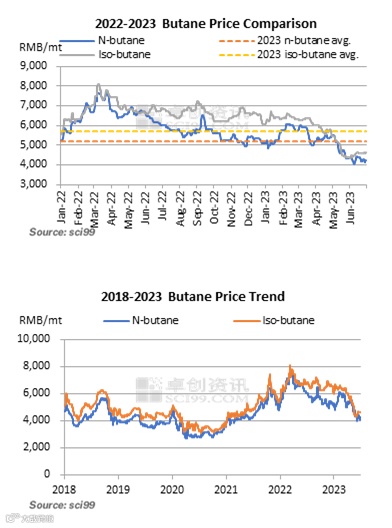
The international crude oil prices hovered at lows, weighing down prices of energy products and butane import costs. Accordingly, China’s butane prices fluctuated downward in H1, 2023. Therein, prices of n-butane downstream products decreased, and profits at downstream plants underperformed. Besides, iso-butane market experienced severer supply pressure.
The international crude oil prices fluctuated within a wide range and hovered at $70-90/bbl in H1, 2023. In May, the rebound in international crude oil prices weakened somewhat, so the overall international crude oil prices hovered at $70-80/bbl. The international crude oil prices witnessed notable Y-O-Y declines in H1, 2023, weighing on China’s butane market.
China’s butane CP went down in H1, 2023. In Q1, 2023, the overall butane import costs rose somewhat. However, the overall butane import costs dropped notably in Q2, 2023, as the demand for butane underperformed and market participants adopted bearish attitudes to CP. The cost decline exerted notable impacts on mixed butane prices. According to SCI’s data, China’s mixed butane prices kept dipping from April, and importer bought on the dips.
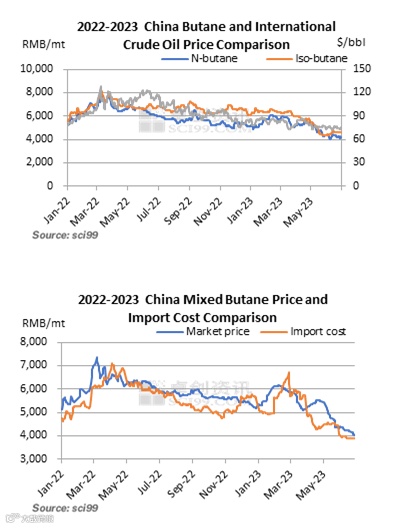
N-butane downstream profits underperformed, offsetting bullish impacts of demand improvement.
In H1, 2023, China’s n-butane output saw limited Y-O-Y changes. Meanwhile, n-butane downstream capacity expansion was minor, and only the 60kt/a MA unit at Binzhou Dayou New Energy was put into use at the end of May. According to SCI’s data, the average operating rate of MA units in H1, 2023 was 77.46%, down 3.86 % Y-O-Y, and the consumption of n-butane from the MA industry was about 550kt in H1, 2023, up 6.80% Y-O-Y. In terms of the n-butane isomerization industry, operating rates of n-butane isomerization units averaged 77.83% in H2, 2023, up 20.6% Y-O-Y, and the consumption of n-butane from the n-butane isomerization industry reached about 1,314.7kt, up 17.87% Y-O-Y.
Although the demand for n-butane from major downstream industries increased, most downstream users maintained just-needed procurement in the wake of notable profit shrinkage, hindering n-butane prices. According to SCI’s data, MA producers experienced profit losses from H2, 2022, and the average profit loss reached RMB 253/mt in H1, 2023. Meanwhile, n-butane isomerization plants experienced an average profit loss of RMB 96/mt.

Iso-butane supply increment was higher than expected, intensifying the market competition.
China’s iso-butane supply rose dramatically in H1, 2023. According to SCI’s data, iso-butane output totaled 1,870kt in H1, 2023, up 17.31% Y-O-Y. The iso-butane production at Shenghong Petrochemical was stable, hitting the surrounding markets. Meanwhile, Zhejiang Petroleum & Chemical sold more iso-butane resources to the market. Given sufficient resources in Shandong, most producers arranged resources for captive use or stopped selling resources to evade risks. Although profits from producing iso-butane dehydrogenation MTBE in H1, 2023 increased by 200% Y-O-Y, most downstream users adopted cautious attitudes to feedstock procurement with oversupply. Therefore, the overall iso-butane prices hovered at lows.
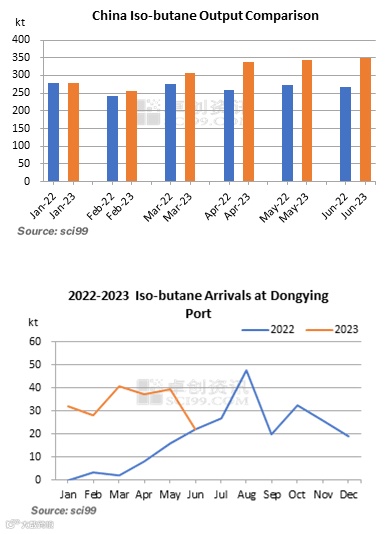
Entering H2, 2023, China’s butane market will probably be influenced by changes in foreign energy products, impacts on butane demand of new unit startup, changes in supply and demand fundamentals, etc.
The international crude oil prices are likely to fluctuate upward, supporting China’s butane market.
Although the Fed may further raise the interest rate, the macro environment may give support to the international crude oil market, as the market will enter a rate cut cycle after the tail end of the rate hike and monetary liquidity will probably be eased again. Moreover, the OPEC+ crude oil production cut and insufficient idle crude oil capacity in the U.S. may give support to the international crude oil prices. Furthermore, the demand for crude oil in the U.S. is likely to improve. Besides, with the approach of summer, weather changes may exert impacts on the international crude oil market, and the crude oil stock in the U.S. may be relatively low. Accordingly, it is estimated that the international crude oil prices will probably move upward in the future, directly influencing China’s LPG market prices.
China’s newly added MA units may be put into use intensively in H2, 2023.
It is predicted that China’s newly added MA capacity may reach 1,080kt/a, and the demand for n-butane is likely to improve 1,170kt. According to the current n-butane supply-demand pattern, some MA producers may need to get n-butane from mixed butane separation, lifting China’s butane import. However, the overall iso-butane supply is likely to increase, weighing down the overall iso-butane prices.
Although the newly added downstream capacity may lift the demand for n-butane, it will probably weigh down prices of downstream products and hit the existing units. Profits from MA production underperform, so MA producers experience severe pressure. Accordingly, the overall procurement enthusiasm is sluggish. With newly added MA units coming on stream, the overall MA production profits will probably influence n-butane procurement. In H2, 2023, there will probably be newly added MA capacity at leading enterprises, and the capacity of one MA unit is likely to surpass 200kt/a, hitting medium and small-scale enterprises.
The improvement in butane prices in traditional demand peak season may be limited.
In general, the demand for n-butane performs well from August to October, mainly supported by the relatively favorable MA consumption, but it becomes tepid in winter. Moreover, the demand for iso-butane is strong in March, April, August, September and October. Therein, refineries take overhauls intensively in March and April, dragging down the overall iso-butane supply. From August to October, supported by the favorable gasoline demand, prices of MTBE and alkylate increase notably, lifting the demand for iso-butane. Given changes in supply and demand, it is estimated that the highest butane price in Q3, 2023 may be lower than that in Q1, 2023. Overall, China’s butane prices may increase to high levels in September, backed by the demand improvement. However, the overall butane price increment may be limited.
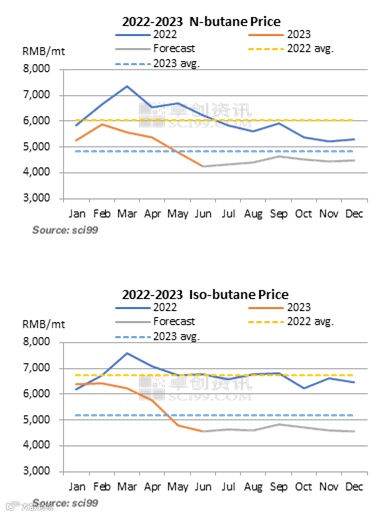
Overall, it is estimated that China’s butane prices will probably hover at lows in H2, 2023 and may see slightly improve from August to October. China’s n-butane and iso-butane prices may hover at RMB 4,000-5,000/mt in H2, 2023. Therein, the highest price may appear in September or October, and the lowest level may be in August or December.
All information provided by SCI is for reference only, which shall not be reproduced without permission.
Please click "Read more" for the full article.