

LNG Import Developed to Help Ensure China Gas Supply
Introduction: China’s natural gas supply became tight since 2017. Due to the lack of peak-shaving ability, China relies more and more on the LNG spot resources. Thus, China’s LNG import volume finally exceeded PNG import volume.
In May 2006, the CNOOC Dapeng Terminal started operation as China’s first LNG receiving terminal. Then in 2007, China became a net importer of natural gas. China’s natural gas dependence degree was 10% in 2010, 30% in 2013, 39% in 2017 and was predicted to be 45% in 2018. In order to ensure the gas supply, three new terminals started running (Sinopec Tianjin, ENN Zhoushan and CNOOC Diefu) started in 2018, and new PNG import contracts were signed to raise the PNG import volume by 5 bcm/a.
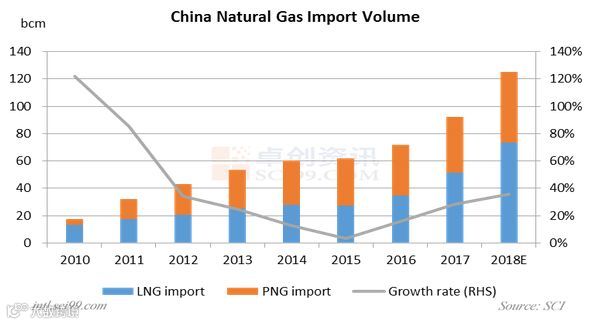
Due to the sluggish downstream market from 2011 to 2015, China’s gas demand was weak in those years, and the growth rate decreased obviously. From 2016 to 2017, the government carried a series of environmental protection policies, such as the coal-to-gas reform, pushing up the gas demand. Thus, the gas import growth rate kept over 20% in the past three years. According to SCI, China imported 12.50 bcm gas in 2018, up 35.47% Y-O-Y. The import volume of PNG was 51.42 bcm, up 25.73% Y-O-Y. And that of LNG was 73.61 bcm, up 43.23% Y-O-Y.
China’s natural gas resources are limited, thus the state has to import many to fulfil the increasing downstream demand. Just like what happened in 2017, the growth rate of China’s LNG import volume was larger than that of PNG. There were two reasons leading to this situation. First, PNG import needs pipelines. However, the construction of pipelines can last for a long time and might be affected by politics. Thus, the PNG import increases slowly. Second, the LNG terminals are a kind of peak-shaving facilities. Though usually, 80% of the LNG imports are via long-term contracts, natural gas importers could still import more LNG spot sources in the peak season. The extremely tight gas supply in 2017 winter and the bullish gas demand in the traditional slack season in 2018 pushed up the growth rate of LNG import to 45%.
China’s gas import volume is predicted to continue to increase obviously in 2019 to ensure the sufficient natural gas supply. The China-Russia Pipeline is predicted to be put into operation at the end of 2019, pushing up the PNG import volume. Besides, the new LNG terminals in Zhangzhou and Chaozhou are also predicted to be put into operation in the year. SCI predicts that the total natural gas import volume will be 157.4 bcm in 2019, up 25.9% Y-O-Y. The import volume of PNG will be 61.7 bcm, up 20% Y-O-Y. And that of LNG will be 95.7 bcm, up 30% Y-O-Y.
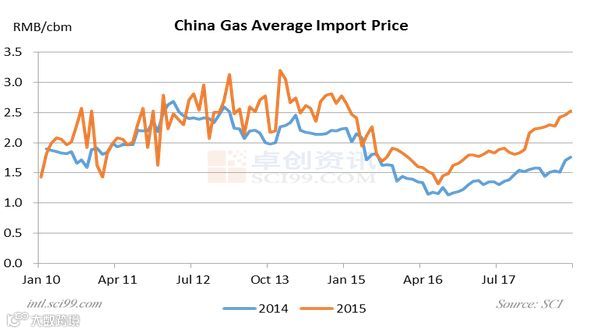
Up to September 2018, China’s average import price of PNG and of LNG was RMB 1.58/cbm and RMB 2.32/bcm separately, up RMB 0.14/cbm or 9.48% and RMB 0.57/cbm or 32.58% Y-O-Y separately. BP’s data showed that the global natural gas consumption volume increased by 96 bcm in 2017, up 3% Y-O-Y (which was the highest growth rate since 2010). And the natural gas production volume increased by 13.1 bcm in 2017, up 4%. SCI predicts that the natural gas import will develop further, especially the LNG import. The LNG import, due to its timeliness and flexibility, has already been an important part to ensure China’s natural gas supply.
……
More detailed information, please click "Read more".

For more information please contact us at
overseas.sales@sci99.com
overseas.info@sci99.com
+86-533-6296499