

Pulp and Paper Integration to Reshape Industry Pattern – An Outlook into China Pulp Market in 2023
Intro: China’s pulp market supply and demand may see minor improvements in 2023, and the influence of the market supply-demand fundamentals on prices mainly comes from two aspects. On the one hand, the constant release of newly added HWP capacity will affect the HWP price, and the limited SWP capacity expansion as well as other uncertainties may affect SWP supply. Second, under the background of pulp and paper integration, the supply of Chinese-made wood pulp will increase. The dependence on imported wood pulp will decrease, weighing on pulp prices. On the demand side, with the acceleration of the pulp and paper integration process in China, the market competition pattern will be reshaped, and the paper market may face downward pressure. Also, with the release of newly added paper capacity, pulp consumption will be supported effectively. In the future, the trend of pulp and paper integration will be apparent. In the meantime, affected by policy and macro factors as well as the financial attributes of the product, it is estimated that the wood pulp import dependence degree will decrease further, and the gross profit rate of the paper industry will improve.
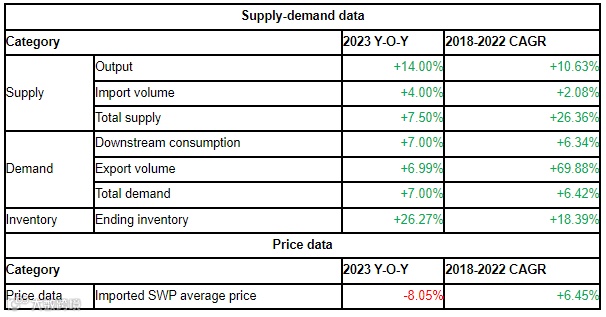
Remark: The above data is calculated based on the estimated growth rate of newly added capacity. In the future, the data will be subject to the influences of the marginal change of overall supply and demand, macroeconomic changes, the competitive advantage of pulp and paper integration, the change of raw material structure caused by the price difference between SWP and HWP, the actual commissioning status of new pulp and paper production capacity, the increase of wood pulp demand led by China’s plastic ban, solid waste import ban and carbon neutrality policies, uncertainties in international and domestic situations, and market participants’ expectations.
Key data interpretation
1. Pulp prices may drop by 7.58%-12.14% Y-O-Y
In 2023, imported SWP, HWP, UKP and CMP prices are expected to drop constantly, and annual average prices may drop by 8.05%, 11.87%, 12.14% and 7.58% respectively Y-O-Y. The annual average price changes are mainly affected by the market supply-demand fundamentals, cost, the financial attribute of the product as well as policy factors. In specific:
First, the newly added capacity in China and overseas countries will mainly produce HWP, CMP and semi-chemical pulp, but limited SWP capacity is planned. In the meantime, considering extended turnarounds and strike-related shutdowns in 2022 as well as aging SWP production lines, there may still be uncertainties in SWP supply in 2023. In contrast, bolstered by newly added HWP and CMP capacity and pulp and paper integration trend, the HWP import volume is expected to increase, and the total pulp supply may rise by 7.50% Y-O-Y in 2023.
Second, as of October 2022, there are numerous planned and under-construction new paper projects in downstream tissue, P & W paper and packaging paper (ivory board and cardboard paper) with a combined capacity of roughly 11,750kt/a. Considering the estimated commissioning data, the operating rates of newly added capacity, the general industry overcapacity and the macro factors, the pulp demand volume may increase by 7% Y-O-Y in 2023.
Third, with the clear pulp and paper integration trend, the market competition pattern may be reshaped, and the price of wood chips will rise steadily. According to customs data, the average hardwood chip import price during the first 11 months of 222 is $213.47/mt, up 21.70% Y-O-Y, and that of softwood chip is $253.36/mt, up 5.49% Y-O-Y. In 2022, the wood pulp import and spot prices have reached five-year highs, imposing cost pressure on the paper industry.
Fourth, the dominant BSK contract price at SHFE has hovered at highs in 2022, affecting participants' sentiment and the spot market trend in 2023.
Last, the influence of policy factors still exists, especially the policy adjustments around late December will continue to affect the market trend.
2. The wood pulp import volume may rebound by 4% Y-O-Y

In 2023, the wood pulp import volume of China may climb to 24,004.2kt, up 4.00% Y-O-Y. The major drivers are as follows. 1. The newly added capacity totals 12,471kt/a in 2023. Therein, the HWP capacity accounts for 65% of the total, and most new projects target the China market. Therefore, the HWP import volume is expected to increase. 2. If the port inventory in Europe continues to accumulate, more volumes may be redirected to the Chinese market. 3. With the pulp and paper integration process in China, the import dependence degree may drop, but the wood pulp consumption will increase nonetheless. So if overseas pulp suppliers lower prices in exchange for sales volume, Chinese buyers may be more active in purchasing.
3. Pulp output may increase by 14.00% Y-O-Y
It is estimated that the pulp output of China will increase by 14% in 2023 mainly due to the following factors. 1. The pulp and paper integration trend is clear in China with numerous planned and under-construction projects at leading market players. Backed by the cost advantage, the pulp output may increase steadily. 2. Although imported wood pulp prices may remain in a downtrend, the price drop may take time due to the high concentration ratio on the sellers’ side. The profitability of the domestic pulp industry is passable, and few domestic players will curb production. In the meantime, downstream paper mills will continue to optimize production costs, and the demand for Chinese-made pulp will be firm. 3. The wood pulp import volume increase may be limited with Chinese-made pulp gaining market share. Paper mills favor spot resources that are reasonably priced with short transportation time.
4. Wood chip prices continue to climb, affecting pulp prices
In 2022, the price of imported wood chips has increased constantly, and the trend is expected to persist in 2023. The main reasons behind the price rise were as follows. 1. The HWP import dependence degree is expected to drop with the pulp and paper integration process in China, but because China is short of forest resources, and the demand for hardwood chips will grow steadily, pushing up the average price. 2. Against the background of the global energy crisis and high inflation, the economy still faces pressing downward pressure. The timber consumption in the construction industry diminishes, and there may be unexpected downtimes at sawmills, which may affect the supply of wood chips. However, the newly added pulp capacity will lead to higher demand for wood chips. Therefore, the wood chip price is expected to increase. The cost of wood chips takes up 70%-80% of the total pulp production costs, and the rising cost pressure will provide bottom support for the HWP price in 2023.
5. Pulp consumption may increase by 7.00% Y-O-Y.
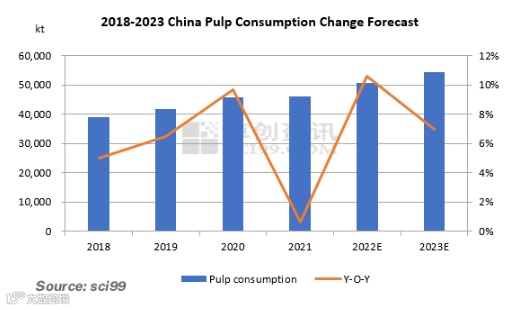
In 2023, the pulp consumption volume in China may rise by 7.00% to 54,402.8kt backed by the constant release in downstream paper capacity in 2022 and 2023. Besides, the paper export may increase. In addition to the falling shipping freight, the operating rates of existing paper capacity may also increase, bolstering pulp consumption.
6. Pulp export volume may increase by 6.99%.
In 2023, China’s pulp export volume may rise by 6.99% Y-O-Y, which narrows slightly from that in 2022. China is one of the top pulp consumers in the world but restricted by its forest resources, the import dependence degree is relatively high. Thus, the export volume is low, accounting for less than 1% of the total demand. Most of the pulp exported is via entrepôt trade. It is estimated that the pulp export may continue to increase because of the falling HWP price, and some players may export pulp to ease the supply pressure in the domestic market. In the meantime, buyers in surrounding countries may purchase pulp from China or by entrepot trade via China considering the cost and shipping factors.
7. Policy factors may continue to affect the market trend
In early December, related policies regarding special circumstances in China have been implemented. On the other hand, on December 28, the tariff commission released the tariff adjustment plan for 2023. Therein, tariffs involving certain P & W paper, cardboard packaging paper and sanitary products are adjusted to 0. The above two policies will support the orderly movement of the paper industry and may reshape the competitive pattern in downstream industries, and put downward pressure on the pulp price.
8. The pulp market may trend under pressure in 2023
In 2023, the supply-demand balance in China’s pulp market will continue to evolve, and the market oversupply may become prominent, weighing on the pulp prices. In the meantime, the reshape of the industry pattern will accelerate with the pulp and paper integration process.
On the supply side, due to the constant release of new market pulp capacity, especially the MAPA project in Chile and UPM’s Paso de los Toros project, as well as domestic integrated capacity in China, the pulp supply will continue to increase.
On the demand side, the paper capacity will be in a capacity expansion cycle in 2023 with a clear trend of pulp and paper integration. Besides, the industry concentration ratio will continue to increase. It is estimated that industry profitability will improve, which will facilitate the steady increase in pulp consumption.
In terms of cost, the issue with tight imported wood chip supply may see no short-term remedy, and the cost factor will provide bottom support for the wood pulp market.
As for other factors, there are uncertainties in the BSK future dominant contract price trend, and it may take time for the pulp import and spot prices to drop. Besides, the tariff adjustments will bring extra competitive pressure on the paper industry, which will also affect the pulp market.
The above outlook is based on market fundamentals only. The BSK futures market and the macro factors may also affect the pulp market. In addition, it is advised to pay attention to the influences of marginal changes in supply-demand fundamentals and other uncertainties.
All information provided by SCI is for reference only, which shall not be reproduced without permission.
Please click "Read more" for the full article.