

Propylene Prices to Hover at Lows in Q2
The feedstock costs exerted notable impacts on propylene prices in Q1, 2023 amid the tug of war between supply and demand. In Q1, 2023, China’s propylene prices increased at first and then moved downward, but the M-O-M changes of average price were limited. In Q2, 2023, impacts of costs may weaken. Moreover, the supply and demand fundamentals will probably be sluggish. Accordingly, it is predicted that propylene prices will continue to hover at lows.
In Q1, 2023, China’s propylene prices increased at first and then moved downward, but the M-O-M changes of average price were limited. Meanwhile, propylene prices in Shandong averaged RMB 7,365/mt in Q1, 2023, down 0.03% M-O-M and down 9.84% Y-O-Y. Therein, the highest price was RMB 7,750/mt on January 28, and the lowest price was RMB 6,800/mt on March 24. Feedstock prices showed ups and downs, so the overall costs exerted dramatic impacts on propylene prices. Moreover, the overall propylene supply in Q1, 2023 declined by 2% M-O-M, supporting propylene prices. Besides, the total consumption of propylene shrank by 2% M-O-M, weighing down propylene prices.
Q1, 2023 Propylene Industry Chain Quarterly Price Comparison
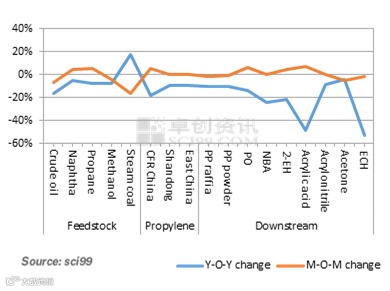
In Q1, 2023, prices of products in the propylene industrial chain fluctuated within a narrow range but largely saw Y-O-Y declines, and prices of some chemical downstream products declined notably Y-O-Y. As for the propylene feedstock, the international crude oil prices and China’s propane prices increased at first and then waned but dropped Y-O-Y. Accordingly, the propylene cost support waned Y-O-Y. In terms of downstream product, prices of propylene downstream products saw limited M-O-M fluctuations but were curtailed Y-O-Y. Moreover, the decline in NBA, 2-EH, acrylic acid and ECH prices was dramatic. Accordingly, the demand for propylene decreased notably Y-O-Y. PP price trend was highly correlated with propylene price. In January, influenced by the international crude oil price increments and replenishment before the Spring Festival holiday, propylene prices moved upward. From February to March, although the propylene supply gave support to the market, the overall propylene demand remained sluggish. Accordingly, propylene prices fluctuated downward.
1. Propylene feedstock prices saw frequent fluctuations, so production costs exerted notable impacts on propylene market.
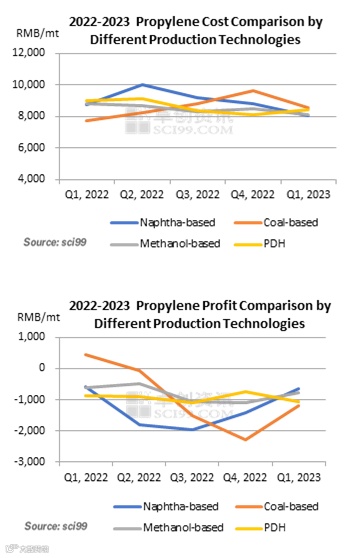
In Q1, 2023, propylene feedstock prices increased at first and then declined, and they were highly correlated with propylene prices. The overall feedstock gas prices remained relatively high, so the overall propylene industry profits remained sluggish. In January, the international crude oil prices and China’s propane prices kept rising, so propylene producers experienced severer cost pressure. PDH plants experienced severe profit losses, so the overall operation enthusiasm of the propylene industry waned, notably putting a dampener on the propylene price increments. From February to March, the international crude oil prices and China’s propane prices fluctuated downward, so the propylene cost support weakened somewhat. Accordingly, propylene prices went down. In Q1, 2023, production costs of propane-based propylene rose somewhat, and production costs of propylene produced via other technologies declined somewhat. However, the overall propylene production profits remained negative, so the overall propylene profitability remained mediocre.
2. China’s propylene supply in Q1, 2023 declined by 2% M-O-M, supporting propylene prices.
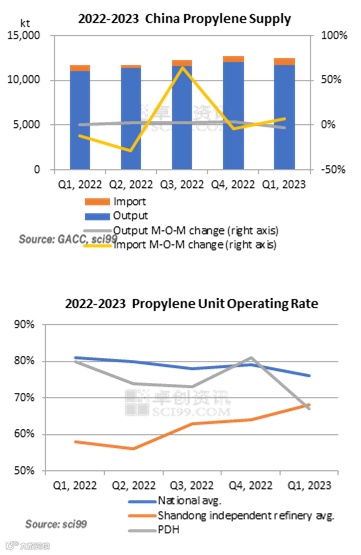
In Q1, 2023, China’s propylene total supply declined by 2% M-O-M, giving support to propylene prices. Therein, China’s propylene output dropped by 2.35% M-O-M, and China’s propylene import volume might increase by 6.75% M-O-M. Production costs of oil-based propylene went down, so operating rates of propylene units at refineries inched up M-O-M. Influenced by the propane price increments, many PDH plants shut units down for maintenance or cut unit operating rates. Accordingly, the operating rate of the PDH industry dropped by 14% M-O-M. In March, China’s PDH unit operating rate dropped below 60%, dragging down the operating rate of the propylene industry. According to SCI’s data, the average operating rate of the propylene industry was about 76% in Q1, 2023, down 3% M-O-M. Given the decline in China’s propylene output, the overall propylene supply in China went down, supporting propylene prices. Although China’s propylene import volume increased somewhat, the increment in propylene import volume exerted limited impacts on China’s propylene market.
3. China’s propylene consumption volume in Q1, 2023 declined by 2%, dragging down propylene prices.
In Q1, 2023, China’s propylene total consumption volume shrank by 2% M-O-M, exerting bearish impacts on propylene prices. Therein, China’s propylene downstream consumption volume shrank by 2%, and China’s propylene export volume might increase by 2%. China’s PP demand was tepid in Q1, 2023, dragging down the overall propylene demand. In January, end plants took holidays in succession before the Spring Festival holiday. After the holiday, the production recovery was slow, so the demand for PP underperformed, impairing propylene demand. From February to March, the demand for PP saw limited improvements, and most PP producers experienced cost pressure. Accordingly, the operating rate of the PP industry kept dipping, dragging down the demand for propylene and exerting bearish impacts on propylene prices. Profits from producing other chemical downstream products were normal. Given the relatively intensive unit maintenance, the demand for propylene from chemical downstream industries was fairish. In Q1, 2023, the operating rate of propylene downstream industry was about 69%, down 2% Y-O-Y. It is predicted that propylene export volume will inch up, exerting limited impacts on propylene market.
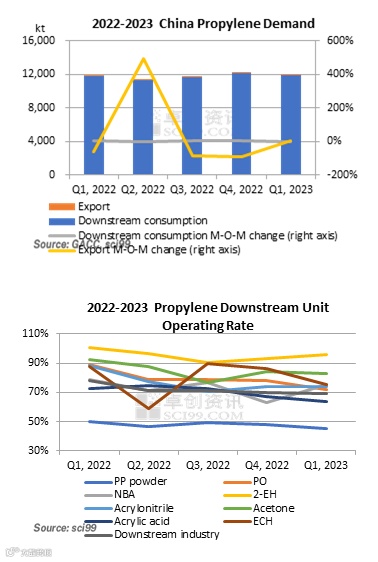
In Q1, 2023, propylene downstream product profitability underperformed, and the downstream industry profit declined notably Y-O-Y. Therein, the average production profits of PP powder, acrylonitrile and phenolic ketone remained negative, and those of other products were positive but relatively low. However, profits from producing acrylic acid and ECH became negative sometimes. Profits from NBA, 2-EH, phenolic ketone, acrylic acid and ECH production declined dramatically Y-O-Y. Accordingly, downstream plants showed resistance to high-priced propylene resources, and the downstream operation enthusiasm weakened. Therefore, the overall propylene demand underperformed in Q1, 2023, exerting bearish impacts on propylene prices.
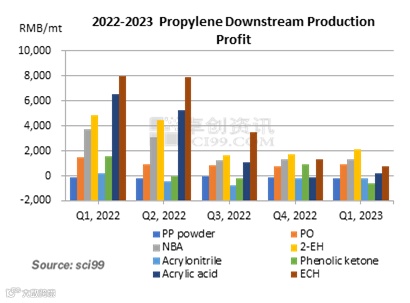
China’s propylene prices will probably hover at lows in Q2, 2023 with bearish expectations for cost and supply and demand fundamentals.
Cost: In Q2, 2023, impacts of feedstock costs on propylene prices may weaken, and those of supply and demand fundamentals may slightly strengthen. The PP market may be the key factor influencing propylene prices, and other factors may remain largely unchanged. It is estimated that the international crude oil prices will fluctuate upward in Q2, 2023, supporting propylene costs. Moreover, propane prices declined to low levels at the end of Q1, 2023. It is estimated that the overall propane prices will hover at lows in Q2, so the propylene cost support may weaken M-O-M. Given the fluctuations in feedstock prices in Q2 may narrow from Q1, so impacts of feedstock costs on propylene prices may weaken in Q2, 2023.
Supply: It is predicted that the overall propylene supply will rise in Q2, so the supply pressure may increase. PDH unit profits improved somewhat at the end of Q1, 2023 with propane prices declining to low levels. Against the backdrop of relatively low propane prices in Q2, the former overhauled PDH units may be restarted in succession, propping up China’s propylene output. Accordingly, China’s propylene market is likely to experience severer supply pressure in Q2, 2023.
Demand: The overall propylene demand may see minor improvements in Q2, 2023. The PP demand may be relatively sluggish. The unit maintenance is likely to be limited, and newly added PP capacity may be put into use in Q2, 2023. Given the PP oversupply, it is predicted that the demand for propylene from the PP market may be curtailed. Accordingly, the PP price trend will probably be the key factor influencing propylene demand. Besides, profits from producing chemical downstream products may be tepid, so it is estimated that most chemical downstream plants will maintain just-needed procurement, giving thin support to propylene demand.
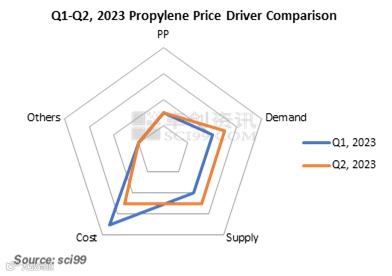
Overall, impacts of feedstock costs on propylene prices may weaken in Q2, 2023, and the overall propylene market supply and demand fundamentals will probably be sluggish. Therefore, it is estimated that propylene prices will hover at lows.
All information provided by SCI is for reference only, which shall not be reproduced without permission.
Please click "Read more" for the full article.