Effect of Abolishing PVC Anti-Dumping Duties on China Market
On October 30, the Ministry of Commerce announced the cancellation of China’s anti-dumping duties (ADDs) on PVC imports from the U.S., Japan, South Korea and Taiwan Province. But its impact on China’s market is limited in the short run. In the long run, and the possibility that foreign major sources enter China based on the general trade mode will rise.
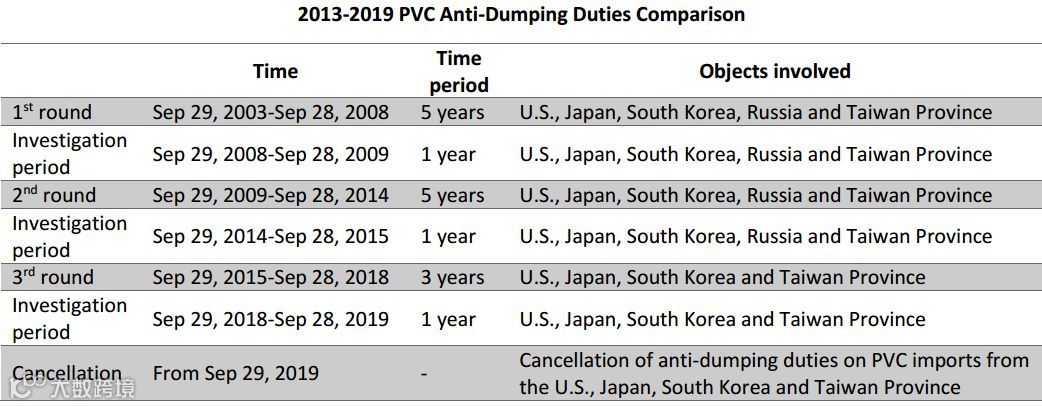
On October 30, 2019, the Ministry of Commerce published No. 43 Announcement of 2019, which said that since September 29, 2019, China canceled anti-dumping duties on PVC imports from the U.S., Japan, South Korea and Taiwan Province. It means the end of 16-year anti-dumping policy (including investigation period)
In the past month, market players speculated for many times about whether PVC anti-dumping duties would be canceled, and most of them were more inclined to think they would end.
The cancellation of China’s PVC anti-dumping duties will impact the international trade competition a lot. Therein, the U.S. has the most obvious cost advantage. It is the world’s largest PVC exporter, and the PVC international trade volume in the U.S. accounts for about 30% of the global one. The PVC exports from the U.S. mainly flowed into South America, South Asia and East Asia markets. Taiwan Province and Chinese Mainland are also major export destination of PVC, accounting for about 25% of the global trade volume. Chinese mainland mainly exports PVC resources to Southeast Asia, India, Central Asia and Russia. Taiwan Province’s PVC supply mainly flows to Chinese mainland, Southeast Asia, India, etc. In addition, Europe, Central and South America, Southeast Asia, Japan and South Korea are also major PVC exporters.
This shows that the U.S., Japan, South Korea and Taiwan are all prominent PVC traders. In the past 16 years, China has been implementing anti-dumping duties against these areas, which played a huge positive role to promote the development of China’s PVC industry.
Nowadays, China’s PVC market has changed. China has become the largest producer and consumer of PVC in the world. As of October 2019, China’s PVC capacity was 253.4kt (including PVC paste), accounting for 43.5% of global PVC capacity. The scale and integration of China’s PVC industry have also increased significantly.
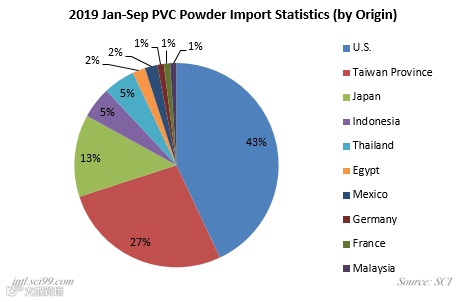
After obtaining the news of cancellation of China’s PVC anti-dumping policy, market participants begin to focus on whether the future foreign supply has an impact on China’s market. To understand this problem, let us first look at the import structure of PVC in China. As can be seen from the below chart, the main origins are the U.S., Taiwan Province and Japan. In addition, the PVC import volume from Indonesia, Thailand, Egypt and Mexico are also high.
Before the anti-dumping policy was abolished, the U.S., Japan and Taiwan Province mainly entered China via the trade mode of processing trade with imported materials. After it was abolished, whether there will be more resources exported from the U.S., Japan and Taiwan Province to China via the general trade mode or not is determined by the price spread between China’s and foreign resources.
First of all, although Sino-U.S. trade friction has eased in the near future, it is still more difficult to be completely reconciled. From the current price comparison, the import cost from the U.S. is higher than the domestic market price, and the arrival period is long. Therefore, the PVC import from the U.S. via general trade mode lacks advantages in the short term.
Secondly, the offer for November cargoes from Formosa Plastics in Taiwan Province was $840/mt CFR China (volume discount: $10/mt for 500mt). In the short term, it is also difficult for its resources to enter the Chinese mainland in the form of general trade. However, in the long run, the possibility will be large.
Finally, the offer for Japanese supply generally refers to that of Formosa Plastics, but the Japanese supply mainly flows to the Indian market. In most cases, the Indian market has a competitive advantage over the Chinese market price. Unless the Chinese market has an extremely large price advantage, the Japanese supply will enter China.
On the whole, after China canceled PVC anti-dumping duties, foreign sources will not enter the Chinese market in the short term. In the long run, theoretically, the PVC sources of Formosa Plastics will enter the Chinese market. It is necessary to pay close attention to the price difference between China’s and foreign major sources.
For more detailed information, please click "Read more".

For more information please contact us at
overseas.sales@sci99.com
overseas.info@sci99.com
+86-533-6090596



 SCI99
SCI99