

H1 2019 China Wood Pulp Market Fundamentals Review and Outlook
In H1 of 2019, the imported wood pulp price first increased and then decreased, and the price fell back to a low level last seen in Q4 2016. In H1 of 2019, the imported wood pulp price first increased and then decreased. Therein, the import price of Fibria and Suzano HWP was around $720/mt; the import price of Arauco SWP increased by $30/mt to $710/mt in March. However, the wood pulp import prices fluctuated downwards in Q2 due to weak demand, with prices being adjusted more frequently in a month. In June, the import prices of SWP and HWP went down by $60/mt and $190/mt respectively from early 2019.
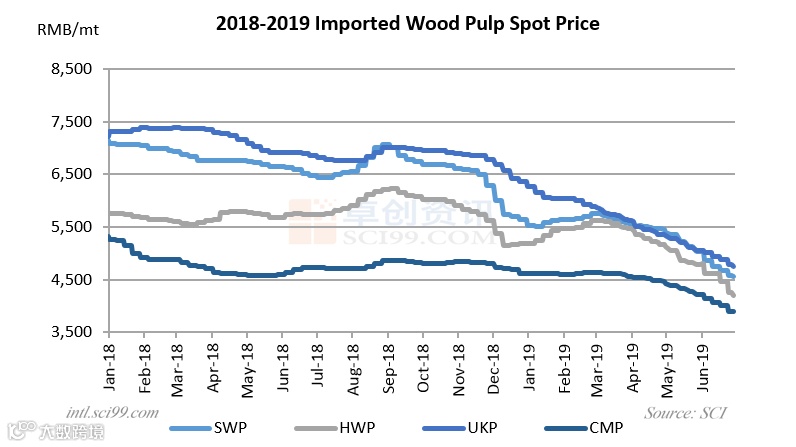
The imported wood pulp spot price first increased and then decreased. In January and February, the spot market price warmed up because the wood pulp import offers were firm. In addition, downstream paper mills replenished their inventory before the Spring Festival holidays. The SWP and HWP prices increased by RMB 100-200/mt and RMB 200-600/mt in January and February respectively. However, the wood pulp spot price had started to trend down in March due to high pulp inventory in major regions. The SWP and HWP prices decreased by RMB 1,000-1,550/mt and RMB 1,200-1,850/mt respectively from March to June, backing to the level in Q4 2016 before the price increase.
The gross profit rate of imported wood pulp dropped to a 5-year low, and it went in opposite with that of paper products. The gross profit rate of imported wood pulp showed an “N-shaped” trend. By the end of June, the gross profit rate of imported Arauco SWP was -25.58%, and that of HWP (Brazil-origin eucalyptus pulp) was -16.32%, hitting at a 5-year low. The gross profit rate at downstream paper mills was affected by their import orders and inventory. The change in gross profit rate is usually slow in effect. The gross profit rates of some paper grades turned negative in Q1 due to high wood pulp import and spot prices. In Q2, the gross profit at paper mills gradually improved because of wood pulp price in discount and paper mills pushing up the paper price. The gross profit rate went back to normal in late June.
SCI Outlook
Supply: The HWP export volume from Brazil to China in H1 2019 increased by 370kt or 12% Y-O-Y; the SWP export volume from Canada to China between January and May declined by 20kt or 2% Y-O-Y. The average global HWP inventory in days from January to May was 64, 34 days higher Y-O-Y. The average global SWP inventory in days was 39, 3 days lower Y-O-Y. The supply pressure on HWP traders is high in the coming months, and players are advised to pay attention to the actual output decrease caused by unit turnarounds and prolonged maintenances. The paper industry will enter the traditional boom season from August to October. Besides, the feedstock inventory is managed at a low level at paper mills. The oversupply in the pulp market may ease if the demand grows.
The cost of imported wood pulp in the spot market are determined by the import prices. Players are advised to pay attention to the actual output reduction volume at overseas pulp mills and their operating strategies.
The China-U.S. trade relationship improved after the G20 summit. The market confidence revived, benefiting market transactions. The China-U.S. trade relationship is still worth paying attention to in H2 of 2019.
According to SCI, the imported wood pulp spot price may first decrease and then increase in Q3. The paper industry will still be in the slack season in July with limited demand increase. The demand increase in August mostly depends on the demand improvement of downstream cultural paper industry. The pulp price may recover gradually in Q4, but it will hardly increase to a high level in early 2019. The pulp price fluctuation frequencies increased after the pulp futures was listed and the pulp futures price and the spot price may share a tighter bound.
.......
More detailed information, please click "Read more".

For more information please contact us at
overseas.sales@sci99.com
overseas.info@sci99.com
+86-533-6090596